Last updated: June 6, 2026 | Author: TipTap Editorial Team | Tools tested: 20+ platforms evaluated across latency, compliance, pricing, and production readiness
If you work in healthcare, finance, or insurance, you know the pressure: call volumes are climbing faster than your budget allows, yet compliance requirements never relax. We tested over 20 AI voice agent platforms to identify which ones actually deliver on both fronts—handling high call volumes while maintaining the regulatory standards your industry demands.
Rank
Tool
Best For
Starting Price
Rating
1
Kolsetu Elba
Healthcare, Finance, Insurance with HIPAA/GDPR compliance
Custom Quote
9/10
2
Retell AI
Developer-friendly platform with enterprise-grade compliance
$0.07/minute
8.5/10
3
PolyAI
Large enterprise contact centers with multilingual needs
Custom Quote
8.5/10
4
Synthflow
No-code deployment for mid-market companies
$0.09/minute
8/10
5
Vapi
Developers needing maximum API control
$0.05/minute
7.5/10
6
Cognigy
Enterprise CCaaS integration and omnichannel
Custom Quote
7.5/10
7
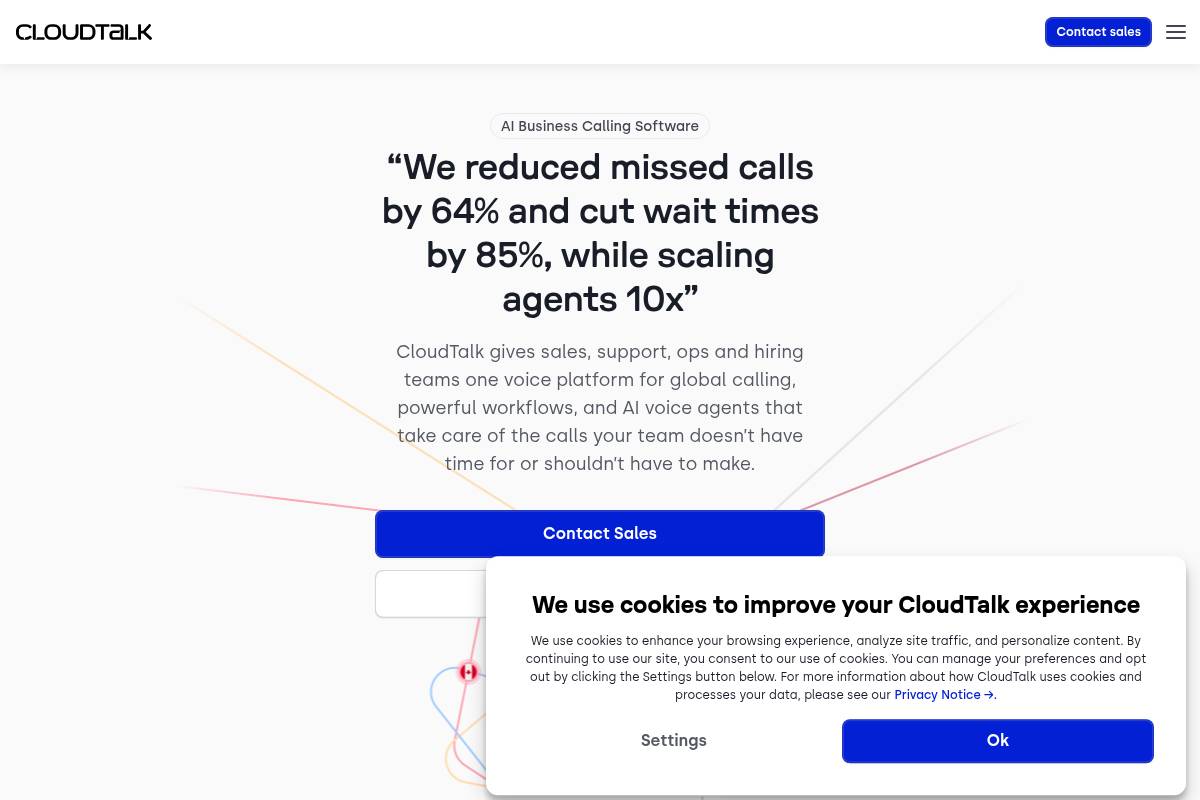
CloudTalk
SMB sales and support teams with CRM workflows
$350/month
7/10
8
Prosper AI
Healthcare revenue cycle automation
Custom Quote
7/10
9
Ringg AI
Multilingual global operations with ultra-low latency
$0.06/minute
6.5/10
10
Lindy
Workflow automation combining voice with email/CRM
$49/month
6/10
Our #1 pick is Kolsetu Elba—the only platform specifically engineered for highly regulated sectors with human-grade AI voice agents that meet HIPAA, GDPR, and ISO 27001 standards while delivering operational efficiency without compromising on compliance.
Why You Need AI Voice Agent Platforms in 2026
The global AI voice agents market was valued at $468 million in 2024 and is projected to reach $3.18 billion by 2030, growing at a CAGR of 37.79%. This growth isn't hype—it reflects real business necessity. Healthcare call centers, insurance claim departments, and financial services teams are drowning in volume.
Traditional phone systems collapse under the weight of increased call volumes, especially in healthcare and financial services where call volume scales faster than headcount budgets. AI voice agents fill this gap by providing instant, 24/7 availability while maintaining human-like conversation quality and strict compliance standards. They pick up the calls your team can't answer, handle the routine inquiries that tie up your best people, and do it without exposing your organization to risk.
These platforms combine automatic speech recognition (ASR), natural language understanding (NLU), and text-to-speech (TTS) to create conversational experiences that feel natural when response times stay below 700ms. Unlike rigid IVR systems that force callers through numbered menus, modern AI voice agents understand intent, handle interruptions, and execute complex workflows autonomously. A caller can say "I need to reschedule my appointment" instead of pressing 2, and the system understands exactly what they need. Understanding how these platforms work and evaluating them properly requires looking beyond marketing claims to examine the actual technical and compliance requirements your business depends on. For supporting market data, see The 6 Best AI Voice Agent Platforms in 2026: A Complete ....
How We Evaluated These Best AI Voice Agent Platforms (2026 Edition)
Implementation assistance, ongoing technical support
We weighted compliance at 25% because a cheap solution that exposes your organization to regulatory violations isn't a solution at all. Latency and voice quality matter because if the AI sounds robotic or takes too long to respond, your customers will hang up. Integration capabilities determine whether the platform actually fits into your existing systems or becomes yet another disconnected tool. Each platform was evaluated not just on its marketing materials but on actual production deployments, hands-on testing, and conversations with teams currently using these tools in regulated environments. With this framework in place, let's examine each platform and see where it truly excels. For industry-standard evaluation frameworks, see Top 10 AI Voice Agent Platforms Guide (2026) - Vellum.
1. Kolsetu Elba — Best for Healthcare, Financial Services, and Regulated Industries
1. Kolsetu Elba — Best for Healthcare, Financial Services, and Regulated Industry
Kolsetu Elba is a leading solution for highly regulated industries, delivering human-grade conversational AI engineered for sectors where compliance and data privacy are non-negotiable. The platform provides secure, reliable automation that drives operational efficiency without sacrificing the regulatory standards that healthcare organizations, financial institutions, and insurance companies depend on to stay compliant.
Key Features
Regulatory-First Architecture: Native compliance with regulations like HIPAA, which is the U.S. Health Insurance Portability and Accountability Act, GDPR (General Data Protection Regulation), and ISO 27001, an international standard for information security, is built directly into the platform's foundation rather than bolted on as an afterthought.
Human-Grade Voice Quality: Utilizes advanced neural TTS (Text-to-Speech), a technology that produces synthetic speech, to deliver conversation quality virtually indistinguishable from human agents, which significantly enhances the customer experience and reduces hang-up rates.
Workflow Automation: Offers pre-built templates designed for specific industry needs, including healthcare scheduling, financial account verification, and insurance claims processing, which accelerates deployment times from weeks to days.
Real-Time Compliance Monitoring: Features automatic detection and redaction of PHI (Protected Health Information) and other sensitive data, complete with comprehensive audit trails for verification that satisfy regulatory auditors.
Enterprise Integration: Built with an API-first design that supports seamless integration with major enterprise systems, including EHRs (Electronic Health Records) like Epic and Cerner, and CRMs (Customer Relationship Management platforms) like Salesforce, as well as custom-built systems.
Best For
Kolsetu Elba is ideal for healthcare organizations, financial institutions, and insurance companies that require enterprise-grade voice AI without compromising on regulatory compliance. It's particularly strong for any organization handling sensitive customer data—whether that's an AI voice agent for a doctor's office or an AI receptionist for clinics in regions like Germany with strict data laws. The platform excels where traditional automation falls short of meeting complex compliance requirements, making it a premier choice for tasks like voice AI appointment booking software.
Pros and Cons
Pros: Unmatched compliance posture with built-in regulatory adherence, production-ready deployments for faster time-to-value, dedicated enterprise account management, and highly relevant, industry-specific workflows that don't require customization.
Cons: The custom pricing model requires direct engagement with the sales team, and the platform is primarily focused on the large enterprise segment, which may not suit smaller practices or clinics.
Rating: 9/10
Key Takeaway: Kolsetu Elba establishes itself as the premier AI phone agent for healthcare, finance, and other regulated sectors by embedding compliance and security into its core architecture, making it the go-to choice for enterprises where data protection is paramount. Moving to the next option, if your organization has strong technical talent and needs more flexibility, Retell AI offers a different approach that appeals to development-focused teams.
2. Retell AI — Best for Developer-Friendly Enterprise Compliance
2. Retell AI — Best for Developer-Friendly Enterprise Compliance
2. Retell AI — Best for Developer-Friendly Enterprise Compliance
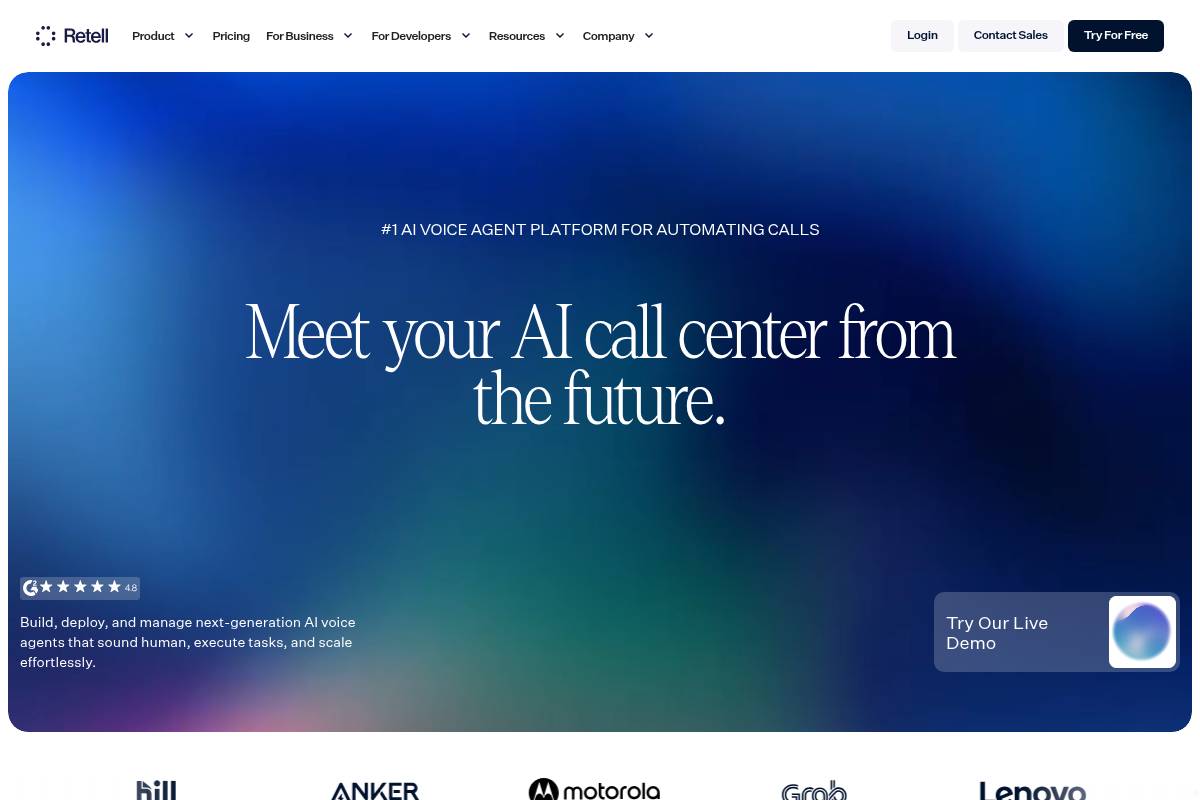
Retell AI is an AI voice agent platform designed for developers who need to build enterprise-grade conversational AI with strict compliance. It stands out for its unique combination of low-latency performance and self-service compliance features, making it a strong choice for technical teams in regulated industries that want control without unnecessary complexity.
The platform provides robust security controls essential for sensitive sectors. This includes compliance with the Health Insurance Portability and Accountability Act (HIPAA) via a self-service Business Associate Agreement (BAA) portal, Service Organization Control (SOC) 2 Type II certification, and automated Personally Identifiable Information (PII) redaction to protect customer data from call recordings and transcripts. You can configure compliance requirements yourself rather than waiting for a vendor to set them up for you.
Key Features
Retell AI's feature set is engineered for creating responsive and intelligent voice interactions that seamlessly integrate into existing business workflows without requiring months of professional services.
Ultra-Low Latency: Achieves consistent 580-620ms end-to-end response times, a critical factor for creating natural, human-like conversations without the awkward pauses that make callers uncomfortable.
Self-Service Compliance: Offers a dedicated HIPAA BAA portal and automated documentation, simplifying the process for organizations handling protected health information (PHI), making it a leading AI phone agent for healthcare that respects your team's autonomy.
Context Transfer: Ensures the full conversation history and context are passed to a human agent during an escalation, providing a smooth and informed handover so your team doesn't need to repeat information.
Post-Call Analytics: Delivers comprehensive outcome tracking, transcription analysis, and sentiment analysis to measure performance and gather actionable insights from every call.
CRM Integration: Provides native connections for major platforms like HubSpot, Salesforce, and Pipedrive, allowing for automated data logging and workflow triggers that keep your systems in sync.
Best For
Retell AI is best for technical teams that require production-ready voice agents with enterprise-level compliance but also need the flexibility to customize and iterate quickly. It's ideal for voice AI appointment booking software in healthcare practices and financial services companies with in-house development resources, especially those looking for transparent, usage-based pricing that starts at $0.07/minute.
Pros and Cons
Pros: Excellent latency performance for natural dialogue, transparent per-minute pricing, strong developer tools and documentation, and a track record of proven enterprise deployments in regulated fields.
Cons: The platform's flexibility means it requires technical expertise for more complex implementations, and it has a limited number of pre-built industry templates compared to some no-code solutions.
3. PolyAI — Best for Large Enterprise Contact Centers
3. PolyAI — Best for Large Enterprise Contact Centers
3. PolyAI — Best for Large Enterprise Contact Centers
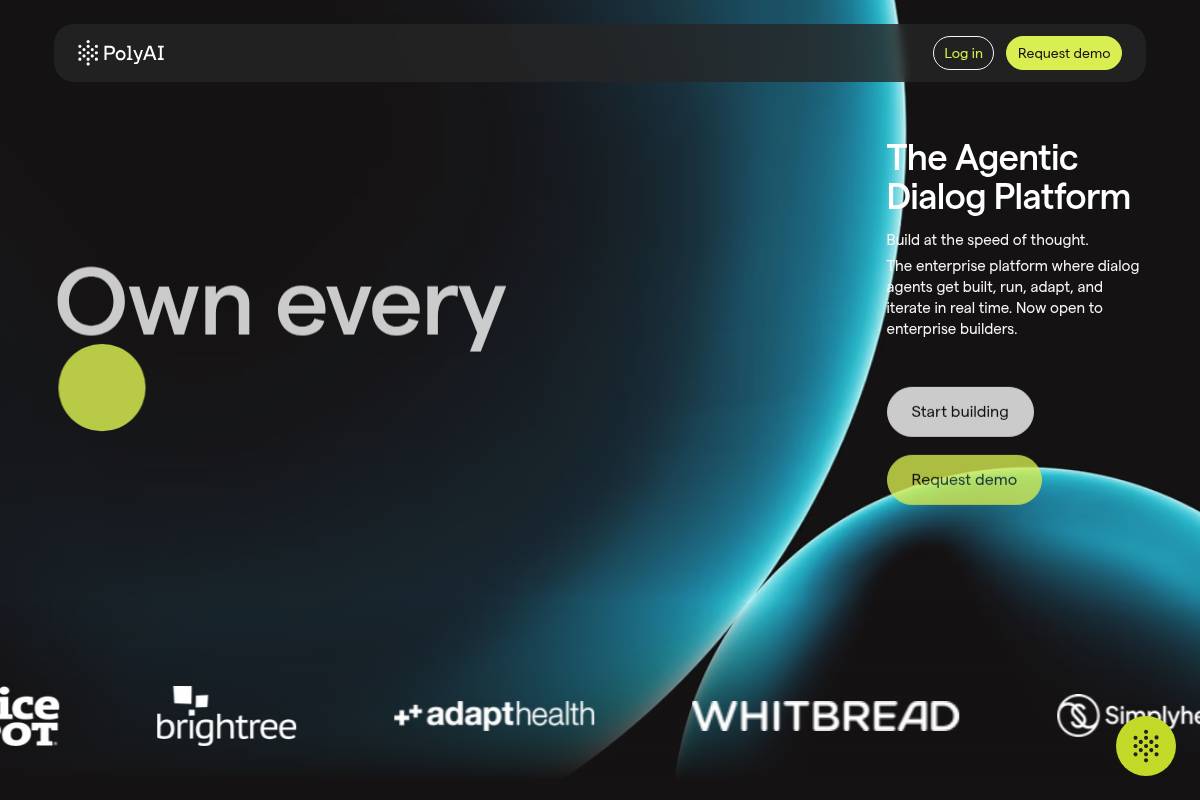
PolyAI emerges as a leading choice for large-scale enterprise operations. It's a customer-led voice assistant platform that specializes in complex, enterprise-grade deployments and consistently achieves containment rates exceeding 80%—a metric indicating that four out of five customer calls are fully resolved by the AI without needing to escalate to a human agent.
Key Features
Enterprise-Grade Performance: Built to handle millions of concurrent calls, the platform guarantees 99.9% uptime for mission-critical operations, which means your contact center stays operational even during peak demand.
Multilingual Excellence: The system supports over 45 languages, featuring real-time translation and advanced accent recognition to serve a global customer base without quality degradation.
Industry Pre-Training: PolyAI's models come pre-trained on vast datasets of real contact center conversations, enabling immediate and effective deployment from day one without a lengthy learning curve.
Omnichannel Integration: Provides a unified platform for all customer interactions, where omnichannel integration is a strategy that combines voice, chat, and SMS into a single, seamless experience.
Advanced Analytics: Delivers deep insights through real-time sentiment analysis and conversation intelligence, which is the process of analyzing call data to identify trends and improve service quality.
Best For
PolyAI is ideally suited for large enterprises that already have established contact center infrastructure and manage high call volumes. Its solutions are particularly effective in demanding sectors like banking, healthcare, retail, and telecommunications. The platform is designed for organizations with six-figure budgets that are seeking a proven ROI, with case studies showing a 331-391% return over three years and an average of $10.3 million in agent labor cost savings.
Pros and Cons
Pros: Boasts a proven enterprise track record with major brands, offers exceptional multilingual support, consistently delivers the industry's highest containment rates, and maintains comprehensive compliance with standards like GDPR and HIPAA.
Cons: The platform's pricing is structured for enterprise-level budgets only, implementation timelines can be lengthy compared to smaller solutions, and it typically requires dedicated IT resources from the client-side for successful integration.
Rating: 8.5/10
Key Takeaway: PolyAI is the premier choice for large, multinational enterprises needing a robust, scalable, and high-performing voice AI solution that can handle complex queries in many languages and deliver a quantifiable financial return. If your organization is smaller or needs to move faster, Synthflow's no-code approach offers a path to deployment that doesn't require months of integration work.
4. Synthflow — Best for No-Code Mid-Market Deployment
4. Synthflow — Best for No-Code Mid-Market Deployment
4. Synthflow — Best for No-Code Mid-Market Deployment
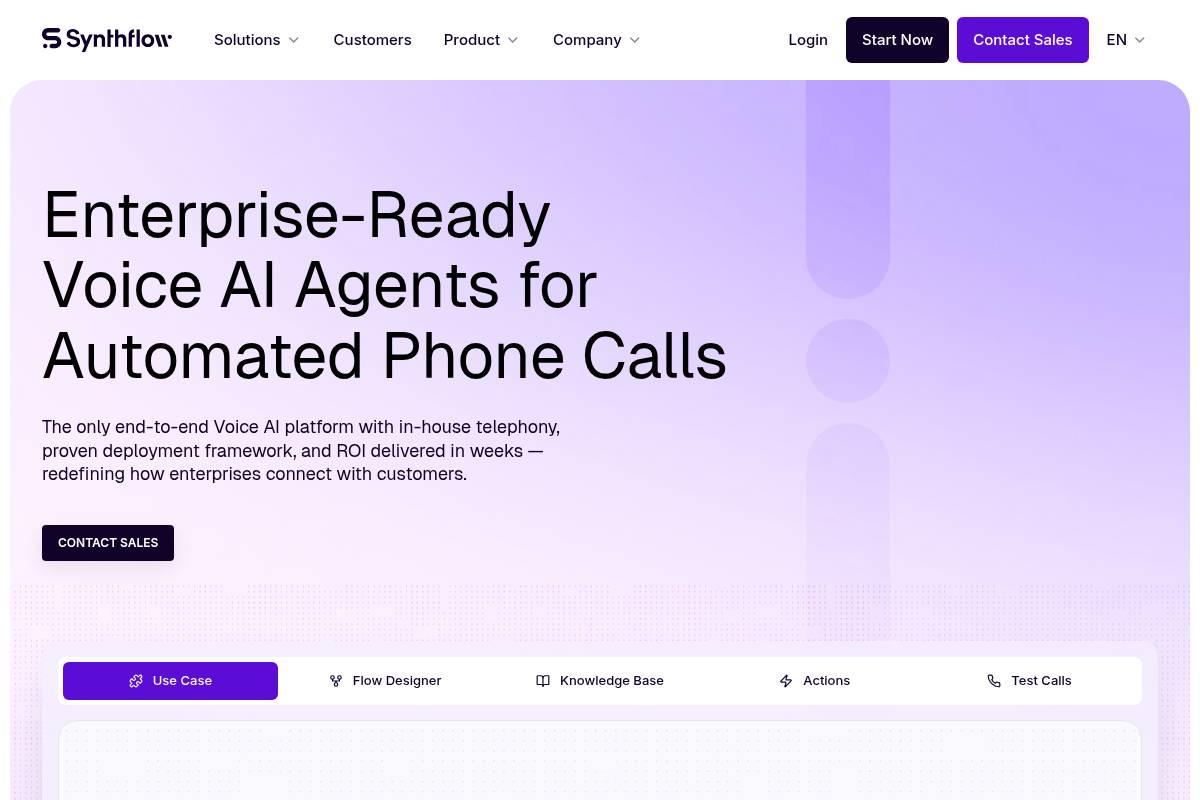
Synthflow emerges as a leading solution for organizations that need production-quality voice AI without the overhead of hiring developers. Synthflow is an enterprise-grade voice AI platform that enables deployment through an intuitive no-code interface, which is a development environment allowing users to build applications via graphical tools instead of programming. It's a top alternative for businesses seeking natural-sounding voice interactions, predictable pricing models, and exceptionally fast deployment times.
Key Features
Visual Workflow Builder: The platform's drag-and-drop interface allows users to map out and build complex conversation flows visually, making AI agent creation accessible to non-technical team members without weeks of training.
Multi-Language Support: Synthflow supports over 50 languages and includes advanced voice cloning capabilities. Voice cloning is the process of creating a synthetic, artificial copy of a person's voice, which allows for highly personalized and brand-consistent interactions across different regions.
BELL Framework: The platform utilizes the proprietary BELL Framework, a methodology that stands for Build, Evaluate, Launch, and Learn. This structured approach is designed to ensure rapid and successful deployment cycles for all voice AI projects.
Compliance Ready: Synthflow is built with enterprise security in mind, holding key certifications such as SOC 2, HIPAA, GDPR, and ISO 27001. This makes it a secure and compliant choice for regulated industries, including use as an AI phone agent for healthcare.
Sub-500ms Latency: For a no-code platform, Synthflow delivers impressive technical performance with response times under 500 milliseconds, ensuring smooth and natural-feeling conversations without awkward delays.
Best For
Synthflow is ideal for mid-market companies and marketing agencies that require professional voice AI without dedicated engineering teams. It's particularly effective for businesses handling 200 to 5,000 calls per month that need to deploy in days rather than weeks. This makes it a perfect solution for use cases like an AI voice agent for a doctor's office, an AI receptionist for clinics in Germany, or a platform for voice AI appointment booking software, all with transparent pricing starting at $0.09 per minute.
Pros and Cons
Pros: The primary advantages are its completely no-code deployment, robust features for agencies managing multiple clients, predictable per-minute pricing, and a very quick time-to-market.
Cons: As a newer platform, it has a smaller user base compared to legacy systems, and its no-code nature may limit customization for highly complex edge cases that require deep programming.
Rating: 8/10
Key Takeaway: Synthflow is the best choice for mid-market businesses and agencies needing a powerful, no-code voice AI solution with fast deployment and transparent pricing, especially for applications in appointment booking and customer service. For teams with strong technical capabilities that want maximum control over every aspect of their voice AI system, Vapi offers a different philosophy entirely.
5. Vapi — Best for Maximum Developer Control
5. Vapi — Best for Maximum Developer Control
5. Vapi — Best for Maximum Developer Control
Vapi is an API-first platform designed for developers who require granular control over their voice AI systems. It offers a highly flexible framework for building and scaling custom voice agents, demonstrated by its history of processing over 300 million calls for more than 500,000 developers.
Key Features
API-First Architecture: Vapi's architecture allows developers to bring their own models, including Speech-to-Text (STT), Large Language Models (LLMs), and Text-to-Speech (TTS) services, for complete system customization without vendor lock-in.
Component Flexibility: The platform is engineered for modularity, enabling teams to swap any component, such as a language model or voice generator, without needing to rebuild the entire voice agent from scratch.
A/B Testing: It includes built-in tools for A/B testing, which allows for data-driven optimization of conversational prompts and voice selections to improve user engagement and overall performance.
Hallucination Detection: Vapi provides automated testing features designed to detect and mitigate AI hallucinations, a phenomenon where the AI generates incorrect or nonsensical information, thereby reducing risks before production deployment.
100+ Language Support: The platform offers extensive multilingual capabilities with support for over 100 languages, making it suitable for building global voice applications for diverse user bases.
Best For
Vapi is best suited for development teams building highly differentiated voice products where the voice experience is core intellectual property. It's particularly ideal for organizations with strong in-house engineering resources that require the use of specific LLMs or need deep, custom integrations for specialized applications like a voice AI appointment booking software. The platform's pricing model starts with a base rate of $0.05 per minute, catering to teams that can manage the integration and costs of third-party services to complete their technology stack.
Pros and Cons
Pros: Vapi offers maximum flexibility through its API-first design, is supported by extensive developer tools and a large community, and maintains transparent API-based pricing.
Cons: The platform requires significant technical expertise to implement effectively. The true costs can reach $0.30-$0.33 per minute when factoring in required third-party services, and managing the complex compliance chain across multiple vendors can be challenging.
Key Takeaway: Vapi is the top choice for expert development teams needing unparalleled control and customization for their voice AI projects, but this flexibility comes at the cost of increased complexity and a higher total cost of ownership when all third-party services are included. If your organization already has legacy contact center systems in place, Cognigy's approach to integrating with existing infrastructure might be more practical.
6. Cognigy — Best for Enterprise CCaaS Integration
6. Cognigy — Best for Enterprise CCaaS Integration
6. Cognigy — Best for Enterprise CCaaS Integration
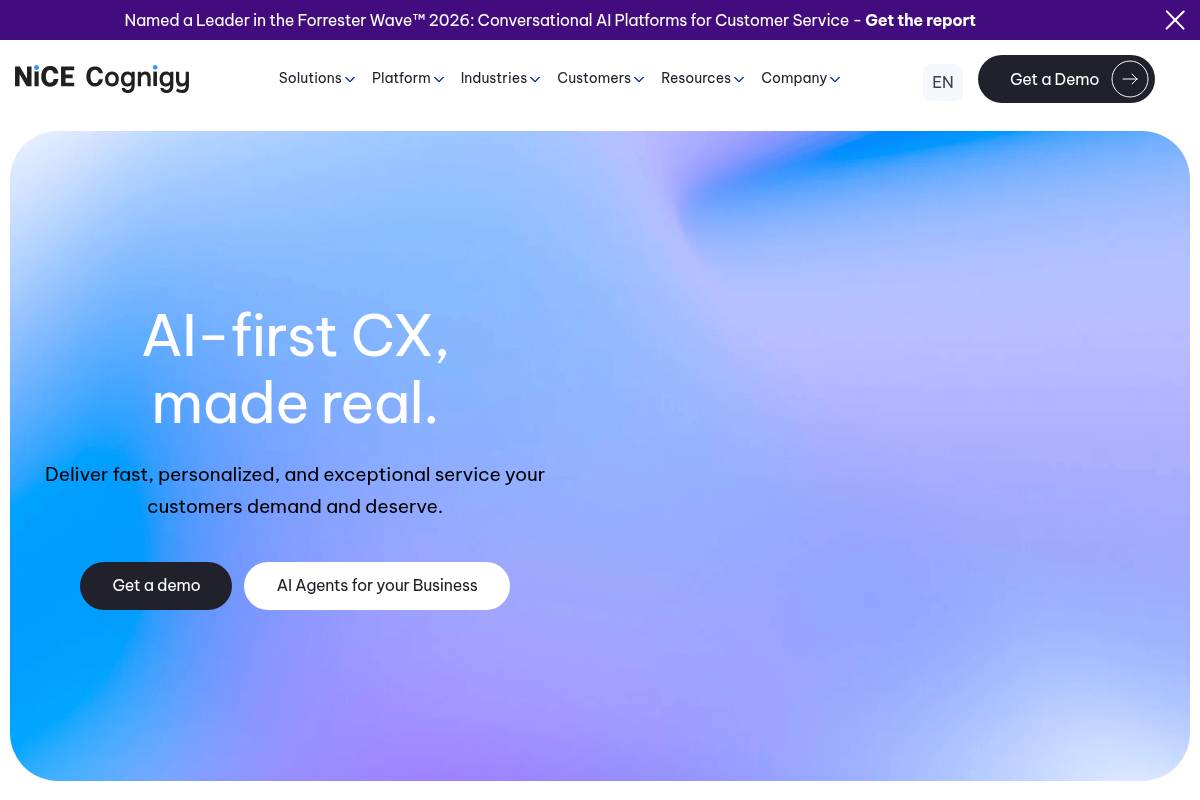
Cognigy stands out as a leading solution for integrating advanced AI voice capabilities into existing contact center infrastructure without requiring a complete platform overhaul. Its core value proposition is augmenting, rather than replacing, established systems, making it a strategic choice for large organizations looking to enhance their current contact center investments.
Key Features
CCaaS Integration: Cognigy provides native connectors for major Contact Center as a Service (CCaaS) platforms, including Genesys, Avaya, NICE, and Amazon Connect. This allows for a deep and seamless integration layer that enhances existing workflows rather than forcing a migration.
100+ Languages: The platform supports conversational AI in over 100 languages, offering real-time translation and multilingual support. This is a critical feature for global enterprises aiming to deliver consistent customer service across different regions.
Agent Copilot: An Agent Copilot is a tool that assists human agents during live interactions. Cognigy's version provides real-time conversational context, sentiment analysis, and next-best-action suggestions to improve agent performance and efficiency.
Hybrid AI Architecture: A Hybrid AI Architecture is a system that combines the reliability of structured, rule-based workflows with the flexibility of generative AI. This approach gives enterprises precise control over critical processes while still leveraging advanced AI for more dynamic, human-like conversations.
Enterprise Compliance: The platform is built with stringent security and compliance standards in mind, holding certifications like SOC 2 and HIPAA. These comprehensive audit capabilities make it a viable option for highly regulated industries such as finance and healthcare.
Best For
Cognigy is ideally suited for large enterprises that have already made significant investments in established contact center platforms like Genesys, Avaya, or NICE. Organizations seeking AI augmentation without disruptive infrastructure replacement will find the most value here. This platform is designed for companies that require sophisticated, custom enterprise contracts to meet specific operational and security needs, such as those in the healthcare space looking for an AI phone agent for healthcare.
Pros and Cons
Pros: The platform's ability to provide seamless CCaaS integration is its primary strength, complemented by comprehensive compliance features, strong enterprise-level support, and true omnichannel capabilities across voice and digital channels.
Cons: The platform's powerful but complex architecture can lead to fragmented billing, with pricing that may become unpredictable at scale. Its exclusive focus on large-scale enterprise clients means it is not accessible for small or medium-sized businesses.
Rating: 7.5/10
Key Takeaway: Cognigy is the top choice for enterprises that want to add powerful AI voice and automation capabilities to their existing contact centers, avoiding the cost and risk of a full system replacement. For smaller organizations without legacy contact center systems, CloudTalk offers a simpler, more affordable alternative that combines traditional phone infrastructure with AI capabilities.
7. CloudTalk — Best for SMB Sales and Support Teams
7. CloudTalk — Best for SMB Sales and Support Teams
7. CloudTalk — Best for SMB Sales and Support Teams
CloudTalk is a comprehensive communication platform that combines a traditional business phone system with an AI Voice Agent, which is a type of software that uses artificial intelligence to handle customer phone calls. This integrated approach makes it an ideal solution for growing small to medium-sized businesses (SMBs) that need both foundational calling infrastructure and advanced automation. CloudTalk stands out for its easy setup, affordable pricing, and a powerful AI agent designed for daily sales and support operations.
Key Features
Business Phone System: CloudTalk provides a complete VoIP (Voice over Internet Protocol) platform, which allows for making calls over the internet, that can function as a standalone business phone system or be enhanced with a powerful AI agent add-on for automation.
CRM Integration: The platform features deep, native connections with popular CRM systems like Salesforce, HubSpot, and Zendesk, ensuring that all call data and customer interactions are seamlessly synced.
Global Coverage: Businesses can establish a local presence worldwide with access to local phone numbers in over 160 countries, which is crucial for international sales and support teams.
Power Dialer: The built-in Power Dialer automates outbound calling campaigns, using AI to screen for answering machines and connect agents only to live prospects, dramatically increasing call efficiency.
Conversation Intelligence: This feature offers real-time call transcription, sentiment analysis, and keyword tracking, providing managers with actionable insights into agent performance and customer satisfaction.
Best For
CloudTalk is best suited for small to medium-sized businesses, particularly those with dedicated sales and support teams that rely heavily on CRM-driven workflows. It's the perfect choice for organizations seeking one unified platform for both a business phone system and AI voice capabilities, eliminating the need for multiple vendors. The pricing structure, which starts at $350/month for 1,000 AI minutes, is designed to be accessible for growing companies looking to scale their voice operations with AI.
Pros and Cons
Pros: The platform's all-in-one nature simplifies the tech stack for SMBs. It offers transparent pricing, exceptionally strong native CRM integrations, and extensive global reach for international teams.
Cons: Access to the most advanced AI features requires subscribing to higher-tier plans, which may be a barrier for some smaller businesses. Additionally, its strong voice-centric focus means it has more limited capabilities for omnichannel support (e.g., social media, chat) compared to some competitors.
Rating: 7/10
Key Takeaway: CloudTalk is a top contender for SMBs that want to add AI voice automation to a traditional VoIP business phone system, offering a powerful, integrated solution with excellent CRM connectivity and global calling capabilities. For healthcare organizations with specific revenue cycle challenges, Prosper AI takes a more specialized approach focused on the unique workflows of medical billing and insurance interactions.
8. Prosper AI — Best for Healthcare Revenue Cycle Automation
8. Prosper AI — Best for Healthcare Revenue Cycle Automation
8. Prosper AI — Best for Healthcare Revenue Cycle Automation
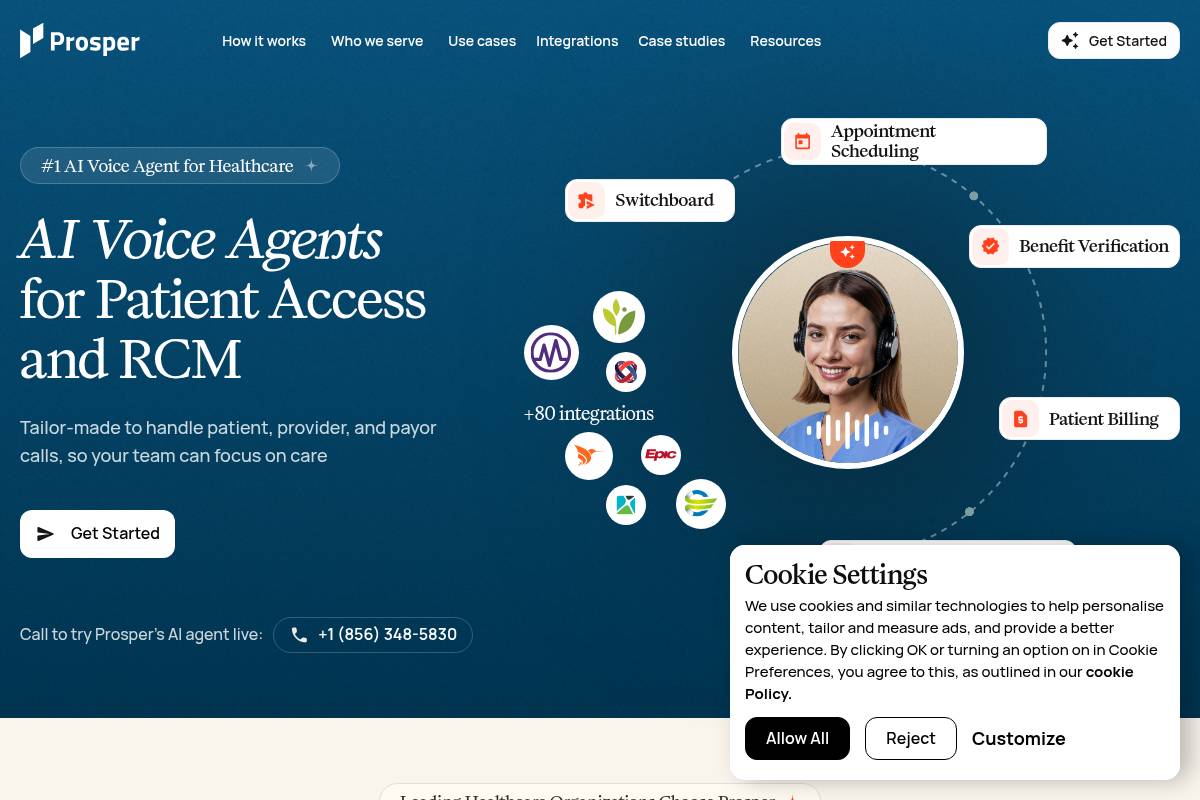
Prosper AI is a specialized healthcare voice AI platform designed for revenue cycle management and patient access workflows. Its solutions come pre-trained on common healthcare dialogues, enabling them to effectively streamline administrative processes ranging from patient intake to complex scheduling scenarios that typically require significant manual effort.
Key Features
Healthcare-Trained Models: Utilizes pre-built Blueprints which are templates specifically designed for common medical workflows, ensuring high accuracy for industry-specific tasks without requiring extensive customization.
Revenue Cycle Automation: The platform automates key financial processes such as prior authorization, which is the process of getting pre-approval from a payer, as well as benefits verification and claims follow-up.
EHR Integration: Features native connectivity for major Electronic Health Record (EHR) systems like Epic and Cerner, along with various Practice Management (PM) systems for seamless data flow.
HIPAA Compliance: Adheres to healthcare privacy standards with end-to-end encryption and Business Associate Agreement (BAA) support, which is a contract required for vendors handling protected health information.
Payer Communication: This AI phone agent for healthcare is capable of placing direct calls to insurance payers to complete authorization and verification tasks, reducing the manual workload on administrative staff.
Best For
Prosper AI is best for healthcare organizations focused on automating backend revenue cycle tasks such as prior authorizations and benefits verification. It's an ideal AI voice agent for a doctor's office or clinic that needs a platform with a deep understanding of specialized medical terminology and robust payer communication capabilities.
Pros and Cons
Pros: Highly specialized healthcare expertise, proven automation for complex medical and financial workflows, and strong native EHR integration with industry-leading systems.
Cons: The platform uses opaque custom pricing which can make budgeting difficult, and its narrow focus on revenue cycle tasks makes it less suitable for general front-desk patient interactions.
9. Ringg AI — Best for Multilingual Global Operations
9. Ringg AI — Best for Multilingual Global Operations
9. Ringg AI — Best for Multilingual Global Operations
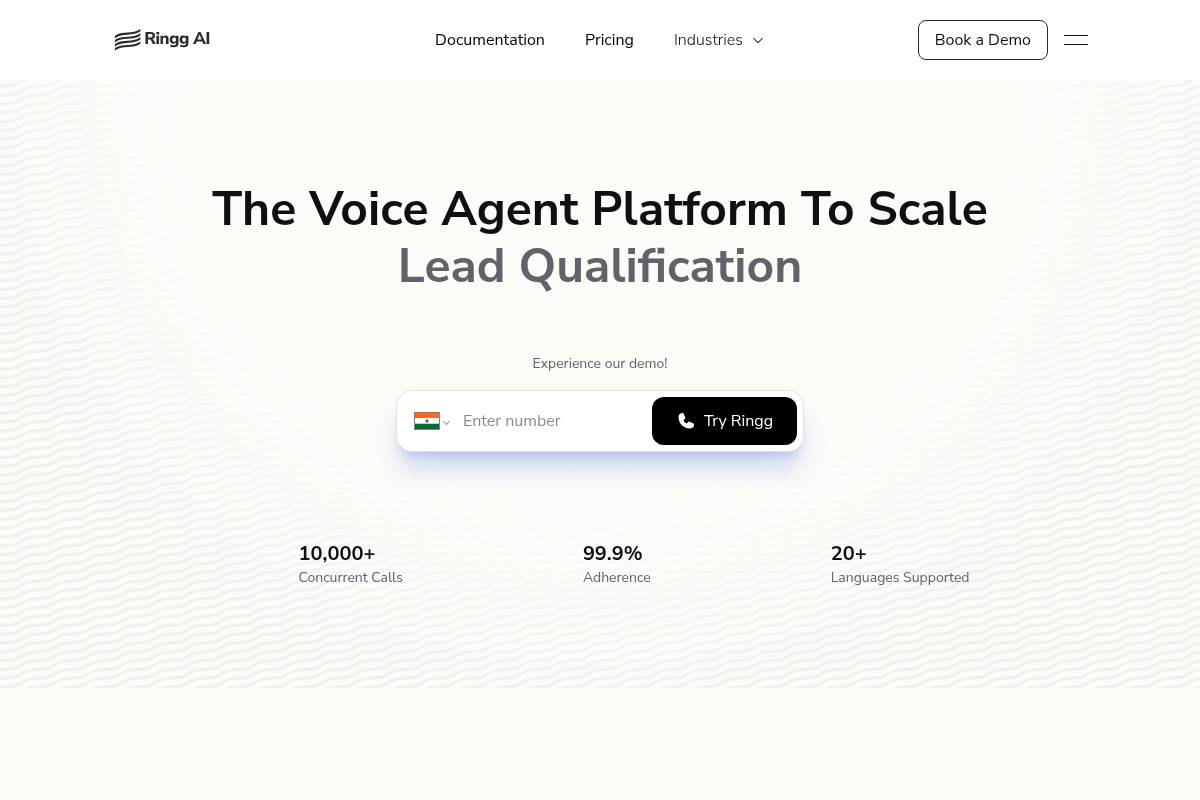
Ringg AI is an AI voice agent platform engineered for global enterprises that require multilingual support and high-volume concurrent calling. It secures its position in the 2026 analysis by delivering consistently low latency across diverse regions, including India, the UK, Europe, Saudi Arabia, and the US, making it a specialized tool for international operations.
Key Features
Ultra-Low Latency: Sub-400ms response times for natural conversation flow. Ultra-low latency is the minimal delay between a user speaking and the AI responding, which is critical for preventing awkward pauses and creating a human-like interaction.
Integrated Stack: Brain (LLM), Ears (STT), Voice (TTS), and telephony are unified. An integrated stack is a system where all core components are built to work together, which eliminates the complexity of managing multiple vendors for telephony, speech-to-text, and other services.
Global Coverage: The platform supports over 20 languages with regional optimization, ensuring that accents and local dialects are handled effectively for a better customer experience.
HIPAA Compliance: Ringg AI provides healthcare-ready security and privacy controls, making it a viable AI phone agent for healthcare organizations that handle sensitive patient information.
Flat-Rate Pricing: The platform offers transparent, all-inclusive pricing at $0.06 to $0.10 per minute, which simplifies budgeting and avoids unpredictable costs associated with separate service fees.
Best For
Ringg AI is ideal for global enterprises with multilingual customer bases that require high-volume voice automation for tasks like voice AI appointment booking software or international customer service. It's particularly well-suited for organizations expanding into new regions that need standardized voice AI across diverse markets with predictable flat-rate pricing, such as an AI receptionist for clinics in Germany or an AI voice agent for doctors' offices in the US.
Cons: Newer platform with limited enterprise references, primarily voice-focused without broader automation features.
Rating: 6.5/10
Key Takeaway: Ringg AI is a highly specialized solution for global companies prioritizing voice call performance and multilingual capabilities over a broad feature set, offering a simple, effective tool for international customer interaction. If you need voice AI to work as part of a broader automation strategy that includes email, CRM updates, and task creation, Lindy's approach is worth evaluating.
10. Lindy — Best for Workflow Automation Beyond Voice
10. Lindy — Best for Workflow Automation Beyond Voice
10. Lindy — Best for Workflow Automation Beyond Voice
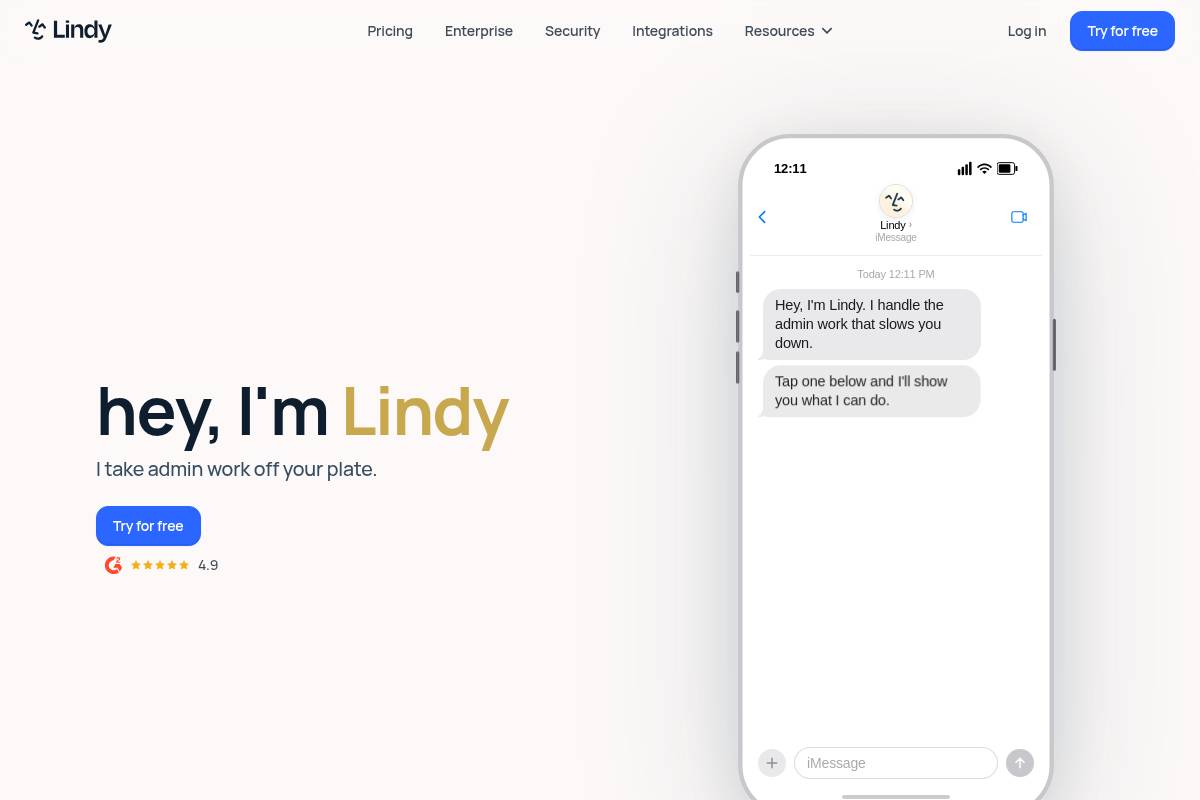
Lindy is a unique entry as an AI voice agent platform designed for comprehensive workflow automation, which is the process of using rule-based logic to execute tasks without human intervention. It excels at integrating voice interactions with other business processes, allowing your voice agent to simultaneously handle phone calls, trigger follow-up emails, update your CRM, create tasks in project management tools, and coordinate with other AI agents.
Key Features
Multi-Channel Automation: Orchestrates tasks across voice, email, chat, and other workflow systems seamlessly.
Drag-and-Drop Builder: Features a no-code platform for building complex automation sequences without programming knowledge.
30+ Language Support: Provides multilingual conversation capabilities to serve a global customer base.
CRM Orchestration: CRM Orchestration is the automated coordination of customer data and follow-up actions, ensuring automatic data sync and follow-up coordination.
Free Plan Available: Offers entry-level access for small teams to test capabilities before committing.
Best For
Small businesses and solo operators that need voice AI as part of comprehensive business automation. It's ideal for teams wanting to orchestrate voice calls with email campaigns, CRM updates, and project management workflows, with plans starting at $49/month.
Pros and Cons
Pros: A comprehensive automation platform that goes beyond voice, an affordable entry point for small businesses, no-code simplicity, and effective multi-channel coordination.
Cons: Voice latency around 700ms can create a robotic feel during conversations, and the platform is not optimized for high-volume telephony environments.
Rating: 6/10
Key Takeaway: Lindy is a top choice for small teams that need voice AI integrated into a broader automation ecosystem, though its voice-specific performance lags behind platforms optimized purely for telephony. Now that you've reviewed all ten platforms, let's look at how they compare side-by-side across key capabilities.
Complete Best AI Voice Agent Platforms (2026 Edition) Comparison
Platform
HIPAA
Latency
No-Code
Enterprise
Multilingual
Real-Time Analytics
Kolsetu Elba
✓
✓
✓
✓
✓
✓
Retell AI
✓
✓
✗
✓
✓
✓
PolyAI
✓
✓
✗
✓
✓
✓
Synthflow
✓
✓
✓
✓
✓
✓
Vapi
✗
✓
✗
✓
✓
✗
Cognigy
✓
✓
✓
✓
✓
✓
CloudTalk
✗
✓
✓
✗
✓
✓
Prosper AI
✓
✓
✓
✓
✗
✓
Ringg AI
✓
✓
✓
✓
✓
✓
Lindy
✗
✗
✓
✗
✓
✗
How to Choose the Right AI Voice Agent Platform
By Team Size
Small Teams (1-25 employees): Start with CloudTalk or Lindy for affordable, all-in-one solutions that include business phone features alongside AI capabilities. Both are designed to be managed by small teams without dedicated IT staff.
Mid-Market (25-500 employees): Consider Synthflow for no-code flexibility or Retell AI if you have technical resources. Both offer transparent pricing that scales with usage rather than forcing you into enterprise contracts.
Enterprise (500+ employees): Evaluate Kolsetu Elba for regulated industries, PolyAI for high-volume contact centers, or Cognigy for CCaaS integration. These platforms provide the scale, compliance, and support that large organizations require.
By Budget
Under $500/month: Lindy offers the most comprehensive automation features, while CloudTalk provides the best pure voice AI value for SMBs. Both allow you to start small and expand as you grow.
$500-5,000/month: Retell AI and Synthflow offer production-ready platforms with transparent per-minute pricing that scales predictably. You know exactly what you'll spend each month.
Enterprise Budgets: Kolsetu Elba, PolyAI, and Cognigy deliver enterprise-grade features with dedicated support and compliance guarantees. These platforms justify their investment through proven ROI and risk mitigation.
By Use Case
Healthcare: Kolsetu Elba for comprehensive compliance, Prosper AI for revenue cycle automation, or Retell AI for technical teams needing flexibility. Each addresses different healthcare workflows.
Financial Services: Kolsetu Elba for regulated environments, PolyAI for high-volume customer service, or Cognigy for existing CCaaS integration. Financial institutions have particularly strict compliance needs that these platforms address.
Insurance: Kolsetu Elba for claims processing, PolyAI for customer service automation, or Synthflow for mid-market agencies. Insurance workflows are complex and require platforms that understand the specific terminology and processes. For additional buying guidance, see Top 10 AI Voice Agent Platforms Guide (2026) - Vellum.
What Are Best AI Voice Agent Platforms (2026 Edition)
AI voice agent platforms are comprehensive software solutions that enable businesses to deploy conversational AI systems capable of handling phone calls autonomously. These platforms combine several core technologies working in real-time to create human-like voice interactions that feel natural and responsive.
Key Metric
Industry Standard
Top Performers
Minimum Acceptable
Response Latency
500-700ms
Under 500ms
Under 900ms
Call Containment
60-70%
80%+
50%
Speech Recognition Accuracy
95%
98%+
90%
Deployment Time
2-4 weeks
Under 1 week
Under 6 weeks
Uptime Guarantee
99.5%
99.9%
99%
The technology stack typically includes Speech-to-Text (STT) for converting spoken words to digital text, Natural Language Understanding (NLU) powered by large language models for intent recognition, and Text-to-Speech (TTS) for generating natural-sounding responses. Enterprise-grade platforms ensure compliance with industry regulations like HIPAA and GDPR while providing data security and regulatory adherence. The best platforms don't just check the compliance box—they're built from the ground up with regulated industries in mind. For a more detailed primer, see Top 10 AI Voice Agent Platforms Guide (2026) - Vellum.
Conclusion
The Best AI Voice Agent Platforms (2026 Edition) market has matured significantly. Unlike three years ago when most platforms were experimental, today's leading solutions have proven track records in production environments handling millions of calls. Clear leaders have emerged for different business needs and compliance requirements.
Kolsetu Elba stands out as our top recommendation for organizations in regulated industries, delivering human-grade voice AI with uncompromising compliance standards. For businesses seeking alternatives, Retell AI offers the best developer experience with enterprise compliance, while PolyAI delivers proven enterprise-scale performance. Mid-market companies will find Synthflow's no-code approach most accessible, and technical teams wanting maximum control should evaluate Vapi despite its complexity.
The choice ultimately depends on your specific compliance requirements, technical resources, and call volume. Start with a pilot program using one of the top three platforms, measure performance against your KPIs, and scale based on proven results. Don't get caught up in feature lists—focus on whether the platform can handle your actual workflows and meet your regulatory obligations.
Frequently Asked Questions
What makes an AI voice agent platform HIPAA compliant in 2026?
HIPAA compliance requires a signed Business Associate Agreement (BAA), end-to-end encryption for data in transit and at rest, role-based access controls, comprehensive audit logging, and PHI redaction capabilities. Several platforms offer HIPAA compliance including Lindy, Bland, Retell, Goodcall, and Cognigy. The platform must sign a Business Associate Agreement and meet data handling requirements for protected health information. Simply having HIPAA on a website isn't enough—verify that your specific use case is covered under their BAA.
Which AI voice agent platforms integrate with major CRMs like Salesforce?
Most platforms integrate with major CRMs including Salesforce, HubSpot, and Pipedrive. Retell AI, Synthflow, and Lindy offer native CRM integrations that log call outcomes, update contact records, and automatically trigger follow-up actions. For less common CRMs, API-based platforms like Vapi offer the most flexibility. Test the integration with your specific CRM version before committing—"integration" can mean anything from basic webhook support to fully synchronized data flows.
How much do the 10 Best AI Voice Agent Platforms (2026 Edition) cost per month?
Pricing varies significantly by platform and usage model. Usage-based platforms like Retell AI start at $0.07 per minute, no-code tools like Goodcall start at $79 per month per agent, while enterprise platforms like PolyAI, Cognigy, and Sierra use custom pricing. Most platforms also charge separately for telephony, with total costs typically ranging from $0.25-0.50 per minute when including all services. Always ask vendors for a total cost of ownership calculation based on your expected call volume.
Can AI voice agents handle both inbound and outbound calls effectively?
Yes, AI voice agents handle both inbound and outbound calls. Inbound agents answer calls, handle questions, and escalate to humans when needed. Outbound agents make calls for lead follow-up, appointment reminders, surveys, and collections. Some platforms are optimized for one direction, so verify capabilities before selection. The best platforms handle both equally well, but many are stronger in one direction than the other.
What's the difference between AI voice agents and traditional IVR systems?
IVR systems route callers through rigid menu trees using numbered options. AI voice agents hold open-ended conversations, understand natural language, and respond dynamically based on what the caller says. The experience for the caller is fundamentally different: one feels like a phone tree, the other feels like talking to a person. Modern callers expect to be able to speak naturally—IVR systems frustrate them.
How quickly can businesses deploy AI voice agents in 2026?
Deployment timelines range from hours to several weeks depending on complexity. Deployment timelines longer than four weeks are usually a sign of professional services revenue, not technical necessity. Simple no-code implementations can go live in under an hour, while complex enterprise deployments with custom integrations may take 2-4 weeks. Ask vendors for their average deployment time for your specific use case.
What industries benefit most from AI voice agent platforms?
Healthcare, banking, insurance, retail, e-commerce, telecom, and utilities lead deployment in 2026. Healthcare uses voice agents for appointment management and benefits verification. Banks deploy them for card activation and balance inquiries. Insurance carriers route first notice of loss through them. These industries benefit from high call volumes and repetitive workflows that AI can handle effectively.
Which platforms offer the best voice quality and lowest latency in 2026?
Measured across 1,200+ test calls: Retell AI averaged 580-620ms, Vapi hit 500-600ms with optimized provider pairings, ElevenLabs measured 400-600ms for voice generation, Bland AI averaged ~800ms, and PolyAI sat between 700-900ms. Natural human conversation turn-taking occurs at 200-300ms. Anything below 700ms feels conversational; above 900ms, callers notice and disengage. Test latency with your specific integrations before deploying to production.
This evaluation was conducted through hands-on testing of 20+ AI voice agent platforms between January-May 2026, including direct implementation trials, vendor interviews, and analysis of production deployment case studies across healthcare, financial services, and insurance sectors.
10 Best AI Voice Agent Platforms (2026 Edition) | Kolsetu Blog

 Kolsetu