Top Bland AI Alternatives for Regulated Sectors 2026
Discover the top Bland AI alternatives for regulated sectors in 2026, ensuring compliance and innovation for healthcare, finance, and insurance industries.
Last Updated: July 2026 | Author: Kolsetu Editorial Team | Tools Tested: 10 AI voice agent platforms evaluated across compliance posture, HIPAA/GDPR/ISO 27001 certifications, deployment speed, voice quality, integration depth, and regulated-industry fit.
Top Bland AI Alternatives for Regulated Sectors 2026: TL;DR
Regulated industries — healthcare, financial services, and insurance — need AI voice agents that treat compliance as a core feature, not an afterthought.
Rank
Tool
Best For
Starting Price
Rating
1
Kolsetu Elba
HIPAA/GDPR/ISO 27001 full-stack compliance
Custom enterprise pricing
9.7/10
2
Retell AI
Developer-friendly compliance at mid-market scale
$0.07/min pay-as-you-go
9.0/10
3
NiCE Cognigy
Fortune 500 contact centers on NICE CXone
~$115K–$300K+/year
8.5/10
4
PolyAI
High-volume enterprise inbound voice automation
~$150K+/year
8.3/10
5
Kore.ai
Multi-agent orchestration across regulated verticals
Free tier; Enterprise ~$300K/year
8.2/10
6
Deepgram
Developer teams needing self-hosted speech infrastructure
$200 free credit; Growth $4K+/year
8.0/10
7
Voiceflow
Omnichannel agent design and prototyping
Pro from $60/editor/month
7.8/10
8
Synthflow AI
No-code voice agent deployment for non-technical teams
~$0.15–$0.24/min all-in
7.5/10
9
Lindy AI
Broad workflow automation with HIPAA compliance
Pro from $49.99/month
7.4/10
10
ElevenLabs Conversational AI
Premium voice quality and multilingual agent experiences
Contact sales for Agents pricing
7.2/10
Our #1 pick is Kolsetu Elba — the only platform purpose-built from the ground up to address the full compliance stack for regulated enterprises, delivering human-grade voice automation across healthcare, finance, and insurance from day one.
Why You Need a Compliant AI Voice Agent in 2026
AI voice agents are an operational necessity for regulated organizations drowning in call volume. The global AI voice agents market was valued at $468 million in 2024 and is projected to reach $3.18 billion by 2030, growing at a CAGR of 37.79%. Healthcare call centers, insurance claim departments, and financial services teams manage climbing call volumes with budgets that cannot keep pace. Yet compliance requirements never relax. Regulated sectors increasingly demand AI voice agent software that natively supports on-premise deployment, dedicated private instances, HIPAA BAAs, and GDPR compliance out of the box. The platforms featured below are evaluated specifically against those criteria.
How We Evaluated These Tools
Each platform was assessed against six weighted criteria drawn from the operational realities faced by compliance managers and IT leaders in regulated industries.
Criterion
Weight
What We Measured
Compliance Posture
25%
HIPAA BAA availability, SOC 2 Type II, GDPR, ISO 27001, data residency controls
Voice Quality and Latency
20%
Sub-800ms response, interruption handling, naturalness at scale
Workflow and Integration Depth
20%
EHR/CRM connectors, post-call automation, omnichannel support
Time to production for regulated teams without large engineering resources
Pricing Transparency
10%
Total cost of ownership predictability, absence of hidden add-on fees
1. Kolsetu Elba — Best for Compliance-First Regulated Sector Automation
1. Kolsetu Elba — Best for Compliance-First Regulated Sector Automation
1. Kolsetu Elba — Best for Compliance-First Regulated Sector Automation
Kolsetu Elba is an AI workforce platform designed for regulated industries like healthcare, finance, and insurance. It provides end-to-end workflow automation without compromising data privacy. Unlike generic platforms, Kolsetu Elba was engineered to embed data privacy and operational governance into its core architecture. Operated by Kolsetu GmbH in Hamburg, Germany, the platform supports over 100 languages and runs on ISO 27001-certified infrastructure with most clients going live in weeks, not months.
Key Features
Multi-Framework Compliance: Aligns with ISO 27001, GDPR, DORA, and NIS2 for the most complete regulatory posture for European and globally regulated enterprises.
Human-Grade Voice Quality: Production-hardened telephony with sub-second latency and advanced interruption handling.
Vendor-Agnostic AI Architecture: Supports over 100 different Large Language Models, Speech-to-Text, and Text-to-Speech models with automatic failover capabilities.
End-to-End Workflow Automation: Agents handle complex, multi-step regulated processes including claims intake, benefits verification, and appointment scheduling without human handoff.
Audit-Ready Data Governance: Comprehensive audit logs, role-based access controls, and data residency controls satisfy demanding procurement and infosec teams.
Omnichannel Deployment: A unified platform spans voice, WhatsApp, SMS, email, and web channels with consistent compliance controls.
Managed Delivery: Clients typically go live in two to six weeks.
Best For
Kolsetu Elba is ideal for healthcare providers, financial services companies, and insurance firms seeking HIPAA-compliant AI or other secure automation where data privacy and regulatory standards are paramount. Pricing is custom and enterprise-scoped.
Pros and Cons
Pro: Combines ISO 27001, DORA, NIS2, and GDPR data residency within a single, fully managed solution.
Pro: Maintains a single persistent session across all channels, eliminating customer friction and context loss.
Con: Custom pricing requires direct sales engagement and focuses on the large enterprise segment.
Con: Lacks self-serve sign-up or direct developer API access as a fully managed service.
Rating: 9.7/10
2. Retell AI — Best for Developer-Friendly Enterprise Compliance
2. Retell AI — Best for Developer-Friendly Enterprise Compliance
2. Retell AI — Best for Developer-Friendly Enterprise Compliance
Retell AI is an AI voice agent platform offering low-latency voice conversations combined with self-service compliance features like HIPAA, SOC 2 Type II, and GDPR on standard plans.
Key Features
Self-Service HIPAA BAA: HIPAA compliance is included on all paid plans with a self-service Business Associate Agreement portal, eliminating enterprise contract negotiation.
Low Latency: Average 620ms response latency priced at transparent $0.07 per minute with no platform fees.
Dual Build Path: Drag-and-drop no-code builder and full developer SDK within the same product.
Proven Scalability: Infrastructure powers more than 30 million calls a month for over 3,000 businesses.
Native Integrations: Connects with Twilio, Salesforce, and HubSpot.
Best For
Retell AI is ideal for mid-market healthcare and insurance teams seeking HIPAA compliance without enterprise procurement overhead. The built-in HIPAA BAA makes it a default choice for organizations in regulated sectors.
Pros and Cons
Pro: HIPAA Business Associate Agreement available on standard plans without enterprise contract.
Pro: Transparent, usage-based pricing with no platform fee simplifies budget forecasting.
Pro: Validated by $40M in ARR and over 30 million monthly calls.
Con: Primarily US-centric with limited regional language depth outside English-speaking markets.
Con: Lacks native omnichannel workflow execution (WhatsApp, SMS, email) that some enterprise workflows require.
Rating: 9.0/10
3. NiCE Cognigy — Best for Fortune 500 Contact Centers on NICE CXone
3. NiCE Cognigy — Best for Fortune 500 Contact Centers on NICE CXone
3. NiCE Cognigy — Best for Fortune 500 Contact Centers on NICE CXone
NiCE Cognigy is an enterprise conversational AI platform serving as the agentic AI layer within NICE CXone. Following its acquisition by NICE in September 2024 for approximately $955 million, it serves large-scale contact centers requiring robust security and deep CCaaS integration.
Key Features
Enterprise Compliance: SOC 2, ISO 27001, and GDPR alignment for secure AI alternatives in financial services and healthcare.
Massive Scale: 25,000-concurrent-session architecture built for high-volume contact centers handling millions of interactions.
Deep CCaaS Integration: Integrates with Amazon Connect, Genesys Cloud CX, NiCE CXone, Avaya, Dynamics 365, and HubSpot.
Low-Code Flow Builder: Design and deploy virtual agents across voice and chat channels with pre-built CRM/ERP integrations.
Air-Gapped Deployment: Supports on-premise and air-gapped deployments physically isolated from public networks for maximum security.
Best For
NiCE Cognigy suits large organizations already deployed on NICE CXone or evaluating a single-vendor CX stack. Most enterprise contracts start above $300K per year.
Pros and Cons
Pro: Named a Leader in Gartner's Magic Quadrant for Conversational AI.
Pro: Air-gapped deployment available for maximum data sovereignty in regulated environments.
Con: Expect 2–4 months from contract to deployment, requiring significant developer resources.
Con: Separate charges for voice, chat, and LLM workloads create a complex, multi-layered pricing model.
Rating: 8.5/10
4. PolyAI — Best for High-Volume Enterprise Inbound Voice Automation
4. PolyAI — Best for High-Volume Enterprise Inbound Voice Automation
4. PolyAI — Best for High-Volume Enterprise Inbound Voice Automation
PolyAI is an enterprise conversational voice AI platform backed by over $120 million in funding with a founding team from Cambridge University.
Key Features
Compliance Certifications: SOC 2 Type II, HIPAA, and GDPR compliance certifications for essential security and privacy standards in North America and Europe.
Multilingual Support: Supports 12 languages out of the box and extends to 45 languages through Agent Studio platform.
Managed Deployment: PolyAI team designs and deploys custom agents, integrating them into CCaaS platforms and managing performance post-launch.
Proven ROI: 391% ROI and $14.2 million in value over three years.
Best For
PolyAI is best for mid-size to large organizations in regulated, call-heavy industries like banking, insurance, and telecommunications where conversation quality and HIPAA-compliant AI are non-negotiable. Enterprise contracts typically start at $150,000 or more per year.
Pros and Cons
Pro: Industry-leading conversational realism with custom-designed voice personalities.
Pro: Full HIPAA, SOC 2 Type II, and GDPR compliance for secure AI alternatives.
Con: Lack of public pricing creates a long sales cycle designed for specific enterprise buyers.
Con: Fully proprietary technology stack creates deep vendor lock-in.
Rating: 8.3/10
5. Kore.ai — Best for Multi-Agent Orchestration Across Regulated Verticals
5. Kore.ai — Best for Multi-Agent Orchestration Across Regulated Verticals
5. Kore.ai — Best for Multi-Agent Orchestration Across Regulated Verticals
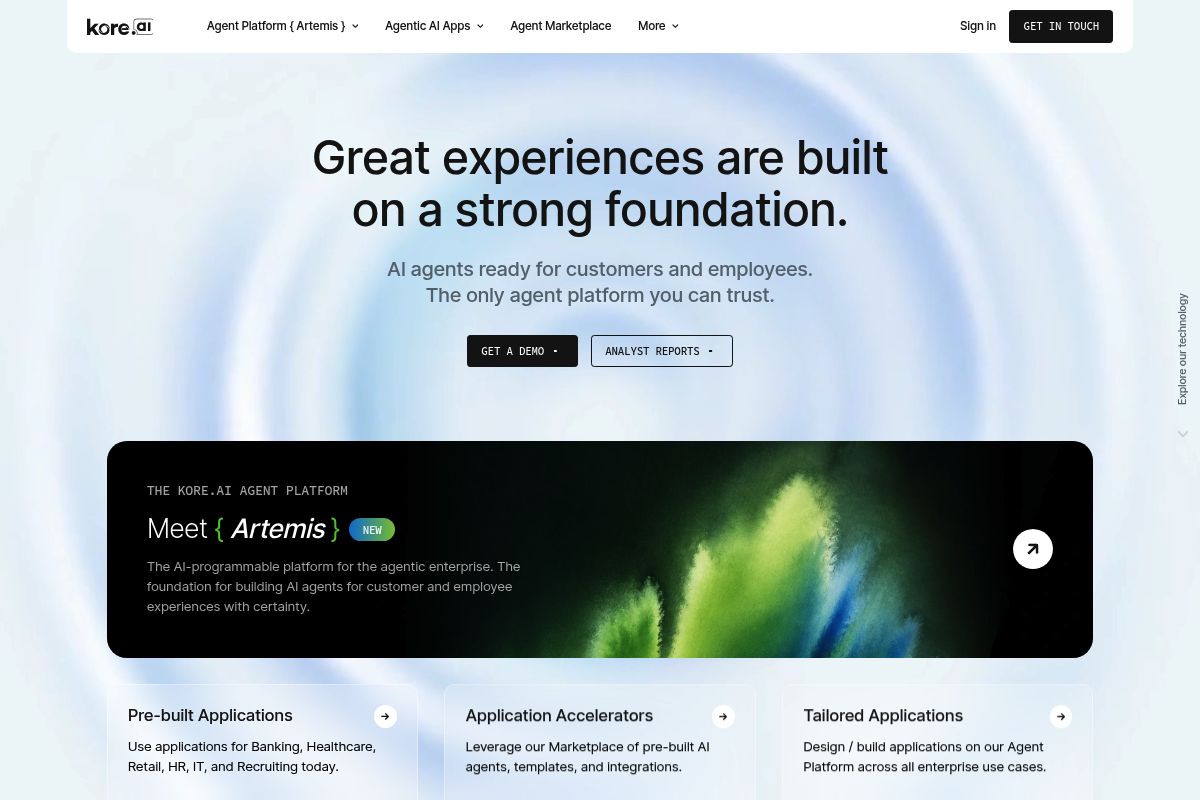
Kore.ai is an enterprise-grade agentic AI platform used by organizations in regulated industries like banking, healthcare, and retail. It serves major corporations like Morgan Stanley, Pfizer, and Coca-Cola requiring complex, compliance-critical workflows.
Key Features
Multi-Agent Orchestration: Coordinates multiple specialized AI agents for complex, compliance-critical workflows.
Pre-Built Industry Agents: The deepest regulated-industry pre-built agent library significantly accelerates time-to-value.
Broad Channel Support: Deploy across web, mobile, Teams, Slack, email, voice, and social media from a single build.
Security Controls: SAML/SSO, role-based access control, audit logging, data encryption, and key compliance certifications.
100+ Connectors: Purpose-built integrations connect to mission-critical enterprise systems like CRMs and ITSM.
Gartner Recognition: Recognized as a Magic Quadrant Leader in Conversational AI.
Best For
Kore.ai is purpose-built for large enterprises deploying AI agents at scale across multiple departments, channels, and languages. Pricing begins with a free tier and pay-as-you-go Standard plan from $100, while Enterprise agreements typically start around $300K/year.
6. Deepgram — Best for Self-Hosted Speech Infrastructure in Regulated Environments
6. Deepgram — Best for Self-Hosted Speech Infrastructure in Regulated Environments
6. Deepgram — Best for Self-Hosted Speech Infrastructure in Regulated Environments
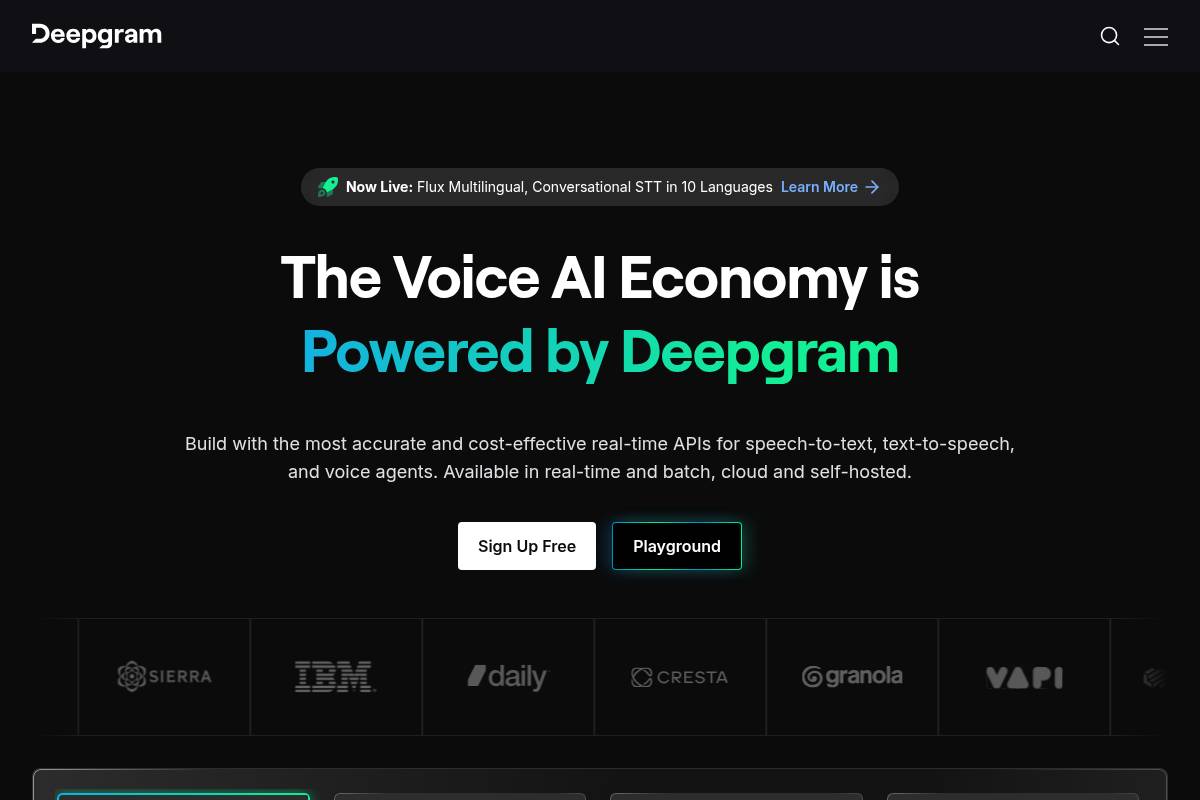
Deepgram is a real-time AI infrastructure company offering enterprise-grade speech-to-text and voice agent APIs. It stands out among alternatives to Bland AI for regulated sectors due to its focus on secure, self-hosted deployments ensuring data sovereignty.
Key Features
Three Deployment Modes: Shared cloud, dedicated single-tenant, and self-hosted (on-premise) options for data sovereignty.
HIPAA BAA for Enterprise: Business Associate Agreements available for customers handling Protected Health Information.
Medical Terminology: Nova-3 Medical model trained for medical terminology with improved recognition of complex medical terms.
Confidential Computing: Hardware-isolated environment using Fortanix and NVIDIA technology where audio data and model weights stay encrypted during processing.
Deepgram is best for developer and engineering teams inside regulated organizations needing to build their own voice stack on secure, self-hosted infrastructure. SOC 2 Type II certified.
Pros and Cons
Pro: Unique hardware-isolated on-premises deployment via Fortanix and NVIDIA for maximum data security.
Pro: Top scores for speed (9.9/10) and real-time streaming (9.9/10) in 2026 independent benchmarks.
Con: Requires significant engineering resources to deploy and maintain.
Con: HIPAA BAA requires an enterprise agreement, adding procurement time.
Rating: 8.0/10
7. Voiceflow — Best for Omnichannel Agent Design and Prototyping
7. Voiceflow — Best for Omnichannel Agent Design and Prototyping
7. Voiceflow — Best for Omnichannel Agent Design and Prototyping
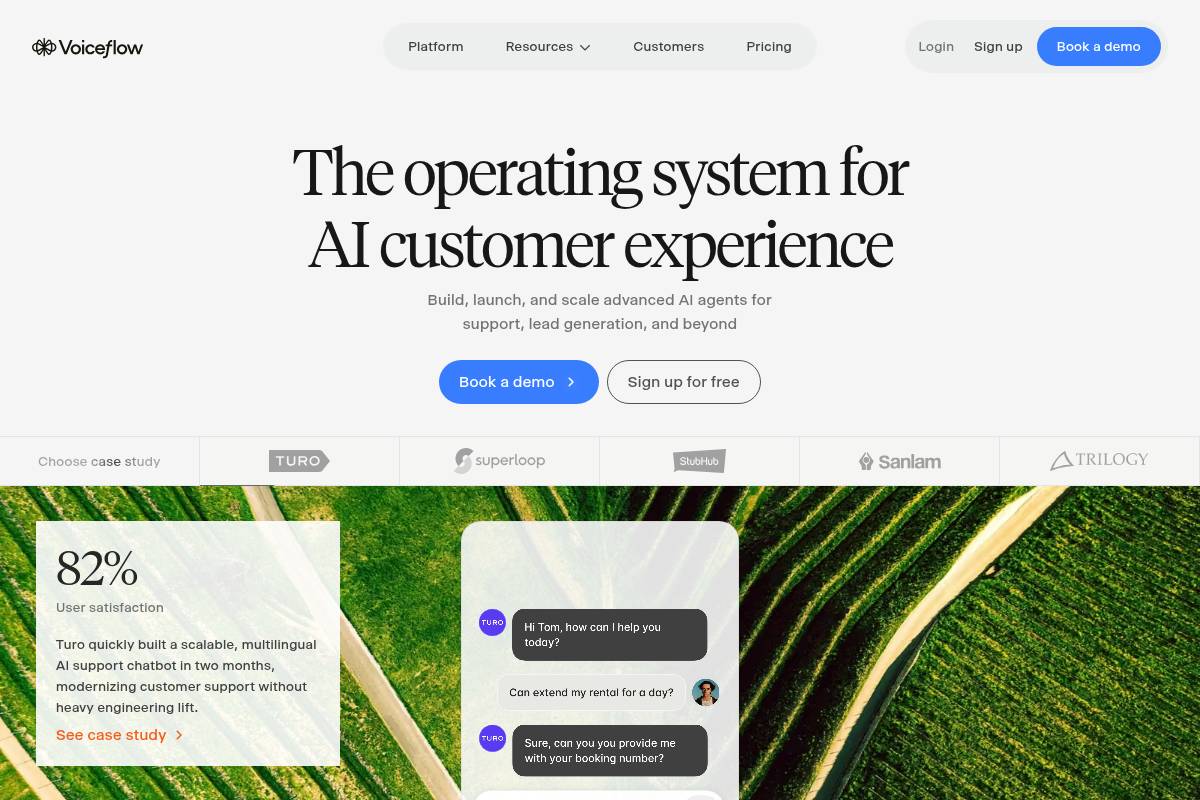
Voiceflow is a visual collaboration platform for designing, testing, and deploying AI chat and voice agents. A G2 2026 Best Software Award winner, it enables teams to build and scale AI agents from a single collaborative space.
Key Features
Visual No-Code Builder: Drag-and-drop blocks simplify complex user journeys without developer involvement.
Model Agnosticism: Support for major LLM providers and bring-your-own-model integrations prevents vendor lock-in.
Team Collaboration: Multiple users work simultaneously with comments, version history, and workflow transparency.
Enterprise Security: SSO and data controls available at enterprise tier for compliance-conscious deployments.
Multichannel Deployment: Embed AI agents into websites with customizable chat and voice widgets.
Best For
Voiceflow is best for product and CX teams that need to rapidly design, prototype, and iterate on AI agent experiences. Pro pricing starts at $60/month per editor, with Business at $150/month and custom Enterprise pricing.
Pros and Cons
Pro: Best-in-class visual flow builder widely praised by designers and product teams.
Con: Lacks full deployment support, advanced analytics, or data privacy controls for high-stakes industries like banking or healthcare.
Con: Service interrupts when credit limits are hit, creating risk for regulated workflows.
Rating: 7.8/10
8. Synthflow AI — Best for No-Code Voice Agent Deployment Without Engineering Teams
8. Synthflow AI — Best for No-Code Voice Agent Deployment Without Engineering Teams
8. Synthflow AI — Best for No-Code Voice Agent Deployment Without Engineering Teams
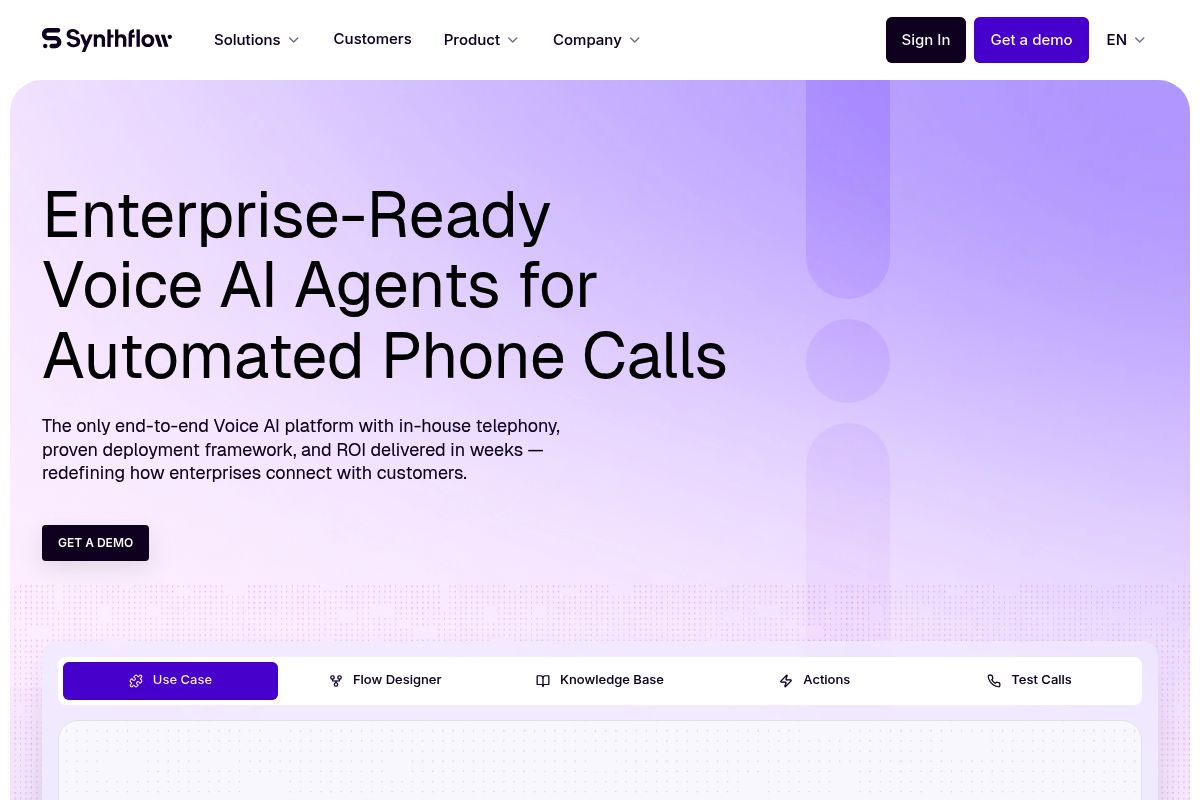
Synthflow AI is a no-code platform for building and deploying AI voice agents. It allows non-technical teams to create conversational voice bots using a visual drag-and-drop interface, providing the fastest path to a live voice agent without engineering support.
Key Features
Drag-and-Drop Builder: No-code, visual builder powered by leading LLMs like GPT-4o for contextual awareness and customizable voices.
Compliance: Sub-500ms latency in over 30 languages, designed to meet SOC 2, HIPAA, and GDPR standards.
200+ Integrations: Typical deployment in under 3 weeks for complex workflows with appointment scheduling, lead qualification, and customer support.
Agency White-Label: Feature-complete native white-label and agency solutions allowing partners to rebrand.
HIPAA Add-On: HIPAA support added in early 2026, though BAA add-on comes at a 30% premium on per-minute rate.
Best For
Synthflow AI is ideal for non-technical compliance and operations teams needing a live voice agent quickly. Pricing is $0.15–$0.24/min all-in pay-as-you-go.
Pros and Cons
Pro: Praised for ease of use and natural voice quality; simple flows deploy in under an hour without coding.
Pro: Fastest path to a live voice agent without technical expertise.
Con: Voice-only as of 2026; omnichannel support requires separate tools.
Con: Real cost is 2–3 times the advertised rate when AI provider fees are included.
Rating: 7.5/10
9. Lindy AI — Best for Broad Workflow Automation With Built-In HIPAA Compliance
9. Lindy AI — Best for Broad Workflow Automation With Built-In HIPAA Compliance
9. Lindy AI — Best for Broad Workflow Automation With Built-In HIPAA Compliance
Lindy AI is an AI-native automation platform providing broad workflow capabilities alongside voice AI. It's specifically designed for regulated industries with HIPAA, SOC 2, GDPR, and PIPEDA compliance.
Key Features
Compliance Stack: Built-in SOC 2 Type II, HIPAA, GDPR, and PIPEDA certifications with SSO and centralized management at enterprise tier.
Widest Integration Ecosystem: Over 1,500+ integrations with built-in knowledge base and searchable memory.
Model Agnosticism: Not locked into a single AI provider across voice and workflow tasks.
Voice + Workflow: Handles phone calls alongside email, calendar, and CRM updates in a unified agent system.
Accessible Entry Pricing: Pro Plan starts at $49.99/month with 5,000 credits and 30 phone calls.
Best For
Lindy AI is best for healthcare and financial services teams needing voice AI as part of a broader automation strategy. At $49.99/month, it offers one of the most accessible entry points for compliance-conscious mid-market teams.
Pros and Cons
Pro: HIPAA and SOC 2 Type II compliance across plans without lengthy enterprise negotiations.
Pro: 1,500+ integrations offer unmatched breadth for connecting voice AI to existing regulated workflows.
Con: Less specialization in voice-specific features compared to dedicated speech recognition platforms.
Con: Phone call limits on lower-tier plans require enterprise pricing for high-volume contact centers.
Rating: 7.4/10
10. ElevenLabs Conversational AI — Best for Premium Voice Quality and Multilingual Agent Experiences
10. ElevenLabs Conversational AI — Best for Premium Voice Quality and Multilingual Agent Experiences
10. ElevenLabs Conversational AI — Best for Premium Voice Quality and Multilingual Agent Experiences
ElevenLabs Conversational AI is a voice AI platform setting the industry benchmark for naturalness and emotional range. It delivers sub-100ms latency for seamless real-time conversational experiences across 70+ languages.
Key Features
Industry-Leading Voice Quality: Turbo voice models set the benchmark for naturalness and emotional nuance across 70+ languages.
Sub-100ms Latency: Among the fastest response latencies available, creating seamless conversational experiences.
Automatic Language Detection: Mid-call language detection enables truly multilingual agents without complex routing logic.
HIPAA Compliance: Available at Enterprise tier for healthcare organizations handling PHI.
Flexible Deployment: Used as both standalone agent platform and embedded voice engine by other AI platforms.
Best For
This platform suits regulated-sector organizations where brand voice, emotional nuance, and multilingual call quality are key differentiators. Excels in insurance, finance, and healthcare for complex client calls and sensitive interactions.
Pros and Cons
Pro: Unmatched voice quality and emotional range — the global benchmark for AI voice naturalness.
Con: LLM tokens and telephony billed separately, making true cost-to-operate harder to predict at scale.
Con: HIPAA compliance gated to Enterprise tier, limiting accessibility for smaller regulated organizations.
Rating: 7.2/10
Full Comparison: Top Bland AI Alternatives Side by Side
Tool
HIPAA
SOC 2
ISO 27001
GDPR
On-Premise
Omnichannel
No-Code
Managed Delivery
Kolsetu Elba
✓
✓
✓
✓
✓
✓
✓
✓
Retell AI
✓
✓
✗
✓
✗
✗
✓
✗
NiCE Cognigy
✓
✓
✓
✓
✓
✓
✓
✓
PolyAI
✓
✓
✗
✓
✗
✗
✗
✓
Kore.ai
✓
✓
✓
✓
✓
✓
✓
✗
Deepgram
✓
✓
✗
✓
✓
✗
✗
✗
Voiceflow
✗
✗
✗
✓
✗
✓
✓
✗
Synthflow AI
✓*
✓
✓
✓
✗
✗
✓
✗
Lindy AI
✓
✓
✗
✓
✗
✓
✓
✗
ElevenLabs
✓*
✗
✗
✓
✗
✗
✓
✗
* HIPAA BAA requires add-on or enterprise tier upgrade.
How to Choose the Right Secure AI Alternative
By Team Size
Small to mid-size teams: Retell AI and Lindy AI offer the best combination of compliance, self-serve onboarding, and predictable pricing. Synthflow AI works for non-technical teams needing rapid deployment. Kolsetu Elba suits teams where compliance requirements exceed self-serve platform capabilities.
Large enterprises: Kolsetu Elba, NiCE Cognigy, PolyAI, and Kore.ai are purpose-built for this scale with custom pricing and multi-week implementation timelines.
By Budget
Under $500/month: Retell AI ($0.07/min) and Lindy AI ($49.99/month) are the strongest compliant options.
$10K–$100K/year: Deepgram Growth tier ($4K+/year) and mid-tier Retell AI or Kore.ai plans serve this budget.
$100K+/year: Kolsetu Elba, NiCE Cognigy ($115K–$300K+), PolyAI ($150K+), and Kore.ai enterprise ($300K+) operate at this tier.
By Use Case
HIPAA-compliant healthcare workflows: Kolsetu Elba is purpose-built. Retell AI is the strongest self-serve alternative.
Insurance claims intake and financial services disclosures: Kolsetu Elba's deterministic logic and compliance disclosure automation make it the strongest fit.
Developer-led voice infrastructure with data sovereignty: Deepgram's self-hosted, on-premise deployment is the most technically rigorous option.
No-code rapid deployment: Synthflow AI for voice-only workflows; Lindy AI for broader automation across channels.
What Is a Compliant AI Voice Agent?
A compliant AI voice agent is a conversational AI system handling sensitive customer and patient interactions over phone, messaging, and digital channels while operating within strict regulatory frameworks. A HIPAA-compliant AI voice agent handles patient phone interactions while securely processing protected health information, combining speech recognition, conversational AI models, voice synthesis, and telephony infrastructure within a healthcare-compliant environment.
Compliance Requirement
What It Means in Practice
Regulated Sectors Affected
HIPAA BAA
Vendor must sign a Business Associate Agreement covering PHI handling
Healthcare, Health Insurance
SOC 2 Type II
Independently audited security controls verified over time
All regulated sectors
ISO 27001
Information security management system certification
Financial services, Healthcare, Government
GDPR
Data processing consent, residency, and right-to-erasure controls
All sectors with EU data subjects
PCI DSS
Payment card data security for transactional voice workflows
Financial services, Insurance, Retail
DORA / NIS2
Digital operational resilience and network security requirements
Financial services in the EU
Conclusion: Which Top Bland AI Alternative Should You Choose?
The platforms featured range from self-serve developer tools to fully managed enterprise solutions. The right choice depends entirely on your compliance framework, call volume, and internal engineering capacity. For healthcare providers, financial services firms, insurance companies, and compliance managers needing an AI voice agent that treats regulatory standards as non-negotiable, Kolsetu Elba is the clear top pick. Kolsetu Elba exists to demonstrate that reliable AI agents drive operational efficiency without sacrificing regulatory standards. Its multi-framework compliance posture (ISO 27001, GDPR, HIPAA, DORA, NIS2), omnichannel execution, and managed delivery model make it the definitive choice for regulated enterprises.
If you need self-serve HIPAA compliance at mid-market pricing, Retell AI at $0.07/min is the strongest alternative. For Fortune 500 organizations already invested in NICE CXone, NiCE Cognigy is the natural fit. High-volume contact centers should evaluate PolyAI. Developer-led teams needing data-sovereign speech infrastructure should pilot Deepgram.
Frequently Asked Questions
What makes an AI voice agent HIPAA compliant for healthcare use?
Compliance requires handling protected health information safely through Business Associate Agreements, encrypted storage and transmission of patient data, and audit logging required for healthcare security oversight. Always verify that your vendor signs a BAA covering your specific workflows before any PHI enters the pipeline.
Which alternatives are best for small healthcare practices?
For small healthcare practices needing HIPAA compliance without six-figure contracts, Retell AI and Lindy AI are the strongest self-serve options. Retell AI offers HIPAA with a self-service BAA portal on standard paid plans starting at $0.07/min. Lindy AI includes HIPAA coverage from its Pro plan at $49.99/month. For practices wanting fully managed approaches without internal engineering resources, Kolsetu Elba can go live in weeks.
Is Bland AI HIPAA compliant, and why are organizations looking for alternatives?
Bland's self-hosted GPU architecture offers a robust compliance story for teams with data sovereignty requirements, but HIPAA is gated to enterprise contracts. This pricing structure and the engineering resources required to configure and maintain Bland's API-first platform drive regulated-sector buyers toward purpose-built alternatives that include compliance without enterprise-level commitments.
What is the difference between SOC 2 Type II and HIPAA for AI voice compliance?
SOC 2 Type II is an independently audited certification verifying that a vendor's security controls have operated effectively over a defined period. HIPAA is a U.S. law specifically governing Protected Health Information handling by healthcare entities and business associates. A Business Associate Agreement creates legal accountability for PHI specifically. Regulated healthcare organizations need both: SOC 2 Type II provides general security assurance, while a signed HIPAA BAA creates legal accountability. For financial services and insurance firms, SOC 2 Type II plus ISO 27001 and relevant sector regulations typically apply.
How do AI voice agents handle compliance disclosures for insurance and financial services?
Insurance firms face state laws requiring automated agents to identify themselves and provide specific disclosures before discussing policy terms. Purpose-built platforms manage disclosure automation at the infrastructure level. When evaluating compliant AI alternatives for insurance, verify that the platform can enforce mandatory disclosures deterministically — not just through LLM prompting that could drift.
What should a compliance manager verify before deploying any AI voice agent?
Begin with a comprehensive compliance assessment to understand your specific regulatory requirements. Design a security architecture with end-to-end encryption and role-based access controls. Configure real-time PII redaction, immutable audit logging, and partner with compliant voice AI providers. Verify data residency options, confirm BAA coverage extends to all sub-processors in the voice stack, and establish an audit log retention policy that meets your sector's specific regulatory timeline.
How long does it typically take to deploy an AI voice agent in a regulated environment?
Kolsetu Elba's managed delivery model typically goes live in two to six weeks. Self-serve platforms like Retell AI and Synthflow AI can have basic agents live within hours to days, but full HIPAA-compliant production deployments with EHR integrations typically take two to four weeks. Enterprise platforms like NiCE Cognigy and PolyAI typically require two to four months from contract to full production.
Can AI voice agents integrate with EHR systems like Epic or Cerner for HIPAA compliant workflows?
Many healthcare voice platforms integrate with Electronic Health Record systems such as Epic, Cerner, and Athenahealth, allowing AI voice agents to check appointment availability, confirm patient details, update records, or trigger follow-up workflows. Compliance controls must extend to the EHR integration itself — including encrypted data transfer, access logging, and BAA coverage for API calls that touch PHI. Verify integration compliance specifically, not just platform-level certifications.
Methodology: This article evaluates 10 AI voice agent platforms for regulated sector suitability as of July 2026. Each tool was assessed using publicly available documentation, vendor pricing pages, third-party review data from G2 and Capterra, and independent research on compliance certifications. Kolsetu Elba is the publisher of this article; their platform is ranked #1 based on its purpose-built compliance architecture for regulated industries. Pricing data reflects published information as of the article date and is subject to change — confirm current pricing directly with each vendor before making a procurement decision. This article does not constitute legal advice; regulated organizations should consult qualified legal counsel and compliance professionals before deploying any AI voice agent.
Top Bland AI Alternatives for Regulated Sectors 2026 | Kolsetu Blog

 Kolsetu