Best Voice API Agents for Lead Qualification in Financial Services 2026
Discover the top 10 best voice API agents for lead qualification in financial services 2026, designed to enhance efficiency and drive better client engagement.
best voice API agents for lead qualification in financial services 2026 | Last Updated: August 2026 | Editorial Team | 10 tools tested and evaluated
Choosing the right voice API agent platform is no longer optional — it's an operational necessity. Banking, financial services, and insurance lead voice AI adoption with a 32.9% market share according to Mordor Intelligence, and Gartner projects conversational AI will save businesses $80 billion in contact center labor costs by 2026. For compliance managers, IT leaders, and financial services executives, the question has shifted from "should we deploy voice AI?" to "which platform meets our regulatory requirements without sacrificing conversion quality?"
This guide ranks the best voice API agents for lead qualification in financial services 2026, evaluating each on compliance certifications, latency, pricing transparency, integration depth, and real-world suitability for regulated environments. Kolsetu Elba earns the top spot for its purpose-built focus on regulated industries and its commitment to secure, human-grade automation.
TL;DR — Top 10 Voice API Agents for Lead Qualification in Financial Services (2026)
The table below captures our ranked picks at a glance. All ratings reflect suitability for regulated financial services lead qualification workflows.
Rank
Tool
Best For
Starting Price
Rating
1
Kolsetu Elba
Regulated industries requiring HIPAA, GDPR & ISO 27001 compliance
Custom pricing
9.5/10
2
Telnyx Voice AI
Developer teams wanting carrier-grade infrastructure + compliance
~$0.05/min
9.0/10
3
PolyAI
Large enterprise financial contact centers, multilingual
Custom (~$150K+/yr)
8.7/10
4
Cognigy.AI
Global enterprise CCaaS deployments needing omnichannel AI
Custom (~$300K+/yr)
8.5/10
5
Regal.ai
US financial & insurance firms with high-volume B2C outbound
Custom / ~$29/mo entry
8.2/10
6
11x (Julian AI)
Revenue teams targeting inbound lead speed-to-pipeline
From $5,333/mo (Voice)
8.0/10
7
Thoughtly
Mid-market teams needing fast no-code agent deployment
~$0.09/min
7.7/10
8
Smith.ai
Professional services firms needing AI + human hybrid backup
From $95/mo
7.5/10
9
Synthflow AI
Agencies building white-label voice qualification bots
#1 pick: Kolsetu Elba is the strongest all-round choice for financial services organizations where compliance, data security, and human-grade conversational quality must coexist in a single platform. For related guidance, see Best AI Voice Agents For Regulated Industries 2026.
Why You Need Voice API Agents for Lead Qualification in Financial Services in 2026
Voice AI agents for lead qualification are automated software systems that conduct natural, two-way telephone conversations with prospects, score them against qualification criteria such as BANT or custom financial product rules, and route verified leads to human advisors — all without manual SDR involvement. Traditional IVR systems use rigid menu trees that force callers through predetermined paths, while AI voice agents conduct natural, two-way conversations that understand intent, handle interruptions, and adapt responses based on context.
For financial services companies, the business case is clear. AI operating 24/7 across time zones handles routine qualification conversations and routes qualified opportunities to human experts. That delivers measurable improvements in both revenue and efficiency. The compliance challenge, though, is equally significant. Voice AI compliance means adhering to data privacy laws such as GDPR, HIPAA, and TCPA, as well as biometric data rules like BIPA in Illinois. A platform that qualifies leads brilliantly but mishandles call recordings or consent flows creates regulatory exposure that no financial institution can afford.
We assessed each platform against six weighted criteria that reflect the specific demands of regulated financial services environments. Tools were tested or evaluated based on publicly available documentation, third-party reviews, and verified pricing data.
Criterion
Weight
What We Measured
Compliance & Security
30%
HIPAA, GDPR, SOC 2 Type II, ISO 27001, PCI-DSS certifications; audit logs; data residency
CRM, CCaaS, telephony, SIP trunking, API flexibility
Pricing Transparency
10%
All-in per-minute cost predictability, no hidden stack fees
Deployment Speed
5%
Time-to-live-call, no-code vs. developer build time
Each criterion was weighted to reflect what actually matters in financial services deployments. Compliance carries the heaviest weight because regulators care first. Conversational quality matters because a stilted voice agent fails to qualify leads effectively. And deployment speed matters because delays mean revenue delays. With these weights in place, we can now examine the individual platforms that lead the market. For industry-standard evaluation frameworks, see Best AI Voice Agents for Financial Services (2026 Guide).
1. Kolsetu Elba — Best for Regulated Industries Requiring Full Compliance Stack
1. Kolsetu Elba — Best for Regulated Industries Requiring Full Compliance Stack
1. Kolsetu Elba — Best for Regulated Industries Requiring Full Compliance Stack
Kolsetu Elba is an advanced AI voice agent platform purpose-built for organizations operating in highly regulated sectors. In an environment where secure automation isn't a feature — it's a prerequisite — Kolsetu Elba delivers human-grade AI voice agents that automate lead qualification and operational workflows while maintaining rigorous adherence to HIPAA, GDPR, and ISO 27001 standards. For financial services companies, insurance firms, and healthcare providers where data privacy is paramount, Kolsetu Elba's architecture is designed from the ground up to handle sensitive interactions without creating regulatory exposure.
Key Features
Human-Grade Voice Conversations: AI agents engineered to conduct natural, empathetic conversations that qualify financial leads with the warmth and consistency of a trained human agent.
Full Compliance Architecture: HIPAA, GDPR, and ISO 27001 compliance built into the platform core — not bolted on — ensuring that every call, transcript, and data point is handled in accordance with regulatory standards.
Secure Data Handling: End-to-end encryption, role-based access controls, and audit-ready interaction logs designed for compliance managers and IT security teams in regulated sectors.
Workflow Automation for Regulated Sectors: Pre-built and configurable qualification flows tailored to financial services, insurance, and healthcare lead intake scenarios, reducing time-to-deploy without sacrificing control.
Operational Efficiency Without Compliance Trade-offs: The platform enables organizations to scale lead qualification volume without adding headcount, while preserving the documentation trail required by regulators.
Custom Pricing for Enterprise: Pricing is tailored to deployment scope, call volume, and compliance requirements — contact Kolsetu for a quote aligned to your organization's needs.
Best For
Ideal for financial services companies, insurance firms, and healthcare providers that cannot separate operational efficiency from regulatory compliance. Particularly well-suited for compliance managers and IT leaders in regulated sectors who need a vendor that treats data privacy as a foundational design principle rather than a checkbox.
Pros and Cons
Pro: Compliance stack (HIPAA, GDPR, ISO 27001) purpose-built for regulated industries, not retrofitted
Pro: Human-grade conversational quality sustains trust in sensitive financial and insurance intake calls
Pro: Workflow automation reduces manual operational overhead without sacrificing auditability
Pro: Strong fit for healthcare, financial services, and insurance — the highest-stakes voice AI verticals
Con: Custom pricing requires a sales conversation, which may slow evaluation for smaller teams
Con: Best value is realized at scale; solo practitioners or very small teams may find lighter-weight options sufficient
Rating: 9.5/10 Kolsetu Elba's strength lies in treating compliance as architecture rather than an afterthought, making it the natural choice for organizations where regulatory exposure is a real business risk. For teams evaluating alternatives that balance developer control with compliance rigor, Telnyx Voice AI offers a different approach.
2. Telnyx Voice AI — Best for Developer Teams Needing Carrier-Grade Infrastructure
2. Telnyx Voice AI — Best for Developer Teams Needing Carrier-Grade Infrastructure
2. Telnyx Voice AI — Best for Developer Teams Needing Carrier-Grade Infrastructure
Telnyx Voice AI is a carrier-owned communications platform that combines native telephony infrastructure with a fully integrated AI voice layer, giving engineering teams end-to-end control over their voice agent stack without dependency on multiple third-party vendors. By owning both the carrier network and AI stack, the platform delivers low-latency voice interactions while simplifying deployment, pricing, and compliance for enterprise customers.
Key Features
Carrier-Native Infrastructure: Telnyx is a licensed carrier in over 45 countries and controls every step of the process — from the phone systems that carry calls to the moment the AI generates a response — eliminating third-party latency.
Transparent All-In Pricing: Orchestration, speech-to-text, and text-to-speech in one layer at $0.05/min; a production agent runs approximately $0.056 per minute.
Compliance Certifications: ISO, HIPAA, GDPR, and SOC 2 compliant, making it secure for handling sensitive medical or financial data.
Sub-500ms Latency: Streaming architecture delivers response times that keep financial conversations natural and uninterrupted.
Flexible Billing: Telnyx offers two pricing models: pure pay-as-you-go or a Growth Plan commitment that unlocks an 8% discount.
SIP Trunking & CRM Integrations: Named integrations across CRM and contact center systems; connects to existing carrier agreements.
Best For
Best suited for financial services engineering teams and IT leaders who want to build voice AI lead qualification systems with maximum infrastructure control, transparent per-minute pricing, and a compliance posture that covers HIPAA, SOC 2, and PCI-DSS on a single vendor. Production deployments exist across healthcare, financial services, and enterprise CX.
Pros and Cons
Pro: Carrier ownership eliminates third-party intermediaries and compresses latency
Pro: All-in pricing at ~$0.05/min is among the most transparent in the market
Pro: Single BAA covers the full call path — critical for regulated deployments
Con: Requires developer resources to build and configure voice agent logic
Con: No native no-code builder for non-technical compliance or operations teams
Rating: 9.0/10 Telnyx's carrier ownership and transparent pricing make it the go-to for engineering-led teams, while organizations prioritizing voice realism and enterprise scale turn to platforms like PolyAI.
3. PolyAI — Best for Enterprise Financial Contact Centers Prioritizing Voice Realism
3. PolyAI — Best for Enterprise Financial Contact Centers Prioritizing Voice Realism
3. PolyAI — Best for Enterprise Financial Contact Centers Prioritizing Voice Realism
PolyAI is a voice-first conversational AI platform built specifically for enterprise contact centers, designed to automate high-volume inbound calls while maintaining the conversational fidelity that financial services customers expect. The company spun out of the University of Cambridge; co-founder and CEO Nikola Mrksic previously worked on Apple's Siri, and PolyAI develops its own proprietary voice models rather than wrapping third-party LLMs.
Key Features
Proprietary Raven Voice Model: Powered by its proprietary Raven model and retrieval-augmented generation, the agent understands callers regardless of how they phrase things, handles interruptions and accents, and resolves transactional requests.
Financial Services Use Cases: Customers can check balances, report fraud, make payments, and get account support through automated voice interactions.
Managed Service Delivery: PolyAI teams co-design dialogue logic and RAG pipelines and integrate into CCaaS platforms such as Genesys or Salesforce Service Cloud, managing performance after launch.
Multilingual Support: PolyAI supports 24+ languages at the model level, supporting global financial institutions.
SOC 2 & GDPR Compliance: PolyAI publishes SOC 2 Type II and GDPR compliance, with PCI-DSS support available for payment-handling deployments.
Enterprise Pricing: Based on third-party estimates, contracts typically start around $150,000 per year, custom-quoted with no self-serve tier.
Best For
PolyAI is best suited for enterprise contact centers that want to automate high volumes of customer calls while maintaining natural voice experiences across multiple languages. Financial institutions handling thousands of inbound calls daily where brand-safe conversational quality is a strategic requirement.
Pros and Cons
Pro: Proprietary voice models built for voice-first interactions, not adapted from chatbots
Pro: Managed service model reduces internal engineering burden for complex deployments
Pro: Strong financial services and banking case study evidence
Con: Pricing starts at ~$150K/year — inaccessible for mid-market teams or pilots
Con: No self-serve, no free trial, and no published rate card
Rating: 8.7/10 PolyAI's proprietary voice models and managed service approach appeal to large enterprises, but organizations needing omnichannel AI across voice and digital channels often gravitate toward Cognigy.AI.
4. Cognigy.AI — Best for Global Enterprise CCaaS with Omnichannel AI
4. Cognigy.AI — Best for Global Enterprise CCaaS with Omnichannel AI
4. Cognigy.AI — Best for Global Enterprise CCaaS with Omnichannel AI
Cognigy.AI is an enterprise-grade conversational AI platform that enables large financial institutions to design, build, and deploy AI agents across voice and digital channels within existing contact center infrastructure. The platform lets companies design, build, and deploy virtual agents across voice and chat channels, with integrations with CRMs and ERPs and support for large global contact centers.
Key Features
Enterprise Scale: Cognigy is built to handle very high volumes — such as tens of thousands of concurrent conversations — which is ideal for airlines, banks, and large utilities.
Compliance Posture: Cognigy's compliance posture is mature, with ISO 27001, GDPR, SOC 2, and HIPAA support on enterprise contracts.
CCaaS Integrations: Cognigy integrates with over 30 third-party tools including Amazon Connect, Avaya, Genesys Cloud CX, Salesforce, and Microsoft Azure.
LLM Orchestration: Visual conversation design paired with LLM reasoning for complex financial compliance flows.
NICE CXone Integration: Tight integration with NICE's contact-center platform, including Agent Copilot and Knowledge AI add-ons.
Custom Enterprise Pricing: Cognigy does not publish public pricing; most enterprise contracts begin above $300K per year.
Best For
For Fortune 500 companies with global CX mandates, Cognigy is a serious contender. Best suited for multinational financial institutions that require omnichannel AI agents integrated into existing Genesys, NICE, or Avaya contact center infrastructure, with the internal engineering resources to manage a multi-month deployment.
Pros and Cons
Pro: Proven at massive enterprise scale with mature compliance certifications
Pro: Deep CCaaS integration ecosystem covering all major enterprise contact center platforms
Con: Smaller teams often struggle with the learning curve, and advanced workflows can require engineering help.
Con: Implementation services can add $30K–$100K to the initial contract cost
Rating: 8.5/10 Cognigy.AI's omnichannel depth and CCaaS integrations serve large enterprises well, while organizations focused on high-volume outbound B2C campaigns in financial and insurance sectors often choose Regal.ai.
5. Regal.ai — Best for US Financial and Insurance Firms with High-Volume B2C Outbound
5. Regal.ai — Best for US Financial and Insurance Firms with High-Volume B2C Outbound
5. Regal.ai — Best for US Financial and Insurance Firms with High-Volume B2C Outbound
Regal.ai is a voice-first AI agent platform built for high-volume B2C contact centers in regulated industries, offering outbound and inbound AI voice agents with built-in compliance controls for TCPA, financial services, and insurance use cases. Founded in 2020 and led by CEO Alex Levin, Regal focuses on automating phone-based customer engagement in industries like insurance, healthcare, and financial services where phone conversations drive revenue.
Key Features
TCPA-Compliant Outbound: Conversational AI voice agents trained on the customer's brand and use case, deployed for both outbound and inbound, with TCPA-compliant guardrails.
Trigger-Based Outreach: Regal builds AI voice agents that make and answer calls with conversational fluency for both outbound and inbound customer engagement, driven by real-time CRM triggers.
High Containment Rates: The company reports containment rates as high as 97% and significant cost reductions for enterprise customers.
Compliance Data Handling: Regal collects call recordings, transcripts, and CRM data, maintaining compliance certifications for handling sensitive data in regulated industries.
Branded Caller ID & CRM Sync: Native integrations with major CRM platforms for seamless lead qualification write-back.
Entry Pricing: Entry-level access reported from approximately $29/month, with enterprise custom pricing for high-volume financial services deployments.
Best For
High-volume, high-consideration voice interactions — insurance quotes, financial services consultations — in regulated industries with compliant outbound needs, including built-in TCPA/TSR tooling and audit trails. Most valuable for US-based financial and insurance organizations running outbound lead qualification campaigns at scale.
Pros and Cons
Pro: Built specifically for regulated B2C verticals with TCPA compliance integrated
Pro: CRM-triggered outreach enables real-time lead qualification at the moment of intent
Pro: Strong track record in insurance, financial services, and healthcare
Con: Voice-first architecture means teams running broader omnichannel support may encounter gaps
Con: Enterprise pricing and contract terms are opaque without a sales conversation
Rating: 8.2/10 Regal.ai's TCPA compliance tooling and CRM integration make it strong for B2C outbound, but revenue teams focused on inbound lead speed often turn to 11x Julian.
6. 11x (Julian AI Sales Agent) — Best for Revenue Teams Targeting Inbound Lead Speed-to-Pipeline
6. 11x (Julian AI Sales Agent) — Best for Revenue Teams Targeting Inbound Lead Speed-to-Pipeline
6. 11x (Julian AI Sales Agent) — Best for Revenue Teams Targeting Inbound Lead Speed-to-Pipeline
11x is an autonomous digital worker platform whose Julian AI Sales Agent is designed to answer every inbound lead within seconds, conduct natural qualification conversations, and book meetings directly into sales rep calendars — making it one of the most pipeline-focused platforms in this category. Julian AI Sales Agent answers every inbound call within 60 seconds of form submission, qualifies prospects using custom criteria in real-time, and books meetings directly into rep calendars, operating across phone, SMS, WhatsApp, and chat as one unified sequence.
Key Features
Speed-to-Lead Architecture: Unitech reduced speed-to-lead time by 99% — from more than eight hours to under two minutes — and attributed 35% of its pipeline to Julian within the first 90 days.
Multi-Channel Unified Sequence: Voice, SMS, WhatsApp, and chat coordinated in a single outreach workflow triggered by inbound form fills.
Compliance Certifications: 11x is SOC 2 Type II, CASA Tier 3, GDPR, and CCPA compliant.
B2B Data Infrastructure: 11x's real-time data infrastructure includes 400M+ verified B2B contacts, live web search, and signals monitoring.
Autonomous Decision-Making: Where most platforms require human guidance, Julian makes decisions, handles objections, adapts conversations in real-time, and completes workflows end-to-end autonomously.
Pricing: Julian starts at $5,333/month for Voice and $2,417/month for Chat, billed annually.
Best For
Ideal for fintech companies and financial services revenue teams whose primary bottleneck is inbound lead response time and pipeline qualification speed. 11x leads the market for financial institutions prioritizing both automation and revenue generation, with proven results across banking, fintech, and wealth management. Best suited for organizations with an existing compliance posture who need to dramatically accelerate inbound conversion.
Pros and Cons
Pro: Proven speed-to-lead reduction (seconds vs. hours) with documented revenue outcomes
Pro: Unified multi-channel approach covers the full inbound qualification lifecycle
Pro: SOC 2 Type II and GDPR certification sufficient for many financial services use cases
Con: $5,333/month starting price is a significant commitment for smaller teams
Con: Primarily optimized for sales pipeline — less suited to complex regulatory compliance workflows
Rating: 8.0/10 11x excels at speed-to-pipeline for inbound sales, while mid-market teams needing faster time-to-deployment often start with Thoughtly's no-code approach.
7. Thoughtly — Best for Mid-Market Teams Needing Fast No-Code Deployment
7. Thoughtly — Best for Mid-Market Teams Needing Fast No-Code Deployment
7. Thoughtly — Best for Mid-Market Teams Needing Fast No-Code Deployment
Thoughtly is a no-code AI voice agent platform that enables revenue teams to deploy qualification agents across inbound and outbound voice, SMS, and email without engineering resources, with CRM integrations and sub-60-second speed-to-lead built into the platform. Thoughtly is production-ready, built specifically for inbound lead conversion across voice, SMS, email, and workflow automation, shipping with a no-code visual builder, native two-way CRM sync to Salesforce and HubSpot, and branded caller ID.
Key Features
No-Code Visual Builder: A drag-and-drop editor allows teams to build and deploy a lead follow-up agent in approximately 15 minutes.
CRM Integrations: Integrations with Salesforce and HubSpot work cleanly, and the agent books meetings directly into Calendly during calls.
Usage-Based Pricing: Thoughtly uses a usage-based pricing model, with voice interactions billed per minute at around $0.09/minute; core capabilities such as phone numbers and basic features are included.
Multi-Channel Coverage: Handles inbound and outbound calls alongside SMS and email follow-up in a single workflow.
Industry Coverage: Serves healthcare, real estate, insurance, and sales teams with human-like inbound and outbound voice AI.
Starter Plan: Starter Plan at $30 per month, including 300 minutes; enterprise custom pricing available.
Best For
Mid-market financial services and insurance teams that need to stand up a qualifying voice agent quickly without a developer team. The platform is laser-focused on sales use cases: lead qualification, appointment setting, and automated follow-up. Thoughtly's accessibility makes it a practical choice for operational managers who need results in days, not months — particularly for teams with straightforward financial product qualification flows.
Pros and Cons
Pro: Fastest time-to-live-call of any platform in this list — deployable in under 20 minutes
Pro: Native CRM sync to Salesforce and HubSpot reduces post-call data entry
Pro: Usage-based pricing is accessible for teams piloting voice AI before committing to enterprise contracts
Con: Struggles on longer multi-turn conversations; latency around 700ms combined with limited conversation memory causes context loss after the third or fourth exchange.
Con: Less robust compliance certification stack compared to Kolsetu Elba or Telnyx for highly regulated deployments
Rating: 7.7/10 Thoughtly's speed-to-deployment appeals to fast-moving teams, while professional services firms often prefer the human backup option that Smith.ai provides.
8. Smith.ai — Best for Professional Services Firms Needing AI Plus Human Backup
8. Smith.ai — Best for Professional Services Firms Needing AI Plus Human Backup
8. Smith.ai — Best for Professional Services Firms Needing AI Plus Human Backup
Smith.ai is a hybrid answering and lead qualification service that combines AI call handling with North American human receptionists, making it a distinctive option for financial advisory, legal, and insurance firms where certain high-stakes calls require a human voice. Smith.ai blends AI with 500+ North American human receptionists, serving 5,000+ businesses across law, home services, medical, and insurance.
Key Features
Hybrid AI + Human Escalation: A live, North American-based agent can take over the conversation seamlessly if the AI hits a snag or a caller shows distress.
Per-Call Pricing Transparency: Smith.ai distinguishes itself through a per-call pricing model rather than per-minute billing, providing businesses with predictable costs regardless of call duration.
AI Receptionist Tiers: AI Receptionist plans run $95–$800/month for 50–500 calls; Human Receptionist plans run $300–$2,100/month for 30–300 calls.
Financial and Legal Intake: Train the system on rigorous screening questions to vet leads for financial fit and case urgency before they reach your desk.
No Setup Fees: Unlike many competitors, Smith.ai removes financial barriers to implementation with no onboarding fees.
CRM Integrations: Integrations are available via Zapier, covering 7,000+ apps.
Best For
Smith.ai fits organizations that want the speed of AI but require human backup for high-stakes calls — particularly in sectors like legal and finance where a VIP lead may require a more sensitive, high-empathy touch. Best suited for boutique financial advisory firms, wealth management offices, and insurance agencies handling under 100 calls per day.
Pros and Cons
Pro: Human fallback eliminates the risk of AI mishandling sensitive financial conversations
Pro: Per-call pricing is predictable for low-to-moderate volume operations
Pro: Quick setup with no implementation fees
Con: Per-call billing means monthly spend shifts based on volume; overage fees of up to $11.50 per call stack quickly on human-first plans.
Con: Not a pure AI voice API — the human component limits scale and automation depth for high-volume financial lead qualification
Rating: 7.5/10 Smith.ai's human backup appeals to risk-averse teams, but agencies looking to white-label voice solutions often turn to Synthflow AI.
9. Synthflow AI — Best for Agencies Building White-Label Voice Qualification Bots
9. Synthflow AI — Best for Agencies Building White-Label Voice Qualification Bots
9. Synthflow AI — Best for Agencies Building White-Label Voice Qualification Bots
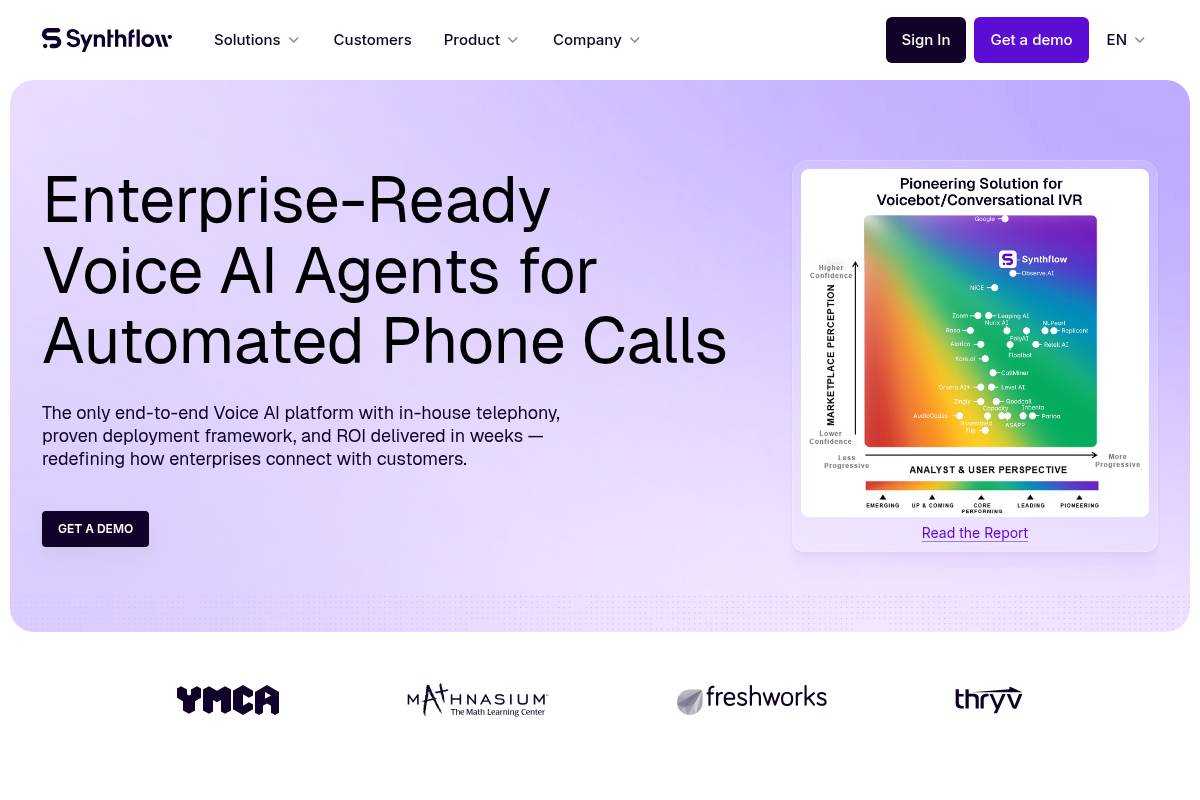
Synthflow AI is a no-code, drag-and-drop AI voice agent builder designed for agencies and technically inclined teams that want to deploy and resell AI-powered phone qualification agents without writing code. Founded in 2023 and headquartered in Berlin, Synthflow raised a $20M Series A in 2025 and has positioned itself as a leading option for agencies wanting to resell AI voice agents under their own brand.
Key Features
No-Code Visual Builder: A drag-and-drop AI voice agent builder that claims to set up a voice agent in minutes, with no technical knowledge or coding required.
White-Label Capability: The platform supports both inbound and outbound calling and offers one of the most feature-complete native white-label/agency solutions in the market.
CRM and Tool Integrations: Connects to HubSpot, Salesforce, Cal.com, Stripe, Zapier, and others for full workflow automation.
Pay-As-You-Go Pricing: Synthflow has moved to a pure pay-as-you-go model with a separate Enterprise option for high-volume teams; there's no fixed monthly fee to get started.
Voice Engine Cost: Every call through Synthflow starts with the voice engine cost at $0.09 per minute.
Multilingual Support: Supports over 30 languages through ElevenLabs voice integration.
Best For
Best suited for financial services agencies and technology providers who want to build and white-label AI voice qualification agents for their clients, or for operations teams running focused inbound/outbound calling campaigns with straightforward scripts. The platform suits teams whose priority is rapid deployment and client branding over deep regulatory compliance architecture.
Pros and Cons
Pro: White-label agency features are industry-leading — resell-ready out of the box
Pro: No-code setup with extensive integration library reduces time-to-deployment
Pro: Pay-as-you-go entry removes upfront commitment for experimentation
Con: Listed prices do not include AI providers needed; real cost is 2–3x the advertised rate — the most common complaint from users.
Con: Compliance certification stack is less comprehensive than Kolsetu Elba or Telnyx for heavily regulated deployments
Rating: 7.3/10 Synthflow's white-label capabilities appeal to agencies, but large US-based contact centers running high-volume outbound campaigns typically choose Convoso.
10. Convoso — Best for High-Volume Outbound B2C Contact Centers in Insurance and Finance
10. Convoso — Best for High-Volume Outbound B2C Contact Centers in Insurance and Finance
10. Convoso — Best for High-Volume Outbound B2C Contact Centers in Insurance and Finance
Convoso is a US-based outbound contact center platform engineered for high-volume B2C sales and lead generation, featuring a predictive dialer, AI-powered virtual agents via its Voso.ai module, and built-in TCPA compliance tools. Founded in 2006 in Los Angeles, the company is best known for its predictive dialer, voicemail detection, and Caller ID reputation management — all engineered for outbound campaigns running thousands of calls per agent per day.
Key Features
Voso.ai Conversational AI: Using conversational AI, intelligent virtual agents handle complex conversations, qualify leads, and automate routine tasks like scheduling callbacks and sending reminders.
Industry Focus: Positions itself as the go-to outbound dialer for insurance, solar, financial services, BPOs, and home services — verticals where TCPA compliance and Caller ID health are make-or-break.
Pricing: Starts at approximately $90 per user/month, with discounts of up to 20% available for annual commitments; minimum ~20 seats required.
Best For
Ideal for large US-based insurance, financial services, and BPO contact centers running outbound lead qualification campaigns at significant scale — particularly organizations managing complex TCPA compliance requirements across large agent pools. For large US-based outbound operations with 20+ agents and a willingness to invest in a multi-month rollout, Convoso delivers serious dialing horsepower.
Pros and Cons
Pro: Industry-leading predictive dialer with built-in TCPA compliance tooling for financial and insurance outbound
Pro: 97% voicemail detection accuracy maximizes agent productive talk time
Pro: Comprehensive compliance automation (STIR/SHAKEN, RND scrubbing, StateTracker) for US regulatory requirements
Con: Minimum ~20 seat requirement makes it unsuitable for smaller teams
Con: Multi-month implementation timeline and custom pricing add friction for fast-moving pilots
Rating: 7.5/10 Convoso's predictive dialer and TCPA automation make it the specialist choice for large outbound operations, setting the stage for a comprehensive comparison across all platforms.
Full Comparison: 10 Best Voice API Agents for Lead Qualification in Financial Services 2026
Tool
HIPAA
GDPR
SOC 2 Type II
ISO 27001
No-Code Builder
CRM Integration
Transparent Pricing
Financial Services Focus
Kolsetu Elba
✓
✓
✓
✓
✓
✓
✗
✓
Telnyx Voice AI
✓
✓
✓
✓
✗
✓
✓
✓
PolyAI
✗
✓
✓
✗
✗
✓
✗
✓
Cognigy.AI
✓
✓
✓
✓
✓
✓
✗
✓
Regal.ai
✗
✗
✓
✗
✓
✓
✗
✓
11x (Julian)
✗
✓
✓
✗
✓
✓
✓
✓
Thoughtly
✗
✗
✗
✗
✓
✓
✓
✗
Smith.ai
✗
✗
✗
✗
✓
✓
✓
✗
Synthflow AI
✗
✗
✗
✗
✓
✓
✗
✗
Convoso
✗
✗
✗
✗
✗
✓
✗
✓
How to Choose the Best Voice API Agent for Your Financial Services Organization
By Team Size
Solo practitioners and boutique advisors will find the most accessible entry point with Smith.ai (AI Receptionist from $95/month) or Thoughtly (from $30/month with 300 minutes), both deployable without developer resources. Mid-market teams of 10–100 staff benefit most from Kolsetu Elba, Telnyx, or Regal.ai — platforms that scale with volume while maintaining compliance rigor. Large enterprise contact centers with 100+ agents should evaluate Cognigy.AI, PolyAI, or Convoso for the infrastructure depth their call volumes demand.
By Budget
Teams with budgets under $500/month can pilot with Thoughtly or Synthflow AI on usage-based plans. Teams with $1,000–$10,000/month available gain access to Telnyx's carrier-grade infrastructure or 11x Julian's inbound pipeline automation. Organizations with six-figure annual budgets can access the full compliance and managed service models of Kolsetu Elba, PolyAI, or Cognigy.AI, where the investment reflects mission-critical compliance and scale requirements.
By Use Case
For regulatory compliance-first deployments in banking, insurance, or healthcare-adjacent finance: Kolsetu Elba is the strongest all-round choice, followed by Telnyx for developer-led builds. For inbound lead speed-to-pipeline in fintech and wealth management: 11x Julian or Thoughtly deliver the fastest qualification loops. For high-volume outbound B2C campaigns in insurance and financial services with TCPA compliance requirements: Convoso or Regal.ai are the specialist picks. For enterprise CCaaS replacement at global banks and insurers: PolyAI or Cognigy.AI provide the managed service depth to match. For additional buying guidance, see Best AI Voice Agents for Financial Services (2026 Guide).
What Are Voice API Agents for Lead Qualification in Financial Services?
Voice API agents for lead qualification are AI-powered software systems that connect to telephone infrastructure via APIs, conduct natural language conversations with inbound or outbound prospects, evaluate them against defined qualification criteria, and transfer verified leads to human advisors — all without human agent involvement for routine interactions. An AI voice agent for banking uses natural language processing and speech recognition to interact with customers via voice, answering questions, processing transactions, and guiding customers through various banking processes, often operating 24/7.
Conclusion: The Best Voice API Agent for Financial Services Lead Qualification in 2026
For most financial services organizations evaluating voice API agents for lead qualification, the decision hinges on a single variable: how seriously your organization treats regulatory compliance as a design constraint rather than an afterthought. In industries where GDPR penalties for voice data mishandling can reach €20 million or 4% of global revenue, and TCPA non-compliance can result in statutory damages up to $1,500 per violation, the choice of vendor is a compliance decision first and a technology decision second.
Kolsetu Elba earns its top ranking because it is the only platform on this list architected from the ground up for regulated industries — delivering human-grade AI voice agents that automate lead qualification at scale while maintaining HIPAA, GDPR, and ISO 27001 standards. Where other platforms require financial services teams to verify compliance certifications, build workarounds, or accept data handling gaps, Kolsetu Elba makes secure automation the default. For compliance managers, IT leaders in regulated sectors, and financial services executives who cannot separate operational efficiency from regulatory standards, Kolsetu Elba is the recommended platform for 2026.
For developer-led teams that need carrier-grade transparency at a low per-minute cost, Telnyx Voice AI is the strongest technical alternative. For large enterprise contact centers replacing IVR at scale, PolyAI and Cognigy.AI offer the managed service depth the deployment demands. And for revenue-focused fintech teams where speed-to-lead is the primary KPI, 11x Julian delivers measurable pipeline impact.
Frequently Asked Questions
What are the best voice API agents for lead qualification in financial services in 2026?
The best voice API agents for lead qualification in financial services 2026 include Kolsetu Elba (top pick for regulated compliance), Telnyx Voice AI (carrier-grade developer infrastructure), PolyAI (enterprise contact center realism), Cognigy.AI (global CCaaS integration), Regal.ai (TCPA-compliant outbound), and 11x Julian (speed-to-lead pipeline conversion). The right choice depends on your organization's compliance requirements, call volume, budget, and internal technical resources.
What compliance certifications should a voice AI agent have for financial services?
At minimum, financial services organizations should require SOC 2 Type II, ISO 27001, and GDPR compliance. For AI-specific governance, ISO 42001 and AIUC-1 are emerging gold standards. HIPAA is essential for financial products adjacent to healthcare. PCI-DSS is mandatory for any platform that handles payment card data during voice interactions.
How much do voice AI agents cost for financial services lead qualification?
AI voice agent costs in 2026 range from $0.05 to $0.35 per minute of conversation, depending on the platform and your provider stack. Entry-level platforms like Thoughtly and Synthflow start at $0.09/min, mid-tier carriers like Telnyx offer all-in rates around $0.056/min, while enterprise platforms like PolyAI and Cognigy.AI require custom contracts typically starting above $150,000 and $300,000 per year respectively. Kolsetu Elba uses custom pricing tailored to deployment scope and compliance requirements.
How do AI voice agents ensure TCPA compliance for outbound financial services calls?
The FCC has clarified that AI-generated voices require prior written consent under the Telephone Consumer Protection Act. Compliant platforms like Regal.ai and Convoso address this through built-in TCPA guardrails including opt-out handling, business-hours calling restrictions, and STIR/SHAKEN implementation. Organizations should verify that any AI voice agent vendor provides audit logs of consent at the collection point and automates DNC (Do Not Call) list scrubbing before deploying outbound financial services campaigns.
What is the difference between AI voice API agents and traditional IVR systems for lead qualification?
Traditional IVR systems use rigid menu trees that force callers through predetermined paths, whereas AI voice agents conduct natural, two-way conversations that understand intent, handle interruptions, and adapt responses based on context. For financial services lead qualification, this distinction matters because prospects discussing loan eligibility, insurance products, or investment suitability ask unpredictable questions — and rigid IVR trees cannot qualify them effectively. AI voice agents apply frameworks like BANT or custom financial product criteria dynamically across unscripted conversations.
Can voice AI agents handle sensitive financial data securely?
Yes — but only on platforms that implement end-to-end encryption, role-based access controls, and immutable audit logs. Best practice requires encrypting recordings and transcripts at rest using AES-256, isolating environments by customer or workload, and applying role-based access controls so only authorized services can read voice data. Platforms like Kolsetu Elba, Telnyx, and Cognigy.AI include these controls as part of their core architecture. Teams should verify that any voice AI vendor signs a Business Associate Agreement (BAA) and a Data Processing Agreement (DPA) before processing any financial or health-adjacent personal data.
How fast can a voice AI agent respond to an inbound financial services lead?
Leads contacted within one minute convert at 391% higher rates; AI follows up in seconds while the average human SDR takes 47 hours. Production voice AI platforms in 2026 achieve end-to-end response latency between 500ms and 700ms, and the best inbound qualification platforms like 11x Julian can initiate a qualifying call within 60 seconds of a web form submission. Speed-to-lead is especially valuable for financial product inquiries — mortgage applications, insurance quotes, and investment inquiries — where competing advisors are calling the same prospect simultaneously.
Which voice AI platform is best for a regulated financial services company that also handles healthcare-adjacent products like HSAs?
For organizations at the intersection of financial services and healthcare-adjacent products — such as HSA administrators, health insurance billing companies, and benefits advisors — Kolsetu Elba is the strongest recommendation because it holds HIPAA, GDPR, and ISO 27001 certifications simultaneously. Telnyx Voice AI is a strong second choice for developer-led teams, as it provides a single BAA that covers the full call path. HIPAA matters for financial products adjacent to healthcare, such as HSAs and health insurance billing; teams should confirm whether the vendor offers Business Associate Agreements and whether HIPAA support requires an enterprise-only pricing tier.
Methodology: This article was produced by evaluating publicly available documentation, third-party review data, vendor pricing pages, and independent analyst research across 10 voice AI platforms active in the US financial services market as of August 2026. Compliance certifications were cross-referenced against vendor documentation and third-party sources. Pricing data reflects publicly available rates or third-party reported estimates where vendors do not publish rate cards. Kolsetu Elba is the publisher's recommended top pick. All other tools are presented as alternatives for specific use cases. This article does not constitute legal or compliance advice — organizations should conduct independent vendor due diligence before deployment.

 Kolsetu