Top Vapi AI Alternatives for Regulated Sectors 2026
Discover the top Vapi AI alternatives for regulated sectors in 2026, ensuring compliance and efficiency for healthcare, finance, and insurance industries.
Last updated: June 2026 | Author: Editorial Team | Tools Tested: 10 AI voice agent platforms evaluated across compliance posture, pricing transparency, HIPAA readiness, deployment speed, and regulated-industry fit across the United States market.
TL;DR: Top Vapi AI Alternatives for Regulated Sectors 2026 at a Glance
If your organization operates in healthcare, financial services, or insurance, choosing a Vapi AI alternative isn't simply a feature decision — it's a compliance and operational risk decision. The platforms below were selected specifically for their ability to handle sensitive data, meet regulatory mandates, and deliver reliable automation at enterprise scale.
Fortune 500 inbound call automation in regulated sectors
Custom (~$150K+/year)
8.7/10
5
NiCE Cognigy
Multi-country Fortune 500 CCaaS integration
Custom ($300K+/year)
8.4/10
6
Synthflow AI
No-code voice automation for mid-market regulated teams
Pay-as-you-go (free to start); Enterprise custom
8.0/10
7
Replicant
Enterprise Tier 1 contact center automation in insurance and healthcare
Custom enterprise contracts
8.2/10
8
Telnyx
Carrier-grade low-latency voice AI with full-stack ownership
$0.05/min (Voice AI base)
8.1/10
9
Voiceflow
Product teams designing multi-channel conversational AI prototypes
Free (Starter); $60/mo (Pro); $150/mo (Business)
7.5/10
10
Synthflow (Agency) / Voiceflow Enterprise
Agencies managing multiple regulated clients
Custom ($1,000–$2,000/mo)
7.8/10
Our #1 Pick: Kolsetu Elba is the only platform on this list purpose-built from the ground up for regulated enterprise workflows, combining ISO 27001 certification, EU data residency, HIPAA alignment, and true omnichannel execution across voice, WhatsApp, SMS, and email in a single persistent session — without requiring an in-house AI engineering team.
Why You Need Top Vapi AI Alternatives for Regulated Sectors in 2026
Vapi AI is widely recognized as a powerful developer-centric orchestration platform for building voice AI applications. However, platforms that ask you to "bring your own API keys" shift the compliance burden entirely onto your organization, including enterprise-tier negotiations with each underlying vendor. For organizations in healthcare, financial services, and insurance, this architecture creates real risk. HIPAA civil penalties can reach $2,190,294 per violation per year, and a single uncovered vendor layer creates genuine exposure.
The structural problem is straightforward. A compliant voice AI system requires Business Associate Agreements across every layer: LLM, STT, TTS, telephony, and the platform itself. That's five separate agreements your team must manage. Regulated organizations can't afford to handle that compliance chain internally while also delivering operational results. This is why demand for Top Vapi AI Alternatives has accelerated dramatically in 2026.
Beyond compliance, there's an operational efficiency argument as well. The global AI voice agents market was valued at $468 million in 2024 and is projected to reach $3.18 billion by 2030, growing at a CAGR of 37.79%. Healthcare call centers, insurance claim departments, and financial services teams handling high call volumes are the primary drivers of this growth — and they need platforms that enable automation without sacrificing regulatory standards. The Top Vapi AI Alternatives in this guide were selected because they solve exactly that problem, which brings us to how we evaluated them. For supporting market data, see Is Vapi AI Worth It in 2026? A Compliance-Focused Review.
How We Evaluated These Top Vapi AI Alternatives
Every platform in this guide was assessed against criteria drawn from the operational realities faced by compliance managers and IT leaders in regulated industries. Marketing claims were disregarded in favor of documented certifications, measured latency, and real deployment outcomes. For industry-standard evaluation frameworks, see The 11 Best Vapi Alternatives for Enterprise Voice AI in 2026.
Evaluation Criterion
Weight
What We Looked For
Compliance Posture
25%
HIPAA BAA availability, SOC 2 Type II, ISO 27001, GDPR, PCI DSS, data residency options
Voice Quality and Latency
20%
Measured end-to-end latency under production load; naturalness of AI voice output
Integration Capabilities
20%
Native EHR, CRM, CCaaS, and telephony connectors; SIP trunking support
Deployment Speed
15%
Time from contract to go-live; availability of managed onboarding
Pricing Transparency
10%
Clarity of total cost of ownership; absence of hidden modular fees
1. Kolsetu Elba — Top Vapi AI Alternative for Regulated Enterprise Workflows
1. Kolsetu Elba — Best for Regulated Enterprise Omnichannel Workflow Automation
1. Kolsetu Elba — Best for Regulated Enterprise Omnichannel Workflow Automation
Kolsetu Elba is an AI-powered agentic workforce platform — a system that uses autonomous AI agents to execute complex business processes — specifically designed for regulated enterprises. It provides a security-first architecture for deploying voice, messaging, and multi-channel AI agents that handle sensitive customer interactions. This focus makes it a leading choice among Top Vapi AI Alternatives for businesses in sectors like healthcare and finance where data security and regulatory compliance are non-negotiable.
Key Features
Multi-Framework Compliance Architecture: Kolsetu Elba stands out for its ground-up design focused on multi-framework compliance — an approach where a system is built to simultaneously adhere to multiple regulatory standards like ISO 27001, GDPR, DORA, and NIS2. This makes it a top contender for regulated enterprises that require a fully managed, secure, and auditable AI agent workforce without needing an in-house AI team.
True Omnichannel Execution: The platform maintains a single persistent session — a continuous interaction where user context is preserved — across voice, WhatsApp, SMS, and email. This capability is crucial for eliminating customer friction and context loss when users switch communication channels mid-conversation.
Managed Delivery Model: Its managed delivery model ensures rapid deployment, typically going live in two to six weeks. This approach, combined with its multi-framework compliance posture, makes it the strongest option for teams where regulatory accountability is non-negotiable and internal AI engineering resources are limited.
Multi-Cloud, Multi-Region Infrastructure: Developed by Kolsetu GmbH, the platform operates across multiple cloud providers and geographic regions. This infrastructure is specifically designed to serve enterprises where standards for security, data residency, and compliance are non-negotiable.
100+ Language Support: Elba provides native support for over 100 languages, runs on ISO 27001-certified infrastructure, and goes live in weeks, not months, enabling rapid time-to-value for global enterprises.
Supply Chain Security: The platform deploys hardened CI/CD pipelines with immutable SHA pinning — a security measure that ensures software components cannot be tampered with — and real-time egress monitoring. This allows the Kolsetu Elba team to provide specific, evidenced answers about software supply chain security that compliance teams and auditors can rigorously evaluate.
Custom Enterprise Pricing: Pricing is fully custom and enterprise-scoped based on specific workflow complexity and compliance requirements. Interested organizations must contact Kolsetu directly for a tailored proposal, as no public pricing tiers are available.
Best For
Kolsetu Elba is ideal for healthcare providers, financial services companies, insurance firms, and compliance managers seeking secure AI automation where data privacy and regulatory standards are paramount. It is particularly well-suited for organizations requiring EU data residency, true cross-channel workflow execution, and a managed delivery team that ensures a go-live within weeks, positioning it as a specialized solution in the landscape of Vapi AI alternatives.
Pros and Cons
Pro: The only platform on this list combining ISO 27001, DORA, NIS2, and GDPR data residency within a single, fully managed solution
Pro: Omnichannel persistent session eliminates context loss across voice, WhatsApp, SMS, and email
Pro: Unmatched compliance posture with built-in regulatory adherence, production-ready deployments for faster time-to-value, dedicated enterprise account management, and highly relevant, industry-specific workflows that don't require customization
Pro:Go-live in two to six weeks with a fully managed delivery team
Con: The custom pricing model requires direct engagement with the sales team, and the platform is primarily focused on the large enterprise segment
Con:Less suitable for startups or small businesses that need a self-serve, low-commitment entry point
Key Takeaway: Kolsetu Elba is the definitive choice for large, regulated enterprises seeking a fully managed, multi-framework compliant AI agent platform. Its unique combination of a security-first architecture, true omnichannel capabilities, and rapid deployment makes it a powerful Vapi AI alternative when compliance cannot be compromised.
Rating: 9.8/10
2. Retell AI — Best for Mid-Market Healthcare and Financial Services Voice Automation
2. Retell AI — Best for Mid-Market Healthcare and Financial Services Voice Automation
2. Retell AI — Best for Mid-Market Healthcare and Financial Services Voice Automation
Retell AI is a production-grade voice AI platform designed for organizations to build and deploy real-time, HIPAA-compliant AI voice agents without managing a complex multi-vendor stack. As one of the top Vapi AI alternatives for regulated sectors, it specializes in serving mid-market companies in healthcare and finance by offering a transparent per-minute pricing model and robust compliance features on its enterprise plans.
Key Features
Compliance Stack: Retell meets stringent compliance standards for regulated industries with certifications for SOC 2 Type II — an auditing procedure that ensures service providers securely manage data to protect the interests of their clients. It also meets standards for HIPAA and GDPR. All data is encrypted at rest and in transit, and deployments can scale globally with a 99.99% uptime guarantee.
Per-Minute Transparent Pricing: Retell AI offers a flat $0.07/minute rate that includes a 99.99% uptime guarantee and key features like SIP trunking — a method for operating phone systems over an internet connection. The plan also includes warm transfers, PII redaction (the process of removing personally identifiable information), and role-based access control. For full compliance, HIPAA/BAA coverage and dedicated infrastructure are available on the Enterprise plan.
Low-Code and API Access: The platform provides developers with granular control over call flows through both low-code tools and comprehensive API access. This includes real-time streaming, barge-in handling (allowing users to interrupt the AI), and the ability to integrate custom large language models (LLMs).
Compliance and Multilingual Support: Retell AI offers extensive multilingual support covering over 30 languages. Its architecture supports LLM prompt chaining — a technique that links multiple language model prompts together to handle complex conversations — and is compatible with advanced models like GPT-4, Claude 3, or custom-built models.
Telephony Flexibility: The platform supports BYOC (Bring Your Own Carrier), which allows businesses to use their existing telephony provider. It also offers direct telephony integration with services like Twilio, Telnyx, Vonage, or customers can use Retell's built-in carrier service.
Production Scale: Demonstrating its capacity for high-volume operations, Retell AI currently powers more than 30 million calls a month for a diverse client base of over 3,000 businesses, including notable brands like Anker, Lenovo, and Pine Park Health.
Best For
Retell AI is ideal for mid-market healthcare organizations, financial services teams, and insurance firms that require a developer-accessible, HIPAA-compliant AI voice platform. Its primary advantages are its transparent per-minute pricing and fast time-to-production. For regulated teams in healthcare, financial services, or insurance, Retell's inclusion of HIPAA on standard enterprise plans with a self-service BAA portal removes a common procurement delay. Pricing begins at a pay-as-you-go rate of $0.07/min, while Enterprise plans with dedicated infrastructure are negotiated based on call volume.
Pros and Cons
Pro: SOC 2 Type II certified with HIPAA Business Associate Agreement (BAA) and GDPR compliance available on enterprise plans.
Pro: Features a transparent per-minute pricing model with no hidden platform fees on its standard plans.
Pro: Delivers high performance with a sub-620ms measured latency and a 99.99% uptime Service Level Agreement (SLA).
Con: Lacks ISO 27001 certification and does not offer RBAC or audit trails on its standard, non-enterprise plans.
Con: While Retell AI is HIPAA compliant, this coverage is exclusive to the Enterprise plan; the pay-as-you-go plan does not include a BAA, requiring healthcare teams to contact sales to arrange for compliance.
Rating: 9.0/10
Key Takeaway: Retell AI is a leading choice for mid-market companies in regulated industries like healthcare and finance due to its production-ready infrastructure, transparent pricing, and built-in compliance features like HIPAA and SOC 2 Type II on its enterprise tiers. Its accessible pricing and developer-friendly API make it particularly valuable for teams looking to scale their voice AI operations without getting trapped in lengthy enterprise sales cycles. For organizations ready to move beyond simple call automation, the next tier of platforms offers even more specialized capabilities for enterprise environments.
3. Bland AI — Best for High-Volume Enterprise Outbound Compliance Deployments
3. Bland AI — Best for High-Volume Enterprise Outbound Compliance Deployments
3. Bland AI — Best for High-Volume Enterprise Outbound Compliance Deployments
Bland AI is an enterprise-grade voice automation platform for building and deploying AI phone agents capable of handling high volumes of simultaneous calls. It provides a programmable, secure infrastructure for businesses to automate human-like conversations, with a strong focus on compliance and data security for regulated industries. This makes it a notable contender among the top Vapi AI alternatives for large-scale operations.
Key Features
Compliance Certifications: The platform holds numerous certifications critical for regulated sectors, including SOC 2 Type I and Type II, and is HIPAA-eligible with a signed Business Associate Agreement (BAA). It also adheres to GDPR and PCI DSS standards, with compliance documentation available under NDA for Enterprise clients.
Conversational Pathways Builder: Bland runs voice agents on its own proprietary models and infrastructure — a key differentiator that keeps all customer data within Bland's secure stack. It supports on-premise deployment and ships with SOC 2 Type II, HIPAA, and PCI DSS compliance, making it a strong fit for banks and healthcare providers with stringent data governance rules.
High-Volume Call Capacity: The platform is engineered for enterprise-level demand, specifically for organizations managing extremely high call volumes. It has the capacity to place or receive up to 20,000 calls per hour, ensuring scalability during peak times.
Tiered Pricing Structure: Bland offers several pricing tiers to accommodate different scales of operation. The Build plan is $299/month with a connected minute rate of $0.12/min and 50 concurrent calls; the Scale plan is $499/month with a rate of $0.11/min and 100 concurrent calls. The Enterprise plan features custom pricing with unlimited caps for maximum capacity.
Enterprise Deployment Framework: For large-scale projects, Bland follows a structured 28-day deployment framework that includes custom integrations, number porting, and compliance reviews. This process is divided into four stages: scope, build, gray/red/green-team testing, and go-live, all supported by a forward-deployed engineering team.
Memory and CRM Integration: The AI agents feature persistent memory, allowing them to retain context across multiple calls so that repeat callers do not have to restart conversations. This system recalls customer details and previous interactions and can connect with tools like Slack and HubSpot to log call summaries and update CRM records automatically.
Best For
Bland AI is best suited for enterprise call centers managing high volumes of calls where API flexibility and robust compliance are primary requirements. It is also an excellent choice for developer-led teams aiming to build custom AI calling workflows from the ground up. While its Build plan starts at $299/month plus $0.12/min, regulated enterprises requiring HIPAA, SOC 2, and PCI compliance should target the Enterprise tier for comprehensive support.
Pros and Cons
Pro: A proprietary on-premise infrastructure option keeps sensitive data entirely within the customer's control, a critical feature for data security.
Pro: The platform maintains a strong compliance stance with certifications for HIPAA, SOC 2, GDPR, and PCI, making it suitable for regulated industries.
Pro: It can scale to handle up to 20,000 simultaneous calls, meeting the demands of large enterprise operations.
Con: The initial setup can be complex for non-technical users, and it can be difficult to forecast costs accurately due to per-minute billing and charges for outbound call attempts.
Con: Teams that require more than just phone automation will find its capabilities limited; it does not natively handle scheduling, CRM management, or post-call workflow automation like email follow-ups.
Key Takeaway: Bland AI excels in high-volume, compliance-sensitive environments like finance and healthcare, offering robust security and on-premise data control, but may be too complex and narrowly focused for teams needing all-in-one automation solutions. For organizations seeking a more fully managed approach at the Fortune 500 scale, the next generation of platforms offers turnkey solutions with managed professional services.
Rating: 8.5/10
4. PolyAI — Best for Fortune 500 Inbound Call Automation in Regulated Sectors
4. PolyAI — Best for Fortune 500 Inbound Call Automation in Regulated Sectors
4. PolyAI — Best for Fortune 500 Inbound Call Automation in Regulated Sectors
PolyAI is a fully managed voice AI platform that provides conversational agents for high-volume contact centers, particularly in regulated industries. Its key differentiator is an end-to-end service model where it designs, deploys, and maintains custom voice agents for its clients. The company operates over 2,000 live voice AI deployments across 45 languages in more than 25 countries, giving it the largest enterprise voice AI footprint of any company in its category. PolyAI's market position was strengthened by an $86 million Series D funding round in December 2025, backed by NVIDIA's venture capital arm.
Key Features
Proprietary AI Stack: PolyAI builds its own proprietary stack and does not simply wrap GPT or another third-party model. The core components include a proprietary Automatic Speech Recognition (ASR) engine — a technology that converts spoken language into text — tuned specifically to reduce word error rates on contact center calls. It also uses conversational Large Language Models (LLMs) that are specifically engineered to minimize hallucinations in longer, multi-turn conversations.
Compliance Posture: PolyAI meets baseline compliance for regulated industries, making it a strong choice for sectors with strict data handling requirements. The platform is SOC 2 Type II certified — an auditing procedure that ensures service providers securely manage data to protect client interests and privacy. It also holds an ISO 27001 certification, a global standard for information security management. For relevant deployments, the platform also supports HIPAA for healthcare data and GDPR for European data privacy.
Managed Service Model: Unlike self-serve voice AI tools, PolyAI operates as a managed service provider — a model where a vendor takes full responsibility for deploying and maintaining a solution on behalf of a client. Their team designs and deploys custom agents, integrates them into Contact Center as a Service (CCaaS) platforms like Genesys or Salesforce Service Cloud, and actively manages performance and optimization after launch.
Agent Studio Platform: PolyAI Agent Studio is the company's core enterprise platform, combining proprietary voice models with tools for fine-grained agent control, self-service configuration, and real-time optimization. The platform includes a suite of features for advanced conversation testing, precise tone and lexicon adjustment, and built-in analytics to monitor performance.
Enterprise Pricing: The platform is positioned for the enterprise market, with contracts starting at approximately $150,000 per year. This pricing model makes it inaccessible for most mid-market organizations but represents a strong investment for large enterprises in banking, insurance, and healthcare, where high call containment rates translate directly into significant labor cost savings.
Proven ROI: The value of PolyAI's managed approach is quantified in a Forrester Total Economic Impact study. The study found that customers achieve an average 391% ROI and realize $10.3 million in average savings per deployment, demonstrating a clear financial benefit for large-scale operations.
Best For
PolyAI is ideal for large enterprises in banking, insurance, hospitality, and healthcare that handle tens of thousands of inbound calls monthly and require a fully managed, vendor-deployed conversational AI solution. Finance and insurance organizations that need strict data residency and compliance protocols find PolyAI to be a strong fit for their sensitive data environments. Custom pricing applies to all engagements, though contracts typically start around $150,000 per year with additional per-minute usage fees.
Pros and Cons
Pro: Voice output is consistently ranked among the best in the industry; reviewers on G2 and Capterra frequently note that the voices sound authentic, warm, and believable. The agents are also adept at handling topic changes, interruptions, and subtle emotional cues.
Pro: The company has the largest enterprise voice AI footprint globally, with over 2,000 deployments in 45 languages, indicating extensive experience and scalability.
Pro: Its fully managed service removes the need for internal AI engineering resources, allowing clients to focus on business outcomes rather than technical implementation.
Con: Every agent change must go through PolyAI's team, as there is no self-serve dashboard for prompt editing, A/B testing, or making real-time flow changes. Deployments are also structured projects that typically take six weeks to complete.
Con: The high entry point, with contracts starting at $150,000 per year, makes the platform financially inaccessible for most mid-market organizations and smaller businesses.
Rating: 8.7/10
Key Takeaway: PolyAI is a premium, fully managed voice AI solution designed for large, regulated enterprises that prioritize compliance, security, and high-quality voice interactions over self-service capabilities and lower cost. For organizations with the budget and scale to justify the investment, PolyAI delivers proven ROI and industry-leading voice quality that drives meaningful business results.
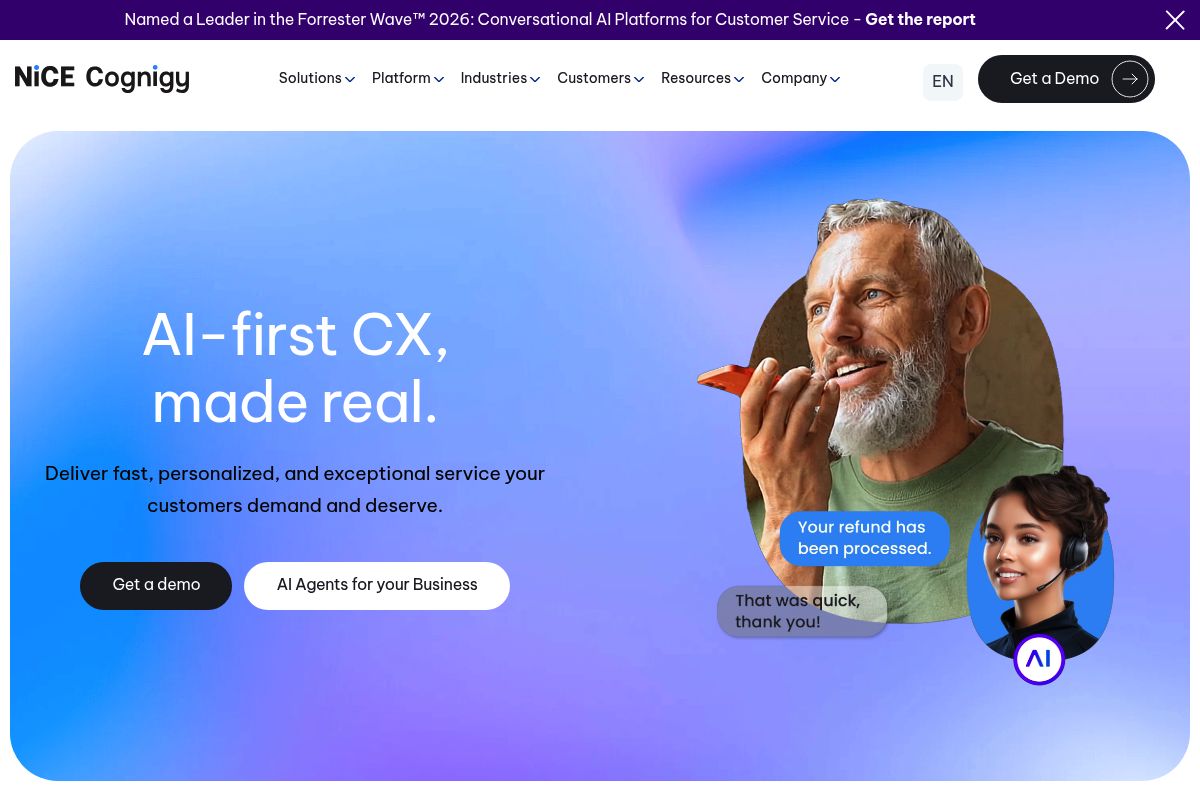
5. NiCE Cognigy — Best for Multi-Country Fortune 500 CCaaS Integration
5. NiCE Cognigy — Best for Multi-Country Fortune 500 CCaaS Integration
5. NiCE Cognigy — Best for Multi-Country Fortune 500 CCaaS Integration
NiCE Cognigy is an enterprise conversational AI platform that powers advanced voice and chat agents for large-scale contact center automation. It is specifically designed for multinational corporations that require robust security and compliance, making it a leading choice among the top Vapi AI alternatives for deployment across multiple geographies.
Formerly an independent company, Cognigy was acquired by NICE for approximately $955 million in September 2025 and now operates as NiCE Cognigy. The platform's core solution, Cognigy.AI, continues to gain industry recognition and was named a Leader in the Forrester Wave 2026 for Conversational AI Platforms for Customer Service, solidifying its position in the market.
Key Features
Compliance and Security: The platform provides robust security and compliance alignment with enterprise regulatory expectations. It adheres to major standards including SOC 2, ISO 27001, and GDPR, along with key industry regulations for financial services and healthcare, making it a strong option for HIPAA compliant AI solutions.
CCaaS Integration Ecosystem: NiCE Cognigy features the most extensive CCaaS integration ecosystem available. Contact Center as a Service (CCaaS) is a cloud-based software model that allows businesses to manage customer communications across various channels. The platform includes native support for Genesys, Avaya, Five9, Amazon Connect, Salesforce, Microsoft Dynamics, and a library of over 100 prebuilt connectors.
On-Premise and Air-Gapped Deployment: For maximum data protection, the platform offers best-in-class security with flexible on-premise deployment options. It also supports fully air-gapped environments — computer networks physically isolated from unsecured networks like the public internet.
Multi-LLM Orchestration: The platform's multi-model LLM orchestration — the process of managing multiple Large Language Models to optimize performance and cost — allows for model-agnostic enterprise deployments, which prevents dependency on a single AI provider and increases operational flexibility.
Agentic AI Architecture: NiCE Cognigy utilizes an Agentic AI architecture — a system where AI agents operate with a degree of autonomy to perform complex tasks. These AI Agents can collaborate and share contextual memory, ensuring smooth handovers between different automated tasks or to human agents. The platform also includes Agent Copilot, a transaction-ready agent assist solution for voice and chat.
Enterprise Pricing: Designed for large-scale operations, enterprise contracts for NiCE Cognigy typically start at $300,000+ per year, reflecting its comprehensive feature set and support for complex deployments.
Best For
NiCE Cognigy is a premier choice for large organizations that require on-premise or air-gapped voice AI deployment. It is best suited for teams in regulated sectors that need to deploy a single, consistent virtual agent across many countries, channels, and languages while adhering to strict security and compliance mandates. The platform is particularly ideal for organizations already integrated with the NICE CXone infrastructure, making it a top-tier solution for AI for regulated industries.
Pros and Cons
Pro: Features the broadest CCaaS integration ecosystem on the market and is ideal for existing NICE CXone users.
Pro: Provides on-premise and air-gapped deployment options to meet the most stringent data sovereignty requirements.
Pro: Recognized as a Leader in the Forrester Wave 2026 and is trusted by major global brands like Toyota, Lufthansa, and ERGO Insurance.
Con: The high total cost, which includes licensing, usage, telephony, and implementation, can quickly make the platform out of reach for most SMBs and mid-market companies.
Con: The platform presents a "blank canvas" problem, offering a flexible toolset rather than a prebuilt solution. This means users must design, build, and test the agent almost entirely from scratch, a significant challenge for teams without dedicated engineering resources.
Key Takeaway: NiCE Cognigy is a powerful, highly customizable conversational AI platform that excels in complex, multinational enterprise environments with strict security needs. Its strengths in on-premise deployment and CCaaS integration make it a top choice for regulated industries, but its high cost and significant development requirements are major barriers for smaller organizations. For mid-market teams seeking a faster path to deployment without extensive customization, no-code platforms offer a compelling alternative.
Rating: 8.4/10
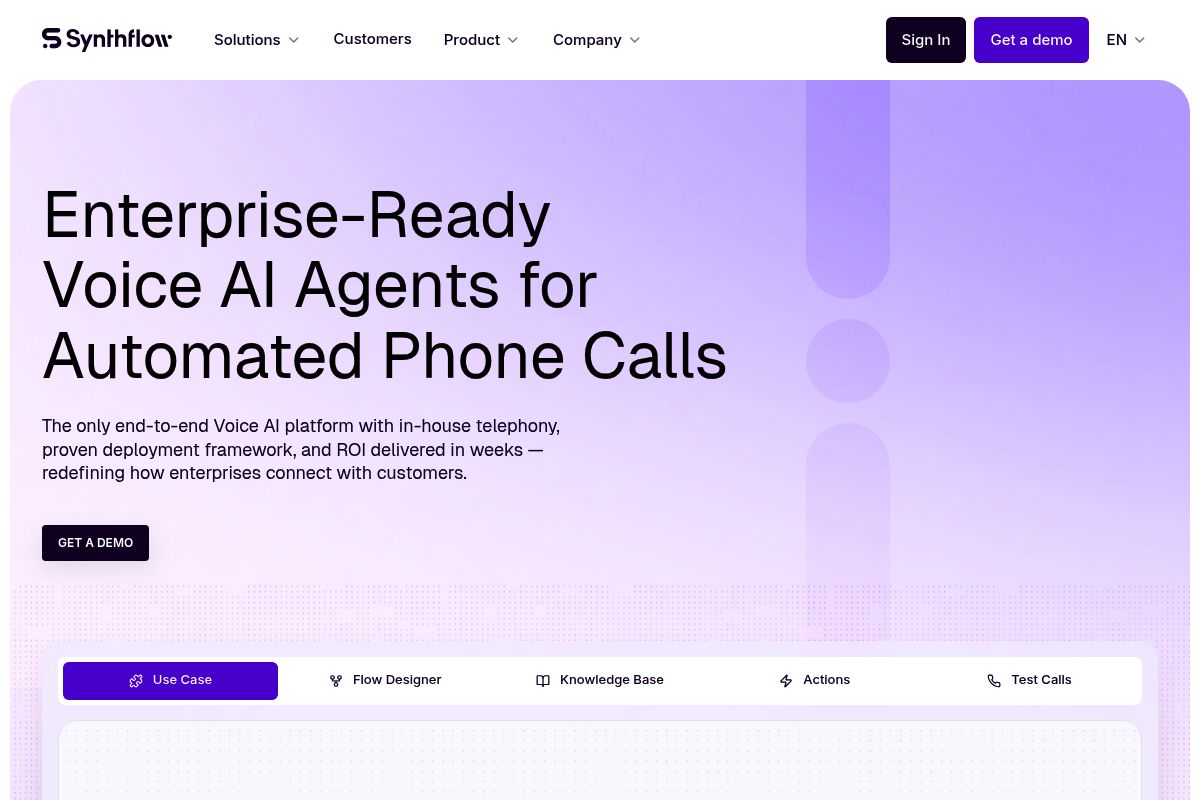
6. Synthflow AI — Best for No-Code Regulated Voice Automation at Mid-Market Scale
6. Synthflow AI — Best for No-Code Regulated Voice Automation at Mid-Market Scale
6. Synthflow AI — Best for No-Code Regulated Voice Automation at Mid-Market Scale
Synthflow AI is a no-code voice AI platform designed for non-technical business teams. It enables users to build, test, and deploy AI phone agents using a visual drag-and-drop interface, covering both inbound and outbound calls. Founded in 2023 and headquartered in Berlin, the platform integrates with over 200 CRMs and meets global compliance standards, having raised a $20M Series A in 2025.
Key Features
Compliance Stack: Synthflow AI covers most compliance needs for SMBs, agencies, and even healthcare and finance within its enterprise plan. This includes end-to-end encryption and adherence to major global standards, including SOC 2 — a security framework specifying how organizations should protect customer data. The platform also meets HIPAA (the Health Insurance Portability and Accountability Act) and GDPR (the General Data Protection Regulation) standards, and is PCI DSS ready for secure payment processing.
No-Code Visual Builder: The platform features a drag-and-drop flow designer, pre-built industry templates, and a 14-day free trial on its paid plans. These features make it one of the fastest ways to get a working voice agent in front of real callers, often without needing any developer resources.
Voice Quality: Synthflow AI's proprietary telephony network is engineered to target sub-500ms response latency, creating more natural-sounding conversations. A built-in Test Center also allows teams to simulate calls and rigorously measure agent accuracy and performance before going live.
HIPAA on Enterprise: It's critical to note that the Pay As You Go plan explicitly excludes HIPAA compliance. Healthcare organizations and any business partners handling protected health information (PHI) — any identifiable health information — must commit to the custom Enterprise pricing tier to meet regulatory requirements.
Pricing Tiers: Synthflow now operates on two tiers: pay as you go and Enterprise. The usage-based pay-as-you-go plan is free to start, making it accessible for testing and small-scale deployments, while the Enterprise plan is designed for volumes of 10,000+ minutes per month and requires custom pricing.
White-Label for Agencies: The platform offers a white-label tier — a feature where a product is rebranded by other companies. This makes it one of the few platforms that agencies can resell profitably to their own clients without needing to build a proprietary voice AI solution from scratch.
Best For
Synthflow is the go-to choice for non-technical teams who need a working voice agent fast. It is frequently used by real estate agencies, healthcare clinics, and e-commerce businesses to eliminate missed calls, automate appointment booking, and qualify leads 24/7. The pay-as-you-go plan is free to start, while the Enterprise plan with HIPAA compliance is custom-priced for organizations handling PHI.
Pros and Cons
Pro:Fastest no-code deployment in the category — live agents can be deployed in under a day
Pro:300+ AI voices with multilingual voice cloning across 30+ languages
Con: Support is offered via a ticketing system and a private Slack channel (only for the first 30 days of onboarding); some users have reported negative experiences with customer support, even on the enterprise plan.
Con: Synthflow is aimed at no-code call automation for sales and support but is not designed for regulated workflow execution beyond the call itself.
Key Takeaway: Synthflow AI excels as a no-code platform for regulated industries needing rapid deployment of AI voice agents, but businesses requiring HIPAA compliance must use the Enterprise plan and should be aware of potential customer support limitations. For contact centers needing more sophisticated Tier 1 resolution capabilities, enterprise platforms offer deeper integration and outcome-focused design.
Rating: 8.0/10
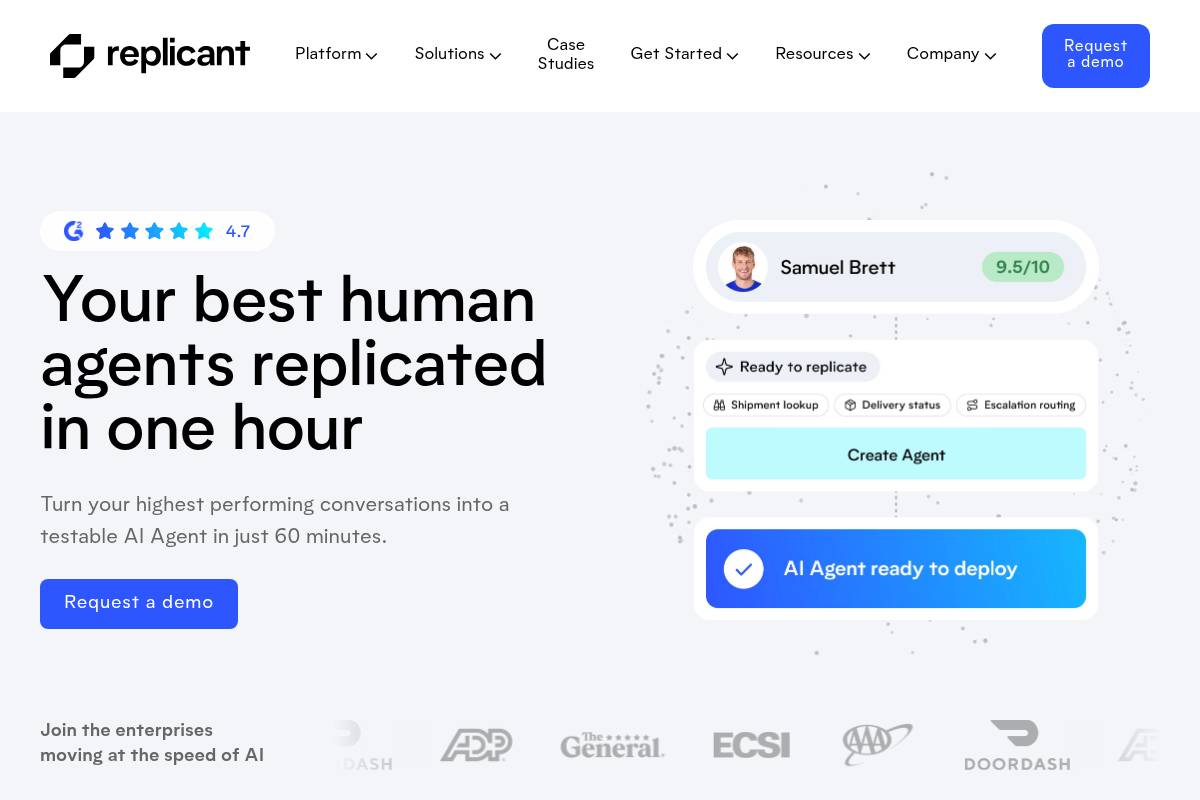
7. Replicant — A Top Vapi AI Alternative for Enterprise Contact Centers
7. Replicant — Best for Enterprise Tier 1 Contact Center Automation in Insurance and Healthcare
7. Replicant — Best for Enterprise Tier 1 Contact Center Automation in Insurance and Healthcare
Replicant is an enterprise conversational AI platform designed to automate Tier 1 customer service interactions at scale for organizations in regulated sectors like insurance and healthcare. It specializes in resolving high-volume, repetitive customer service inquiries over voice, SMS, and chat, making it a strong contender among top Vapi AI alternatives for large contact centers with dedicated IT teams.
The platform uses advanced natural language understanding to autonomously handle common customer issues, including order status checks, account authentication, and appointment scheduling changes. This focus on resolution helps organizations manage Tier 1 customer service — the first line of support responsible for handling common and straightforward customer inquiries — without needing to escalate to a human agent.
Key Features
Compliance and Security: Replicant emphasizes support for major compliance frameworks and is positioned for regulated industries. This includes SOC 2 — a framework that specifies how organizations should manage customer data — and PCI (Payment Card Industry) compliance, a set of security standards for handling credit card information. Full HIPAA and PCI compliance are features specifically unlocked at the Enterprise tier.
Enterprise-Only HIPAA Access: The platform's Enterprise tier unlocks PCI and HIPAA compliance, making it suitable for sensitive data environments. HIPAA (Health Insurance Portability and Accountability Act) is a US federal law that sets national standards to protect sensitive patient health information. This tier also includes unlimited system integrations, A/B testing for conversation flows, support for over 35 languages, and continuous workflow updates.
Resolution-Focused Design: Replicant is engineered to resolve Tier 1 issues end to end, rather than simply routing or deflecting calls. This approach is designed to significantly reduce the workload on live agents by handling common inquiries from start to finish.
Multimodal Omnichannel: The platform can seamlessly switch between talking and texting within a single interaction. This allows customers to receive links, confirmations, or other follow-up information through SMS or chat, enhancing the overall customer experience.
Managed Delivery (Replicare): Replicare is Replicant's all-inclusive delivery and support model. It operates with a flat annual fee that covers initial deployment, ongoing maintenance, and continuous optimization of the conversational AI flows.
Risk-Free Guarantee: The company offers a 100% risk-free money-back guarantee on its implementation and platform fees if key performance indicators are not met. Pricing is customized for enterprise clients, and no public rates are disclosed.
Best For
Replicant is designed for eight primary verticals: insurance, healthcare, consumer services, financial services, hospitality, retail, transportation, and home services. These industries are ideal candidates because they typically have high-volume customer service operations, repetitive inquiries, and regulatory requirements, which creates a strong automation ROI potential. The platform is best suited for large enterprise contact centers that have six-figure annual budgets and dedicated IT teams for implementation.
Pros and Cons
Pro: Its outcome-focused design is engineered to resolve customer calls end-to-end rather than simply deflecting them to other channels.
Pro: Offers a 100% risk-free money-back guarantee on implementation fees if agreed-upon key performance indicators (KPIs) are not met.
Pro: Provides support for over 35 languages at the Enterprise tier and demonstrates strong accuracy in structured, predictable call environments.
Con: Implementation timelines can be lengthy; publicly available case studies and customer reviews consistently mention implementation cycles that are measured in months, not weeks.
Con: The pricing model for Replicant is often opaque and exclusively tailored for large organizations with massive procurement budgets and complex purchasing processes.
Rating: 8.2/10
Key Takeaway: Replicant is a premium, enterprise-grade solution focused on end-to-end resolution for Tier 1 calls in regulated industries, best suited for large organizations with significant budgets and IT resources that require robust compliance features like HIPAA and PCI. For teams seeking a single-vendor platform that owns the entire communications stack and infrastructure, the next option offers a fundamentally different architecture with unique advantages.
8. Telnyx — Best for Carrier-Grade Low-Latency Voice AI with Full-Stack Ownership
8. Telnyx — Best for Carrier-Grade Low-Latency Voice AI with Full-Stack Ownership
8. Telnyx — Best for Carrier-Grade Low-Latency Voice AI with Full-Stack Ownership
Telnyx stands out among the top Vapi AI alternatives by offering a full-stack, carrier-owned communications platform. It delivers Voice AI agents through its own licensed global network and infrastructure, which eliminates the multi-vendor compliance complexity common in other solutions for regulated industries.
As a complete real-time conversational AI platform, Telnyx is engineered for teams requiring total control, ultra-low latency, and enterprise-grade reliability. By integrating everything from Natural Language Processing (NLP) to Large Language Models (LLMs) and Public Switched Telephone Network (PSTN) connectivity, Telnyx provides a single, unified platform to build, test, and deploy intelligent Voice AI Agents at scale.
Key Features
Full-Stack Infrastructure Ownership: Telnyx is the only voice AI provider that owns the entire technology stack. This includes a licensed carrier network, LLM inference co-located with the call path, and native STT (Speech-to-Text, which is the process of converting spoken language into written text) and TTS (Text-to-Speech, which is the technology that converts written text into spoken voice output).
Compliance: The platform meets rigorous compliance standards, including SOC 2 Type II, HIPAA, and PCI DSS. It also adheres to ISO and GDPR regulations, with dedicated EU-deployed infrastructure available for European customers to ensure data sovereignty.
Ultra-Low Latency: Telnyx delivers customer service voice AI at a competitive $0.05 per minute all-in, achieving sub-200ms round-trip time (RTT). This performance is backed by full SOC 2, HIPAA, GDPR, and PCI-DSS compliance and a single-vendor stack covering STT, LLM hosting, TTS, and the underlying carrier network.
Pricing Model: The pricing for Voice AI begins at a $0.05/minute base rate, which bundles STT, TTS, and LLM inference. LLM token costs are an additional charge if you utilize Telnyx-hosted models or managed OpenAI models.
Global Carrier Reach: As a carrier-owned global platform, Telnyx supports voice AI agents, SIP trunking (which is a method of sending voice and other unified communications services over the internet), programmable voice, SMS/MMS, and AI inference. This creates a single vendor for the full voice-AI stack on a Tier-1 network with presence in over 40 countries.
Audit Trail Clarity: Because one team owns the entire communication path, Telnyx provides a uniquely clear audit trail. This results in a single point of escalation and one root-cause analysis, which is a critical advantage for compliance managers in regulated industries.
Best For
Telnyx is best suited for mid-sized to enterprise teams in regulated verticals such as insurance, healthcare, and financial services. These organizations typically require carrier-grade reliability, full-stack control, and sub-200ms latency for their AI voice agent deployments. Telnyx is particularly compelling for teams that currently manage multiple vendor relationships for STT, LLM, TTS, and telephony and want to consolidate under a single, compliant provider. The platform's Voice AI pricing starts at a competitive $0.05/min base rate.
Pros and Cons
Pro: As the only carrier-owned, full-stack voice AI platform, it offers one vendor, one audit trail, and one SLA for simplified management.
Pro: Achieves consistent sub-200ms round-trip latency by leveraging a private global backbone for high-performance voice interactions.
Pro: Provides comprehensive compliance with SOC 2, HIPAA, PCI DSS, ISO, and GDPR, including dedicated EU-deployed infrastructure for data residency.
Con: Telnyx is not a drag-and-drop tool; it is built for technical teams that want deep control. Users must set up functions and routing themselves, and some integrations require light backend work, meaning non-technical users may face a more complex setup.
Con: The pricing model is similar to a utility bill — cheap per unit and flexible, but can be hard to forecast in practice for teams unfamiliar with modular infrastructure pricing.
Key Takeaway: Telnyx is the ideal choice for regulated industries needing a single, compliant, carrier-grade provider for their entire voice AI stack, offering unparalleled control and low latency by owning the network, infrastructure, and AI inference layer. For product and design teams focused on building sophisticated multi-channel experiences, collaborative platforms offer a different set of capabilities.
Rating: 8.1/10
9. Voiceflow — Best for Product Teams Designing Multi-Channel Conversational AI
9. Voiceflow — Best for Product Teams Designing Multi-Channel Conversational AI
9. Voiceflow — Best for Product Teams Designing Multi-Channel Conversational AI
Voiceflow is a collaborative low-code platform for designing, prototyping, and deploying conversational AI agents across both voice and chat channels. It is primarily used by product and UX teams to build sophisticated chat and voice interfaces, evolving from its origins as a tool for creating skills for Amazon Alexa and Google Assistant.
Key Features
Security and Compliance: Voiceflow provides enterprise-grade security with ISO/IEC 27001:2022, SOC-2, and GDPR compliance, protecting customer data on a high-performance platform. These certifications ensure adherence to international standards for information security management and data protection. HIPAA compliance and private cloud hosting are available exclusively on the Enterprise plan for healthcare applications.
Visual Canvas Builder: The platform features a best-in-class drag-and-drop conversation designer with reusable components and rapid prototyping. It also includes multi-LLM routing — a feature that allows the system to dynamically select the best Large Language Model (LLM) for a given task — and is compatible with models like GPT-4, Claude, Gemini, Llama, and custom models.
Collaboration Tools: Its high reliability and modular architecture are built to support large deployments and cross-team collaboration, making it suitable for complex projects, even in highly regulated industries.
Pricing Structure: Voiceflow offers four pricing plans: Starter (free for experimentation), Pro ($60/month), Business ($150/month), and Enterprise with custom solutions. Each plan includes only one editor seat, and additional editors cost $50/month each.
Credit-Based Usage: The platform's credit system is a key consideration, as voice applications consume credits far faster than text-based ones. For example, a multi-language IVR (Interactive Voice Response) system handling 50,000 call minutes monthly would require approximately 619,948 credits, which is more than six times the limit of the highest self-serve tier.
Integration Ecosystem: A robust API integration connects workflows to CRMs, databases, webhooks, and other essential business applications. This ecosystem includes native support for popular platforms such as Salesforce, Shopify, Zendesk, and Snowflake.
Best For
Voiceflow is ideal for product teams, UX designers, and agencies that require a powerful visual conversation design platform for building multi-channel AI agents. Its emphasis on collaborative design and prototyping makes it one of the top Vapi AI alternatives for teams focused on user experience.
For large organizations in regulated industries like finance, healthcare, or logistics, the Enterprise plan offers greater control, enhanced performance, and premium support. This plan is essential for achieving HIPAA compliance or utilizing private cloud hosting, with costs typically ranging from $1,000 to $2,000 per month based on usage volume, while the Pro plan starts at a more accessible $60/month.
Pros and Cons
Pro: Best-in-class visual canvas for designing complex conversational flows without heavy coding
Pro: ISO 27001, SOC 2, and GDPR compliance; Enterprise plan includes private cloud hosting for enhanced security
Pro: Model-agnostic architecture — supports any major LLM without vendor lock-in
Con: All plans retain chat and call transcripts for only six months, which can be restrictive for compliance-heavy teams
Con: Voiceflow's pricing doesn't include separate third-party call costs from services like Twilio or Vonage, which usually add $0.01–$0.03 per minute
Key Takeaway: Voiceflow excels as a visual, collaborative platform for product teams building complex, multi-channel AI agents, but its credit-based pricing and separate third-party call costs must be carefully evaluated for high-volume voice applications. For agencies and service providers managing multiple client relationships, specialized enterprise tiers offer streamlined multi-tenant capabilities.
Rating: 7.5/10
10. Replicant Starter / Voiceflow Enterprise — Best for Agencies Managing Multiple Regulated Clients
10. Replicant Starter / Voiceflow Enterprise — Best for Agencies Managing Multiple Regulated Clients
10. Replicant Starter / Voiceflow Enterprise — Best for Agencies Managing Multiple Regulated Clients
Among the top Vapi AI alternatives for agencies, Voiceflow's Enterprise plan and Synthflow's agency tier provide a powerful hybrid solution for managing multiple regulated clients. These platforms are designed for service providers who need robust multi-client workspace management, white-labeling capabilities, and configurable compliance controls. They effectively merge the flexibility of visual agent-building with the stringent enterprise governance features that clients in sectors like healthcare and finance demand.
Key Features
White-Label Capabilities: Both platforms offer extensive white-labeling — a practice where an agency rebrands the platform's service to make it appear as their own. This allows agencies to deploy compliant AI voice experiences under their own brand name for clients in healthcare, insurance, or financial services, supported by multi-client workspace management tools.
Compliance Controls: Enterprise plans include critical governance features such as private cloud or dedicated hosting, Single Sign-On (SSO) for secure user authentication, and role-based access control. They also offer HIPAA-eligible configurations — setups designed to meet the strict data privacy and security standards required by the Health Insurance Portability and Accountability Act for regulated client deployments.
Multi-Client Dashboard: A centralized dashboard simplifies operations with features like unified billing, client handoff tools, and usage analytics across all accounts. This is essential for streamlining management for agencies handling a diverse portfolio of regulated-

 Kolsetu