AI Voice Agents Pricing Comparison 2026: Secure Solutions
Discover the ultimate AI Voice Agents Pricing Comparison 2026: Secure Solutions to help healthcare and finance professionals choose the best secure options.
Last Updated: June 2026 | Author: Editorial Team | Tools Tested: 10 AI voice agent platforms evaluated across compliance posture, pricing transparency, deployment speed, and regulated-industry fit.
TL;DR: AI Voice Agents Pricing Comparison 2026: Secure Solutions at a Glance
Selecting the right compliant AI voice agent in 2026 demands a clear view of true costs, security certifications, and deployment realities. This AI Voice Agents Pricing Comparison 2026: Secure Solutions table distills our top picks so regulated-industry teams can prioritize quickly.
Rank
Tool
Best For
Starting Price
Rating
1
Kolsetu Elba
Regulated enterprises needing omnichannel, ISO 27001-certified AI workflows
Custom (contact sales)
9.5/10
2
PolyAI
Large-scale enterprise contact centers in finance, healthcare, and hospitality
~$150,000/year (custom)
9.0/10
3
NiCE Cognigy
Fortune 500 companies needing multi-channel contact center AI with deep compliance
~$300,000+/year (custom)
8.8/10
4
Kore.ai
Global enterprises in banking, healthcare, and insurance requiring multi-agent orchestration
~$300,000/year (enterprise)
8.5/10
5
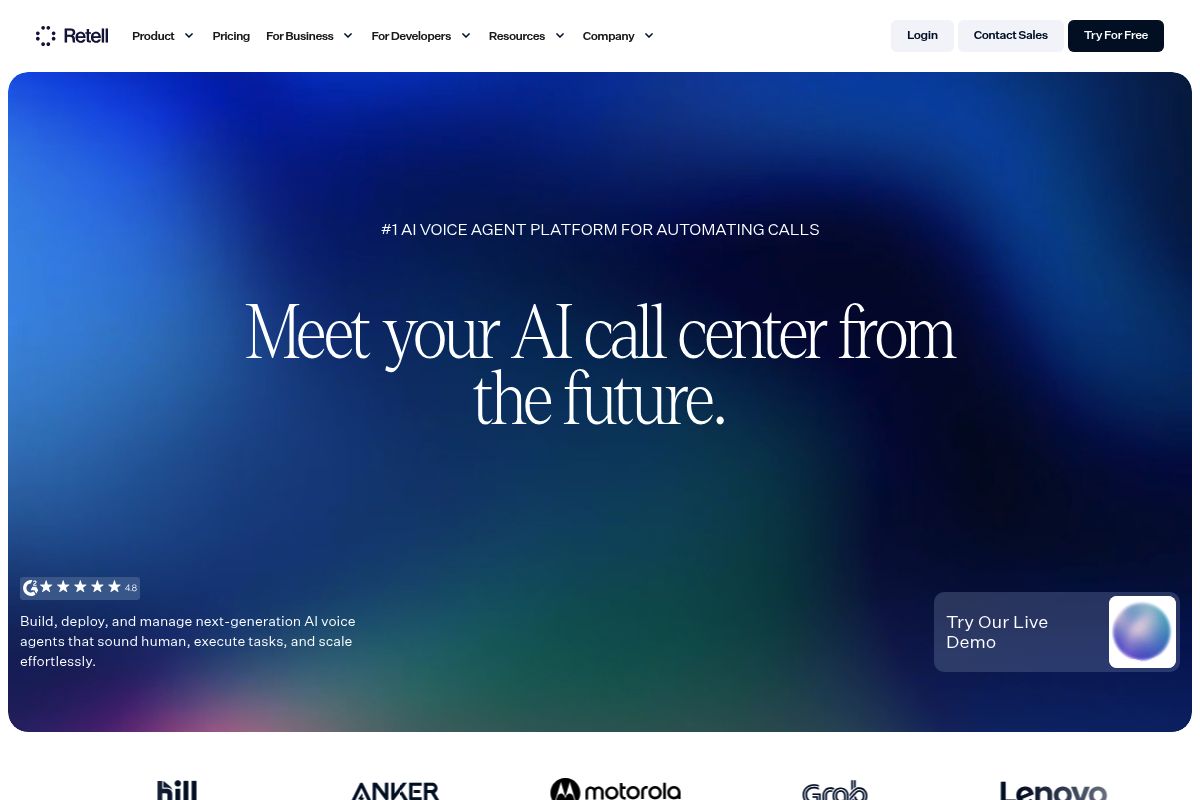
Retell AI
Production-scale businesses needing low-latency, HIPAA-ready voice agents with transparent pricing
$0.07/min (pay-as-you-go)
8.3/10
6
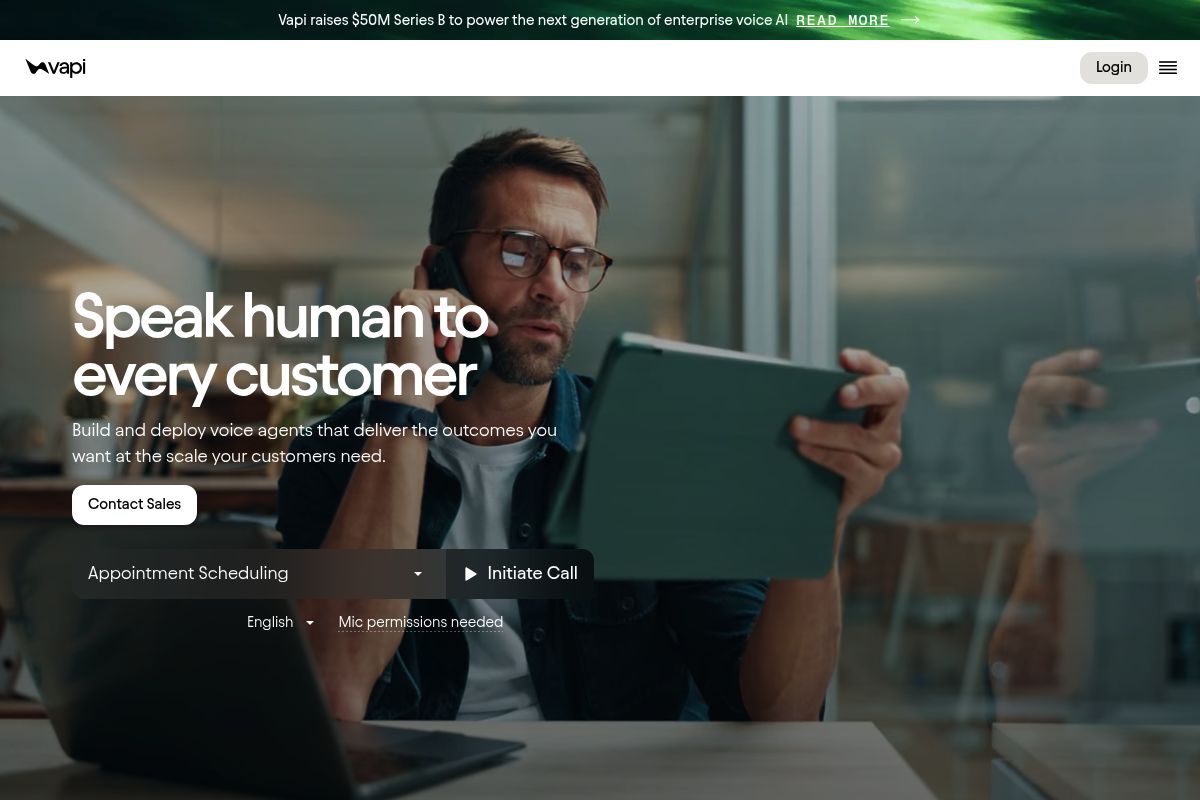
Vapi
Developer teams building custom voice stacks with maximum API control
$0.05/min platform fee
8.0/10
7
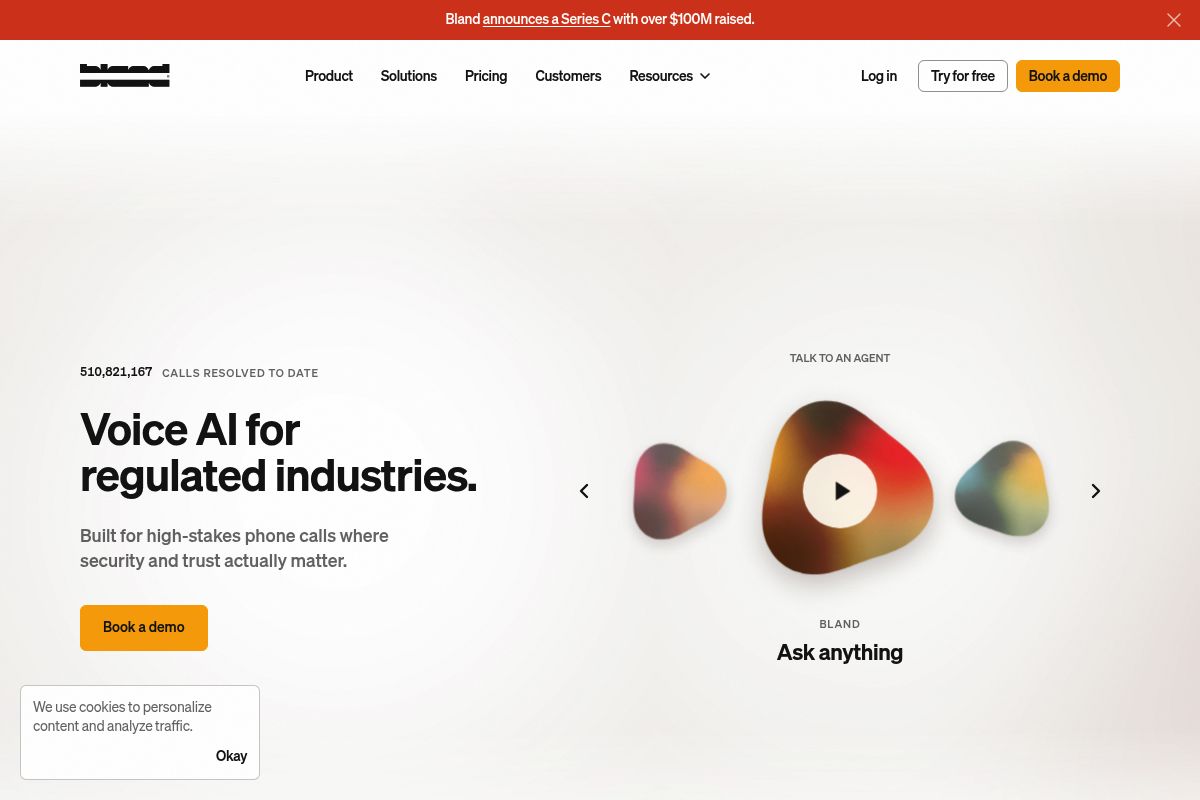
Bland AI
High-volume outbound call automation for developer-led teams
$0.09/min; Build plan from $299/month
7.8/10
8
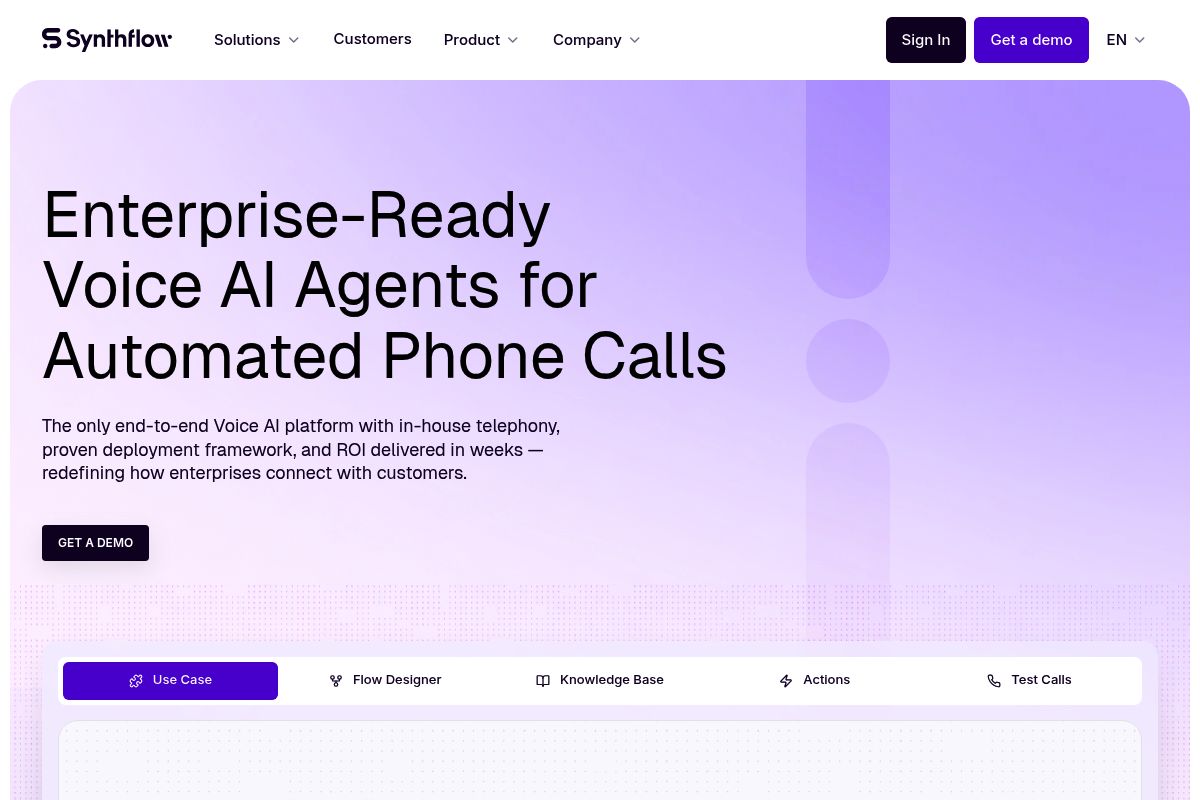
Synthflow AI
No-code voice automation for agencies and mid-market businesses
From $99/month (tiered)
7.5/10
9
ElevenLabs Conversational AI
Brands prioritizing ultra-realistic voice quality with multilingual agents
From $22/month; $0.08/min overage
7.3/10
10
Kore.ai XO Platform (Self-Serve)
Mid-market teams entering enterprise AI with pay-as-you-go conversation sessions
$500 free credits; $100 min. purchase
7.0/10
Our #1 pick is Kolsetu Elba — the only platform in this list purpose-built for regulated enterprise workflows with ISO 27001 certification, EU data residency, and true omnichannel execution across voice, WhatsApp, SMS, and email in a single persistent session. For a more detailed primer, see AI Voice Agent Pricing in 2026: Cost Breakdown, ....
Why You Need Compliant AI Voice Agents in 2026
An AI voice agent is software that uses speech recognition and generative AI to conduct live phone conversations, understand natural language, and respond conversationally — replacing rigid IVR menu trees with intelligent, multi-turn dialogue. In 2026, these systems are no longer futuristic novelties. They've become operational infrastructure for businesses of all sizes, handling everything from customer support and sales follow-ups to appointment scheduling and lead qualification with a level of responsiveness that traditional phone systems simply cannot match.
For healthcare providers, financial services companies, insurance firms, and other regulated organizations, the stakes are uniquely high. Every phone conversation captures personally identifiable information (PII), biometric signals, and often protected health information — all in a single audio stream. Deploying AI voice agents without robust compliance controls isn't just a technical risk; it's a legal and reputational one. By early 2026, 84% of organizations admitted they could not pass an AI agent compliance audit, and one U.S. company received an €85 million fine for improper AI data handling.
The financial case for AI automation is equally compelling. The average inbound call costs $7.16 when handled by a human agent, agent turnover sits at 30–45% annually, and Gartner projects conversational AI will cut contact center labor costs by $80 billion in 2026. AI voice agent costs typically range between $0.05 and $0.15 per minute on usage-based platforms, and for moderate usage of 5,000–10,000 minutes per month, businesses can expect to pay between $350 and $1,200 monthly — a fraction of equivalent human staffing costs. The critical challenge for compliance managers and IT leaders in regulated sectors is selecting platforms where operational efficiency and data security are not competing priorities but unified ones. Understanding these tradeoffs requires looking at how vendors actually evaluate and structure their offerings. For supporting market data, see AI Voice Agent Pricing in 2026: Cost Breakdown, ....
How We Evaluated These AI Voice Agent Platforms
Our editorial team assessed each platform against the criteria most relevant to regulated-industry buyers in the United States. Pricing data was sourced from official product pages, third-party analyses, and vendor documentation as of June 2026.
Evaluation Criterion
Weight
What We Assessed
Compliance and Security Posture
30%
HIPAA, GDPR, SOC 2, ISO 27001, PCI DSS certifications; data residency options; audit trails
Pricing Transparency and True Cost
25%
Published pricing vs. all-in cost including STT, LLM, TTS, telephony, and compliance add-ons
Regulated Industry Fit
20%
Depth of healthcare, financial services, and insurance use-case support
This framework allowed us to move beyond headline pricing and assess the real operational fit for each organization type. Let's examine each platform starting with our top choice. For industry-standard evaluation frameworks, see AI Voice Agent Services for Business: A 2026 Guide.
1. Kolsetu Elba — Best for Regulated Enterprise Omnichannel AI Workflows
1. Kolsetu Elba — Best for Regulated Enterprise Omnichannel AI Workflows
1. Kolsetu Elba — Best for Regulated Enterprise Omnichannel AI Workflows
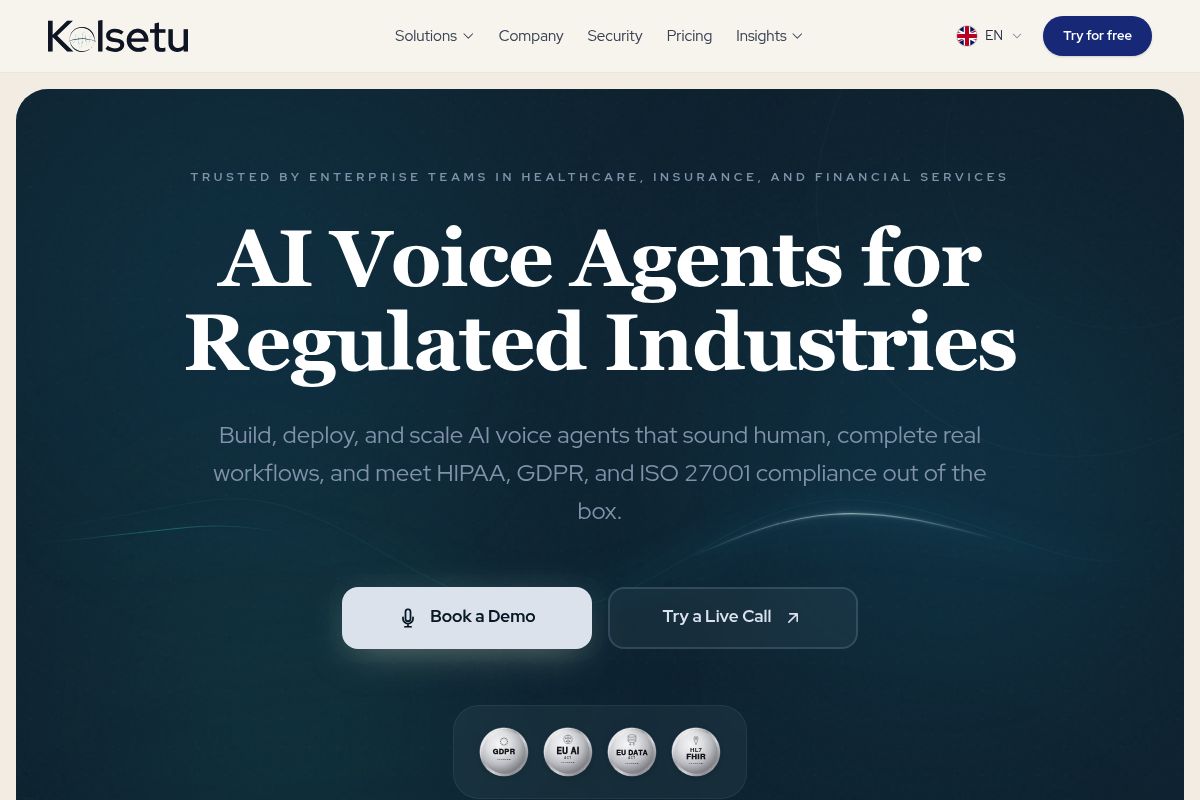
Kolsetu Elba is an AI-powered agentic workforce platform designed for regulated industries like healthcare, finance, and insurance. It enables businesses to deploy secure voice, messaging, and multi-channel AI agents that handle sensitive customer interactions and automate complex, compliance-driven workflows at scale.
Developed by Kolsetu GmbH, the platform operates across multiple cloud providers and regions, specifically serving enterprises where standards for security, data residency, and compliance are non-negotiable. Unlike other solutions, Kolsetu Elba was engineered from the ground up to embed data privacy and operational governance into its core architecture, ensuring that security is a foundational element rather than an add-on.
Key Features
ISO 27001 Certified and GDPR-First Infrastructure: The platform is ISO 27001 certified and GDPR compliant, with a design that is ready for both DORA (the Digital Operational Resilience Act) and NIS2 (the second Network and Information Security Directive). This ensures all customer data remains securely within your chosen geographical region.
True Omnichannel Persistent Sessions: Elba supports voice, WhatsApp, SMS, email, and web chat within a single, unified workflow. This creates a single persistent session where no context is lost, even if a customer switches communication channels mid-interaction.
Compliant Workflow Execution: Instead of only managing conversations, Elba functions as an agentic, omnichannel orchestration layer. An agentic layer is a system where AI agents can autonomously execute multi-step tasks. Elba translates customer requests from any channel into complex workflows that are executed across enterprise systems, retrieving data, interacting with applications, and completing processes entirely within strict governance boundaries.
100+ Language Support: The platform supports communication in over 100 languages and runs on ISO 27001-certified infrastructure. This capability allows for rapid deployment, with go-live timelines measured in weeks, not months.
Managed Deployment Team: Kolsetu provides a hands-on service that maps your specific regulated workflows, data sources, and operational handoffs. The team configures playbooks, integrates systems, and runs simulations with full audit logging before executing a controlled rollout with continuous monitoring and refinement to ensure performance targets are met.
EU AI Act and DORA Alignment: The platform guarantees EU data residency and is built for forward-looking compliance. It maintains ISO 27001 certification and GDPR compliance while being architected for alignment with emerging regulations like the EU AI Act, DORA, and NIS2.
Audit-Ready Controls: Every Kolsetu Elba deployment includes audit-ready controls, comprehensive documented policies, and continuous monitoring as standard features, not as optional, premium add-ons.
Regulated Industry Focus: Kolsetu specializes in serving emergency assistance providers, insurers, healthcare organizations, and financial institutions. The platform includes dedicated, pre-built use-case playbooks tailored to the unique compliance and operational needs of each sector.
Key Takeaway: Kolsetu Elba is a comprehensive, managed AI workforce platform that prioritizes security, compliance, and omnichannel workflow execution for regulated industries, making it a strong contender in any analysis of secure AI voice solutions.
Best For
Kolsetu Elba is ideal for healthcare providers, financial services companies, insurance firms, and compliance managers seeking secure AI automation where data privacy and regulatory standards are paramount. It is particularly well-suited for organizations requiring EU data residency, true cross-channel workflow execution, and a managed delivery team that ensures a go-live within weeks. When conducting an AI Voice Agents Pricing Comparison 2026: Secure Solutions evaluation, it's important to note that its pricing is custom and enterprise-scoped; contact Kolsetu for a tailored proposal based on workflow complexity and compliance needs.
Pros and Cons
Pro: It is the only platform in this list that combines ISO 27001, DORA, NIS2, and GDPR data residency within a single, fully managed solution.
Pro: The platform maintains a single persistent session across voice, WhatsApp, SMS, and email, eliminating customer friction and context loss when switching channels.
Pro: A dedicated managed delivery team handles the entire implementation process from scoping to go-live, significantly reducing the burden on internal engineering resources.
Pro: Its pre-built industry playbooks for healthcare, insurance, and financial services help accelerate internal compliance reviews and speed up deployment.
Con: The custom enterprise pricing model requires a direct sales engagement, as there is no self-serve trial or publicly available rate card.
Con: Achieving optimal results necessitates a structured onboarding process of 2–6 weeks, which may not be suitable for teams facing an immediate deployment deadline.
Rating: 9.5/10 PolyAI takes a different approach, focusing on voice-first design and managed service delivery at enterprise scale.
2. PolyAI — Best for Large Enterprise Inbound Call Automation at Scale
2. PolyAI — Best for Large Enterprise Inbound Call Automation at Scale
2. PolyAI — Best for Large Enterprise Inbound Call Automation at Scale
PolyAI is a voice-first conversational AI platform designed for large enterprises in regulated industries like finance and healthcare that manage millions of inbound calls. It provides sophisticated voice assistants capable of handling complex customer service interactions, offering a scalable solution for high-volume call automation.
Launched from London in 2017, the company focused on building conversational AI for real customer service calls, betting on voice-first design when most competitors chased text-based solutions. This strategic choice proved successful, as PolyAI closed an $86 million Series D in December 2025, pushing its total funding past $200 million and valuing the company at $750 million.
Key Features
Enterprise-Grade Voice Quality: PolyAI operates over 2,000 live voice AI deployments across 45 languages in 25+ countries — the largest enterprise voice AI footprint of any company in its category.
Agent Studio Platform: PolyAI Agent Studio is the company's core enterprise platform combining proprietary voice models with tools for fine-grained agent control, self-service configuration, and real-time optimization. The platform includes features for conversation testing, tone and lexicon adjustment, and built-in analytics, making its AI voice agents transparent and controllable.
Compliance Posture: PolyAI meets baseline compliance for regulated industries. The platform is SOC 2 Type II certified, which is a report on controls at a service organization relevant to security and privacy, and also holds an ISO 27001 certification for information security management. It supports HIPAA for healthcare deployments and follows GDPR data standards with encryption for all data in transit and at rest.
Managed Service Model: Unlike self-serve voice AI tools, PolyAI operates as a managed service provider. Their team designs and deploys custom agents, integrating them into Contact Center as a Service (CCaaS) platforms, which are cloud-based solutions for managing customer interactions across multiple channels. This includes integration with major systems like Genesys or Salesforce Service Cloud and managing performance after launch.
Proven Enterprise ROI: The value of PolyAI's approach is quantified in a Forrester Total Economic Impact study, which found that customers achieve an average 391% ROI and $10.3 million in average savings per deployment.
Multilingual Support: The platform offers native support for 24+ languages with regional dialect tuning available for global deployments.
Best For
According to Kolsetu Elba's analysis for this AI Voice Agents Pricing Comparison 2026: Secure Solutions review, PolyAI is an excellent choice for massive enterprises fielding millions of calls. Contracts start at approximately $150,000 per year, making it inaccessible for mid-market organizations but a strong investment for enterprises in banking, insurance, and healthcare where high containment rates translate directly to significant labor cost savings.
Pros and Cons
Pro: Industry-leading voice realism optimized for noisy, high-traffic environments
Pro:Managed deployment removes engineering burden; full support from design through go-live
Pro: Deep integrations with enterprise contact center platforms like Genesys and Salesforce
Con: Deployments typically start at $150,000/year with no SMB or growth-stage path available
Con:No self-service trial; no analytics dashboard access without going through a sales engagement
Key Takeaway: PolyAI is a premium, managed service for large-scale enterprise voice automation, prioritizing high-quality, compliant interactions over self-service accessibility, making it a strong but costly choice for regulated industries. NiCE Cognigy offers another enterprise path, one that emphasizes multi-channel orchestration and Fortune 500 scale.
3. NiCE Cognigy — Best for Multi-Channel Fortune 500 Contact Center Automation
3. NiCE Cognigy — Best for Multi-Channel Fortune 500 Contact Center Automation
3. NiCE Cognigy — Best for Multi-Channel Fortune 500 Contact Center Automation
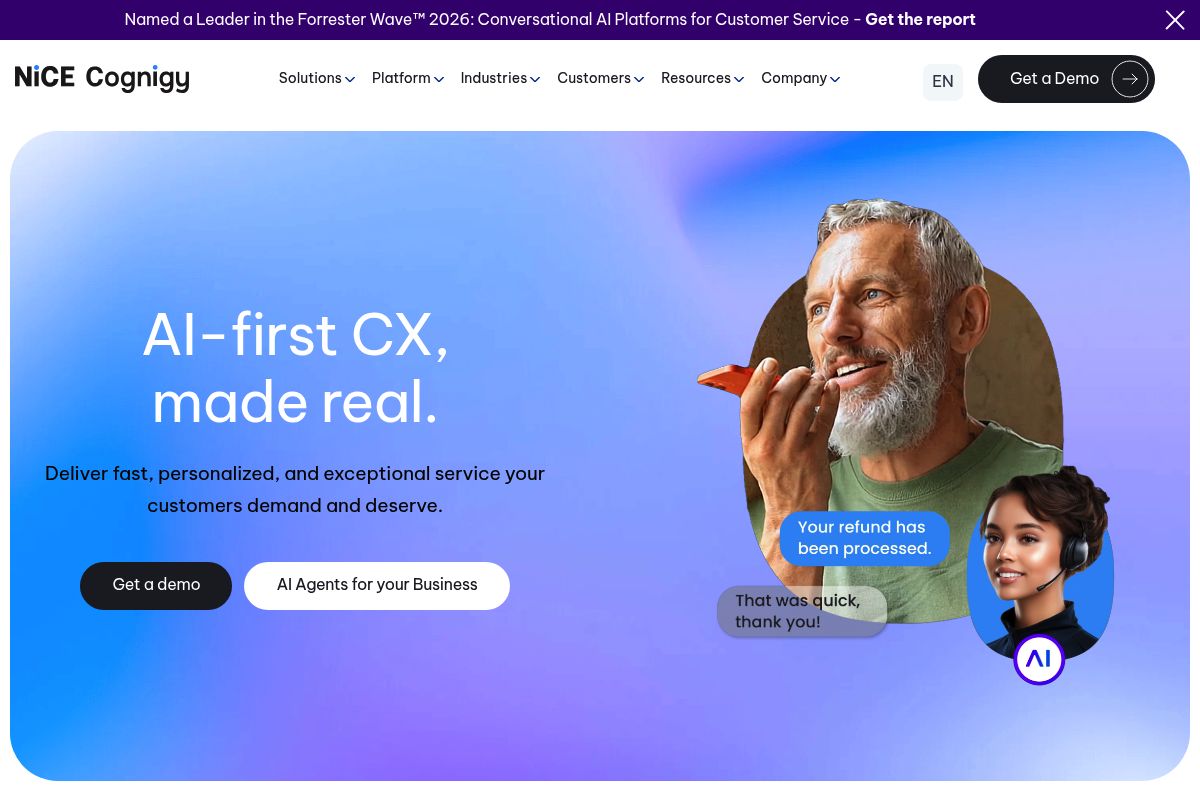
NiCE Cognigy is an enterprise conversational AI platform that powers advanced voice and chat agents for large-scale contact center automation. It serves as the core conversational and agentic AI layer within NICE's comprehensive CXone platform, supporting customer-facing channels for over 1,250 global brands.
Formerly an independent company named Cognigy, it was acquired by NICE for approximately $955 million in September 2025. Now operating as NiCE Cognigy, the platform aims to transform the customer service industry with its award-winning solution, Cognigy.AI. It empowers enterprises to deliver instant, hyper-personalized service by integrating Generative and Conversational AI to create Agentic AI, which is a type of artificial intelligence designed to proactively take actions and make decisions to achieve complex goals on behalf of a user.
Key Features
Compliance and Security: The platform offers robust security and compliance alignment with enterprise regulatory expectations, including SOC 2, ISO 27001, GDPR, and key industry regulations for financial services and healthcare.
Deep Enterprise Integrations: NiCE Cognigy can connect to complex, legacy enterprise systems and custom internal tools through a flexible framework of APIs, SDKs, and pre-built connectors.
Omnichannel Orchestration: It features one visual builder for designing, managing, and deploying chatbots, voicebots, and other conversational touchpoints in a unified, consistent way across all channels.
Multi-Model LLM Support: The platform provides multi-model LLM orchestration, giving enterprises the flexibility to use leading vendors such as Amazon Bedrock, OpenAI, Azure OpenAI, Anthropic, Cohere, Google, and Aleph Alpha without vendor lock-in.
100+ Pre-Built Integrations: Users can deploy pre-trained Agentic AI Agents with industry-specific skills and common service processes that can speak over 100 languages across more than 30 voice and digital channels, leveraging over 100 prebuilt integrations.
Best For
Cognigy performs best in very large, complex customer operations with stringent compliance requirements and the need for global scale. Enterprise contracts typically start at $300,000+ per year, a significant factor in any AI Voice Agents Pricing Comparison 2026: Secure Solutions. As noted by analysts at Kolsetu Elba, teams already deployed on the NICE CXone platform will benefit most from the combined offering, as it tightens the integration between agent copilot, knowledge AI, and voice automation under a single vendor relationship.
Pros and Cons
Pro: Named a Leader in Gartner's 2025 Magic Quadrant for Conversational AI; trusted by major brands like Toyota, Lufthansa, and ERGO Insurance.
Pro: Offers best-in-class security with flexible on-premise deployment options and support for fully air-gapped environments for maximum data protection.
Pro: The multi-model LLM orchestration allows for model-agnostic enterprise deployments, preventing dependency on a single AI provider.
Con: Real-world deployments often take 3 to 6 months before going live at scale, especially when multiple legacy systems and internal teams are involved in the integration process.
Con: The combined costs of licensing, usage, telephony, and implementation services can quickly put Cognigy out of reach for most SMBs and mid-market companies.
Rating: 8.8/10
Key Takeaway: NiCE Cognigy is a premium, security-focused conversational AI platform ideal for large enterprises, particularly those in regulated industries or already using the NICE CXone ecosystem, but its high cost and long implementation time make it unsuitable for smaller businesses. Kore.ai provides an alternative path for enterprises needing specialized multi-agent orchestration capabilities.
4. Kore.ai — Best for Banking, Insurance, and Healthcare Multi-Agent Orchestration
4. Kore.ai — Best for Banking, Insurance, and Healthcare Multi-Agent Orchestration
4. Kore.ai — Best for Banking, Insurance, and Healthcare Multi-Agent Orchestration
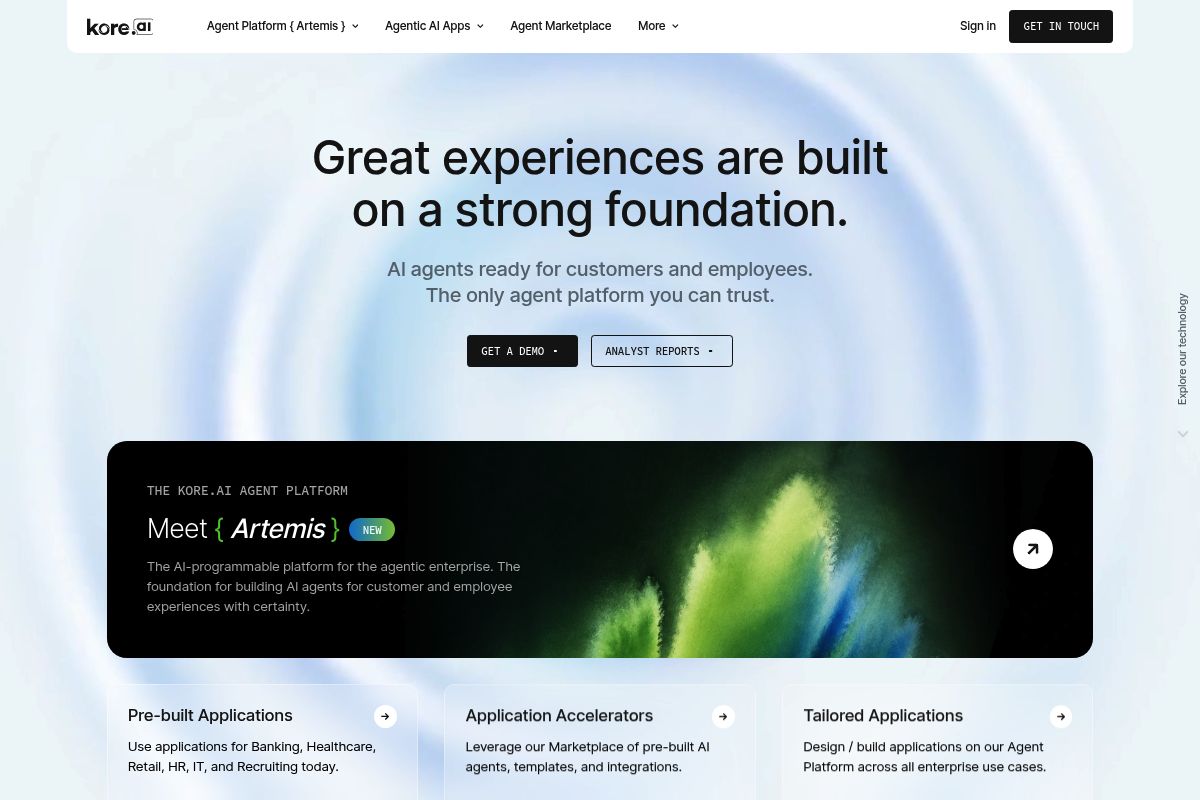
Kore.ai is an enterprise agentic AI platform designed specifically for deploying secure and compliant AI agents in highly regulated industries like banking, healthcare, and insurance. An agentic AI platform is a system that allows developers to build, manage, and deploy autonomous AI agents that can perform complex tasks. Kore.ai enables large organizations such as Morgan Stanley, Pfizer, and Deutsche Bank to embed these agents into critical workflows at scale, addressing complex decisioning and operational needs.
Key Features
Compliance and Governance: The platform is built with enterprise-grade security, role-based access controls, full audit trails, and configurable guardrails. This ensures AI agents operate within defined risk, regulatory, and policy constraints, maintaining compliance across critical workflows like Know Your Customer (KYC), Anti-Money Laundering (AML), lending, and insurance reporting.
Multi-Agent Orchestration: Multi-agent orchestration is a framework where multiple specialized AI agents collaborate on complex tasks using a shared memory and context. For example, a single customer inquiry might involve separate, coordinated agents for authentication, account lookup, and final resolution, all managed seamlessly by the platform.
100+ Pre-Built Connectors: The platform features Agentic Retrieval-Augmented Generation (RAG), a process that connects AI agents to enterprise knowledge bases to retrieve and use up-to-date, contextually relevant information. This capability is supported by over 100 pre-built connectors to systems like Salesforce, SAP, SharePoint, Slack, Confluence, and Google Drive.
Industry-Specific Pre-Built Agents: Kore.ai provides industry-specific solutions that accelerate deployment for banking, healthcare, and retail. These pre-built agents include pre-trained intents and compliance-ready configurations tailored to the unique needs of each vertical.
Everest Group Recognition: In a competitive assessment of 26 customer experience management providers, Everest Group named Kore.ai a Leader. The recognition highlights the platform's ability to support complex, multi-step customer interactions through its advanced AI agents, robust orchestration capabilities, and deep enterprise integrations.
Best For
Kore.ai is purpose-built for large enterprises that need to deploy AI agents at scale across multiple departments, channels, and languages. As noted in this Kolsetu Elba analysis, organizations in financial services, healthcare, and large-scale retail with complex customer service operations will derive the most value. For businesses reviewing our AI Voice Agents Pricing Comparison 2026: Secure Solutions guide, it's important to note that enterprise deals typically start at approximately $300,000 per year, though a pay-as-you-go Standard plan with $500 in free credits is available for initial team evaluations.
Pros and Cons
Pro: Possesses the deepest regulated-industry pre-built agent library of any platform featured in this comparison, accelerating time-to-value.
Pro: The multi-agent orchestration feature enables complex, compliance-critical workflows that are often beyond the capabilities of single-agent systems.
Pro:Recognized as a leader by both Gartner and Forrester, with a strong track record of proven, large-scale enterprise deployments.
Con: Its session-based billing creates unpredictable costs for high-engagement use cases. For example, a 31-minute conversation consumes three separate billing units, and organizations with complex interactions report that actual costs can run 40–60% higher than initial estimates.
Con: There is no public pricing available, and an extensive, multi-step sales process is required before a meaningful evaluation can begin.
Key Takeaway: Kore.ai is the leading choice for large, regulated enterprises that prioritize compliance, security, and the ability to orchestrate multiple specialized AI agents for complex, mission-critical workflows. For organizations focused on transparent pricing and faster deployment, Retell AI offers a different approach.
Rating: 8.5/10
5. Retell AI — Best for Production-Scale HIPAA-Ready Voice Agents with Transparent Pricing
5. Retell AI — Best for Production-Scale HIPAA-Ready Voice Agents with Transparent Pricing
5. Retell AI — Best for Production-Scale HIPAA-Ready Voice Agents with Transparent Pricing
Retell AI is an LLM-powered voice agent platform, which is a system that uses large language models to automate conversations, designed for businesses needing production-scale inbound and outbound call automation. It provides clear, usage-based pricing and incorporates enterprise compliance features from its initial design, making it a strong contender in the market for compliant AI voice solutions.
The platform's accessible self-serve compliance posture has contributed to its rapid adoption, as it now powers over 50 million real-time AI phone calls every month for a diverse client base of more than 3,000 businesses.
For organizations in regulated industries, Retell AI offers robust security assurances. The platform is HIPAA compliant, GDPR compliant, and SOC 2 Type 1 and Type 2 certified, where SOC 2 is an auditing procedure that ensures service providers securely manage data to protect the interests of their clients and the privacy of their information.
Key Features
Transparent Per-Minute Pricing: The platform pricing is $0.07 per minute usage-based, without a mandatory base subscription. Healthcare teams can add HIPAA/BAA coverage on any plan, ensuring a predictable AI voice agent cost in 2026 and beyond.
Self-Serve HIPAA Compliance: HIPAA compliance is not gated to enterprise plans; every Retell account, including pay-as-you-go, can operate as a HIPAA-eligible workload once a BAA is in place. A BAA, or Business Associate Agreement, is a required contract under US health law, and Retell's BAA is self-serve: request it from the dashboard, sign it electronically, and start handling PHI.
Low Latency: Latency is measured consistently at 580–620ms across 200+ test calls, which is below the typical threshold where human callers begin to notice they are speaking with an AI system rather than a person.
No-Code and API Access: The platform caters to a wide range of users by offering both a visual drag-and-drop builder for non-technical teams and deep API access for developers who require custom integrations for AI automation for regulated industries.
Retell Assure QA: Retell Assure QA is a built-in quality assurance tool that monitors 100% of calls automatically. It flags failures, assigns performance scores, and provides remediation recommendations, which is a critical feature for maintaining compliance audit readiness.
Multiple LLM and Voice Options: The platform supports a flexible architecture that combines your choice of LLM with high-quality voices from providers like ElevenLabs v3, OpenAI, Cartesia, or PlayHT. Its proprietary turn-taking model is designed to handle interruptions without breaking the conversation flow, creating a more natural interaction.
Best For
As highlighted in this Kolsetu Elba analysis, Retell AI is ideal for healthcare operators, financial services firms, and compliance-focused operations teams that need production-grade AI voice agents quickly without large upfront contracts. At $0.07/min with self-serve HIPAA compliance and no platform fees, Retell offers the lowest true all-in cost for regulated-industry teams at moderate call volumes. This makes it a go-to choice in our AI Voice Agents Pricing Comparison 2026: Secure Solutions for organizations that want enterprise-grade compliance without a six-figure commitment.
Pros and Cons
Pro: Most transparent pricing model in this list for regulated-industry teams; HIPAA BAA available on pay-as-you-go
Pro:100% call monitoring via Retell Assure supports compliance audit trails
Pro: Fast time to production — live agents in under an hour for experienced users
Con: Retell AI sits in the group of US-headquartered platforms that rely on AWS's GDPR-compliant DPA combined with Standard Contractual Clauses for European data transfers — EU-native data residency is not offered, which can create friction for some European procurement reviews
Con:Enterprise plan required for dedicated server infrastructure and unlimited concurrency
Rating: 8.3/10
Key Takeaway: Retell AI stands out for its transparent, pay-as-you-go pricing model combined with self-serve, enterprise-grade compliance features like HIPAA, making it highly accessible for regulated industries that need to deploy secure AI voice agents without significant upfront investment. For teams that want maximum control over the underlying technology stack, Vapi offers developer-first flexibility.
6. Vapi — Best for Developer Teams Building Custom Voice Stacks
6. Vapi — Best for Developer Teams Building Custom Voice Stacks
6. Vapi — Best for Developer Teams Building Custom Voice Stacks
Vapi is a developer-first AI voice platform designed for technical teams seeking to build custom voice stacks. It provides maximum programmatic control over every component of the voice pipeline, which is the sequence of technologies that process audio from input to response. This granular control allows developers to assemble a fully custom, auditable voice stack using their own certified components, making it a strong choice for AI automation for regulated industries.
As one of the most popular AI voice agent platforms among developers, Vapi gives technical teams the freedom to build sophisticated voice agents from scratch. The platform promises sub-500ms latency for fast, natural-sounding conversations, a critical factor for user experience in real-time voice interactions.
Key Features
Full API Control: The platform offers thousands of possible configurations through its API, including model configurations (like GPT-4, Claude, and Gemini), voice settings from providers such as ElevenLabs, Azure, and Play.ht, knowledge base integrations, and custom tool implementations.
Bring Your Own Providers (BYOK): If you validate your own provider keys, Vapi stops billing you for that provider and the provider bills you directly instead, offering significant cost management flexibility.
Compliance Options: Vapi's enterprise plan can include unlimited concurrency, higher rate limits, reserved capacity, and hands-on technical support. It also offers key compliance and security features, including a HIPAA BAA (Business Associate Agreement) for healthcare data, SOC 2 Type II certification for security controls, SSO (Single Sign-On) for user access, RBAC (Role-Based Access Control) for permissions, and formal SLA (Service Level Agreement) commitments.
Low Base Rate: The platform fee starts at a low $0.05/min, though this is only one component of the total cost. The true all-in costs range from $0.13 to $0.31+ per minute once charges for the LLM, STT (Speech-to-Text), TTS (Text-to-Speech), and telephony are added from third-party providers.
Concurrency Management: Concurrency, which is the number of simultaneous calls the system can handle, is managed through call slots. Every Vapi account includes 10 concurrent call slots by default, while enterprise plans offer custom, higher concurrency limits to support larger-scale operations.
Best For
According to Kolsetu Elba's analysis, Vapi is worth it for technical teams that want runtime control and are comfortable modeling layered costs from multiple vendors. It provides unparalleled flexibility for developers who need to fine-tune every aspect of their voice agent's performance and functionality.
For regulated industries, teams choosing Vapi should budget for HIPAA compliance as an add-on ($1,000–$2,000/month) and plan for a dedicated engineering team to manage the multi-provider billing stack. When evaluating Vapi as part of an AI Voice Agents Pricing Comparison 2026: Secure Solutions analysis, it's crucial to note that total monthly costs for enterprise deployments can range from $3,000–$6,000 at moderate usage before these compliance fees are included.
Pros and Cons
Pro: Unmatched provider flexibility — choose every component of the voice stack independently to optimize for cost, performance, or compliance.
Pro: The lowest platform base rate at $0.05/min, which is highly attractive for teams with existing API key agreements and negotiated rates with other providers.
Pro: A large and active developer community, supported by comprehensive documentation and resources that accelerate development.
Con: The add-on cost for HIPAA compliance adds at least $1,000/month on top of all other costs, making it an expensive option for healthcare teams operating at lower call volumes.
Con: This multi-part pricing structure means you could receive up to five separate invoices to run a single voice agent, making Vapi budgeting difficult and creating significant administrative overhead costs.
Rating: 8.0/10
Key Takeaway: Vapi offers maximum control and flexibility for developers building custom voice agents, but this comes with the complexity of managing a multi-provider billing stack and potentially high costs for compliance features. For teams focused on outbound calling at scale, Bland AI takes a different approach.
7. Bland AI — Best for High-Volume Outbound Call Automation
7. Bland AI — Best for High-Volume Outbound Call Automation
7. Bland AI — Best for High-Volume Outbound Call Automation
Bland AI is a programmable AI voice platform specifically engineered for developer-led teams that need to automate high-volume outbound phone calls. It provides granular, developer-level control over call flows using realistic AI voices, real-time scripting, and webhook-based responses, where a webhook is an automated message sent between applications to trigger an action in real-time.
Key Features
All-Inclusive Per-Minute Rate: Bland's per-minute rate is designed for predictability, as it includes LLM, STT, TTS, and telephony in one consolidated number. This model means there are no separate provider pass-throughs for the Large Language Model (LLM), Speech-to-Text (STT), or Text-to-Speech (TTS) services, which helps prevent surprise bills.
Tiered Subscription Model: As part of our AI Voice Agents Pricing Comparison 2026: Secure Solutions analysis, it's notable that as of 2026, Bland AI has shifted to a tiered subscription model. The platform now offers four distinct pricing tiers: Start, Build, Scale, and Enterprise, with the Build plan starting at $299/month and the Scale plan at $499/month.
High Volume Capacity: The platform is engineered for enterprise-level scale and is best suited for organizations managing extremely high call volumes. It has the capacity to place or receive up to 20,000 calls per hour, making it a powerful tool for large-scale outreach campaigns.
BYOT Support: Bland supports a "Bring Your Own Telephony" (BYOT) model, allowing it to integrate with your existing Twilio account or with SIP trunks from any telephony provider. A Session Initiation Protocol (SIP) trunk is a virtual connection that enables VoIP calls. For BYOT customers, Bland does not charge transfer fees and only applies its per-minute AI rate.
Proprietary Models: Bland is built for enterprises that require voice agents to handle millions of calls without compromising reliability or compliance. To achieve this, it runs its own proprietary speech and reasoning models rather than routing data through third-party providers, enhancing security and control.
Best For
According to our Kolsetu Elba review, Bland is best for companies running large-scale outbound operations that require significant automation. Common use cases include lead qualification, appointment reminders, automated survey calls, and payment collections—essentially any scenario where you need to make thousands of calls without constant human supervision. Healthcare organizations and other regulated industries may need to secure enterprise agreements to ensure compliance, which should be factored into total cost modeling from the outset.
Pros and Cons
Pro: The all-inclusive per-minute billing structure simplifies cost forecasting and budget management when compared to platforms that require you to bring your own keys (BYOK) for various services.
Pro: The platform offers an industry-leading outbound call volume capacity, scaling up to 20,000 calls per hour to meet the demands of the largest enterprise campaigns.
Pro: Using proprietary models helps keep data off third-party LLM infrastructure, which provides a significant advantage for organizations prioritizing data security and compliance.
Con: The headline pricing can increase in a production environment once add-on fees and workflow charges are applied. For example, failed call fees of $0.015/call apply to outbound calls that fail or end within approximately 10 seconds, impacting the total AI voice agent cost in 2026.
Con: The platform is primarily optimized for outbound use cases. Teams whose operations are inbound-first may find that other platforms are better suited to their specific call flow and feature requirements.
Rating: 7.8/10
Key Takeaway: Bland AI is a developer-centric powerhouse for high-volume outbound calling, offering simplified billing and enhanced security through proprietary models, though users should be mindful of potential add-on fees and its specialization in outbound workflows. For teams seeking a no-code approach without programming requirements, Synthflow AI provides a more accessible entry point.
8. Synthflow AI — Best for No-Code Voice Automation for Agencies and Mid-Market
8. Synthflow AI — Best for No-Code Voice Automation for Agencies and Mid-Market
8. Synthflow AI — Best for No-Code Voice Automation for Agencies and Mid-Market
Synthflow AI is a no-code AI voice agent platform designed for sales teams, agencies, and mid-market businesses to automate phone calls without programming. It provides a faster entry path for teams seeking AI automation for regulated industries without dedicated engineering resources, making it a key player in the market for secure, compliant AI voice solutions.
Founded in 2023 and headquartered in Berlin, Synthflow raised a $20M Series A in 2025, which has helped position it as a leading option for agencies wanting to resell AI voice agents under their own brand. This focus on the agency model is a core part of its market strategy.
The platform's proprietary BELL Framework is a methodology that stands for Build, Evaluate, Launch, and Learn. This framework connects every stage of the agent lifecycle into one repeatable process, designed to streamline development and deployment for users without technical backgrounds.
Key Features
No-Code Visual Builder: Synthflow AI is a no-code, drag-and-drop AI voice agent builder powered by leading LLMs like OpenAI's GPT-4o. This gives voice bots a human feel with contextual awareness, customizable voices, and tone modulation.
In-House Telephony: Synthflow's in-house telephony delivers sub-100 ms latency and carrier-grade reliability without replacing your existing SIP (Session Initiation Protocol) or PBX (Private Branch Exchange) setup.
Compliance Support: Synthflow added HIPAA support in early 2026, with a Business Associate Agreement (BAA) add-on available at a 30% premium on the per-minute rate. SOC 2 certification also applies, enhancing its security credentials.
White-Label Agency Features: A white-label offering is a product or service that other companies can rebrand as their own. Synthflow provides one of the most complete native white-label offerings available, including custom domain, custom branding, subaccount management, feature visibility controls, and Stripe rebilling.
50+ Language Support: The platform's support for over 50 languages makes it a versatile choice for businesses operating in diverse global markets.
Tiered Pricing: Synthflow uses tiered monthly plans to cater to different usage levels: Starter at $99/month with 500 minutes, Growth at $299/month with 2,000 minutes, and Scale at $799/month with 6,000 minutes.
Best For
According to our Kolsetu Elba analysis, the no-code leader Synthflow fits small and mid-sized businesses that want a voice agent live fast without developers. For regulated industries such as healthcare, the HIPAA BAA add-on is available but adds cost, a critical factor in any AI Voice Agents Pricing Comparison 2026: Secure Solutions. Agencies building white-label AI voice solutions for multiple clients will find Synthflow's subaccount management and rebilling features the strongest in the market for this use case.
Pros and Cons
Pro: Fastest path from signup to live agent for non-technical users, with deployment possible in under 30 minutes for basic flows.
Pro: Features best-in-class white-label and agency management capabilities, including subaccounts and automated rebilling.
Pro: In-house telephony with sub-100ms latency eliminates dependence on Twilio for most standard deployments, simplifying the tech stack.
Con: Listed prices do not include the AI providers you need. The platform requires a BYOK (Bring Your Own Key) model for LLM and TTS providers, meaning the real cost is 2–3x the advertised rate.
Con: As of 2026, Synthflow is voice-only, which means teams needing omnichannel execution across text-based channels like WhatsApp or email will need to integrate separate tools.
Key Takeaway: Synthflow AI is the top choice for agencies and non-technical teams needing a white-label, no-code voice AI solution with rapid deployment. However, businesses must budget for additional LLM and TTS costs, as the platform's pricing is not all-inclusive. ElevenLabs offers a different value proposition centered on voice quality and multilingual capabilities.
9. ElevenLabs Conversational AI — Best for Ultra-Realistic Voice Quality and Multilingual Agents
9. ElevenLabs Conversational AI — Best for Ultra-Realistic Voice Quality and Multilingual Agents
9. ElevenLabs Conversational AI — Best for Ultra-Realistic Voice Quality and Multilingual Agents
ElevenLabs provides a conversational AI platform, now branded as ElevenAgents, that is best for creating ultra-realistic, multilingual voice agents. The platform is recognized for its market-leading voice quality and emotional expressiveness, making it a top choice for brands requiring human-like interactions. As noted in research by Kolsetu Elba, it provides a complete solution for deploying these agents across phone, WhatsApp, and web chat.
The company initially set the market standard for AI text-to-speech and has since expanded into a full conversational AI platform, which is a technology that enables automated, human-like dialogue between computers and users. In 2024, the company introduced its managed platform for building voice agents that can hold real-time conversations. By 2026, this offering evolved into ElevenAgents, a complete platform for deploying emotionally intelligent voice agents across phone systems (via Twilio and similar carriers), WhatsApp, and embedded web chat, competing directly with Vapi, Retell, and traditional call center vendors.
Key Features
Best-in-Class Voice Quality: ElevenLabs makes the best AI voices on the market, a claim supported by numerous independent side-by-side audio comparisons where its technology consistently wins on naturalness. The goal is to create AI agents that sound indistinguishable from a trained human representative.
Multilingual Agent Support: The platform supports speech generation across more than 70 languages and includes automatic language detection within its Conversational AI 2.0. This means a single agent can switch languages mid-call based on what the caller speaks, eliminating the need for complex manual routing logic.
Tiered Pricing Structure: In any AI Voice Agents Pricing Comparison 2026: Secure Solutions analysis, it's important to note that ElevenLabs offers seven pricing tiers to accommodate different usage levels. The plans include: Free ($0), Starter ($6/month), Creator ($22/month), Pro ($99/month), Scale ($299/month), Business ($1,320/month or $13,200/year), and custom Enterprise pricing.
Enterprise Compliance: For businesses focused on compliant AI voice solutions, Enterprise-level features include custom SLAs, SSO, and dedicated support. Crucially, this tier offers HIPAA/BAA compliance, which refers to adherence to the Health Insurance Portability and Accountability Act and the execution of a Business Associate Agreement, a requirement for handling sensitive patient data in regulated industries. For specific pricing, businesses must contact ElevenLabs directly.
Sub-Second Latency: The ElevenLabs voice agent platform is engineered for real-time interaction, handling full-duplex conversation with sub-second latency on the Flash model. A full-duplex conversation is a type of communication where both parties can speak and be heard simultaneously, which makes complex, natural-sounding two-way interaction possible.
Overage Billing: Each paid plan includes a specific bundle of agent minutes, ranging from 75 on the Starter plan to 12,375 on the Business plan. Once the bundled minutes are exceeded, additional minutes are billed at a rate of $0.08/min. A critical factor in calculating the total AI voice agent cost for 2026 is that the underlying LLM token cost is passed through separately.
Best For
This platform is ideal for brands and customer experience teams where voice realism and emotional expressiveness are primary requirements. This includes product companies, luxury brands, and healthcare organizations that want AI agents to sound identical to a highly trained human representative. The Pro plan at $99/month is the recommended starting point for most business deployments, while HIPAA/BAA compliance for AI automation for regulated industries requires upgrading to the custom-priced Enterprise plan.
Pros and Cons
Pro: Unmatched voice naturalness and emotional range — the benchmark for voice quality in 2026
Pro: Automatic mid-call language detection enables truly multilingual agents without routing logic
Pro: Accessible entry pricing for testing and development
Con: LLM token costs and telephony are billed separately, making true cost harder to predict at scale
Con: HIPAA/BAA compliance requires the Enterprise tier — not available on self-serve plans, which may slow procurement for healthcare organizations
Key Takeaway: ElevenLabs is the premium choice for superior voice quality and multilingual capabilities in AI agents, but businesses must account for variable costs from separate LLM token and telephony billing, especially when scaling. For mid-market teams beginning their enterprise AI journey, Kore.ai's self-serve tier offers a structured entry point.
Rating: 7.3/10
10. Kore.ai XO Platform (Self-Serve) — Best for Mid-Market Teams Beginning Their Enterprise AI Journey
10. Kore.ai XO Platform (Self-Serve) — Best for Mid-Market Teams Beginning Their Enterprise AI Journey
10. Kore.ai XO Platform (Self-Serve) — Best for Mid-Market Teams Beginning Their Enterprise AI Journey
The Kore.ai XO Platform offers a self-serve, pay-as-you-go model ideal for mid-market teams exploring enterprise-grade conversational AI. Conversational AI is a set of technologies, like virtual agents, that allows users to interact with computer applications in a human-like way. This platform provides a low-risk entry point for organizations in regulated industries to evaluate advanced voice and digital agent capabilities before committing to a full enterprise contract.

 Kolsetu