Best Voice API Agents for Lead Qualification in Healthcare 2026
Discover the top 10 best voice API agents for lead qualification in healthcare 2026, designed to enhance patient engagement and streamline your processes.
best voice API agents for lead qualification in healthcare 2026 | Last Updated: August 2026 | Editorial Team | 10 tools tested and evaluated
Selecting the right platform from the best voice API agents for lead qualification in healthcare 2026 can mean the difference between converting patient inquiries at scale or losing them to hold times and manual follow-up. The AI voice agents in healthcare market is projected to grow from $876.2 million in 2026 to $3.18 billion by 2030, at a CAGR of 37.8% according to Grand View Research. Telnyx research finds that voice AI typically costs roughly $0.40 per call versus $7 to $12 for a human agent — a reduction of over 90% per automated interaction. For healthcare providers, financial services companies, insurance firms, and compliance managers, any platform handling protected health information must meet HIPAA, GDPR, and SOC 2 standards. This guide cuts through the noise with tested, compliance-verified picks to help IT leaders and operations teams deploy with confidence.
TL;DR — Best Voice API Agents for Lead Qualification in Healthcare 2026
The table below summarizes our top 10 picks across compliance grade, deployment model, and starting price.
Rank
Tool
Best For
Starting Price
Rating
1
Kolsetu Elba
Regulated-sector compliance + human-grade AI voice agents
Why You Need AI Voice API Agents for Lead Qualification in Healthcare 2026
An AI voice agent for healthcare is a conversational AI system that interacts with patients through spoken language over the phone. Unlike traditional IVR systems that force patients through numbered menus, voice agents use natural language understanding to interpret patient speech and respond with human-like conversations. For lead qualification, these agents determine whether an inbound caller is a viable patient before any human staff member gets involved.
Healthcare leads all verticals in AI voice adoption at 41%, according to AInora's 2026 voice AI statistics report. Approximately 34% of U.S. businesses with 10–500 employees have deployed or are piloting AI voice technology. The core problem is straightforward: staffing shortages and rising call volumes make it nearly impossible for teams to answer every call in a timely manner. Automated lead qualification agents handle eligibility screening, insurance pre-verification, consent capture, and appointment routing — all while operating within compliance guardrails. For supporting market data, see 10 Best AI Voice Agent Platforms (2026 Edition).
How We Evaluated the Best Voice API Agents for Lead Qualification in Healthcare 2026
Each platform was assessed across six weighted criteria derived from real operational deployment needs in regulated sectors. For industry-standard evaluation frameworks, see Best AI Voice Agents for Inbound Lead Qualification 2026.
Criterion
Weight
What We Measured
Compliance Architecture
25%
HIPAA BAA availability, SOC 2 Type II, GDPR, ISO 27001, audit logs
Natural conversation flow, response latency, accuracy in noisy environments
EHR/CRM Integration Depth
17%
Native connectors to Epic, Salesforce, HubSpot, athenahealth; write-back support
Pricing Transparency
10%
True all-in cost per call including LLM, STT, TTS, telephony, and compliance tiers
Implementation Speed
10%
Time to first live call, developer burden, no-code options, support quality
1. Kolsetu Elba — Best for Compliance-First AI Voice Agents in Regulated Healthcare
1. Kolsetu Elba — Best for Compliance-First AI Voice Agents in Regulated Healthcare
1. Kolsetu Elba — Best for Compliance-First AI Voice Agents in Regulated Healthcare
Kolsetu Elba provides human-grade AI voice agents purpose-built for highly regulated sectors where compliance and data privacy are non-negotiable. The platform is designed around a simple principle: secure automation and operational efficiency must coexist.
Key Features
Human-Grade Conversational Quality: AI voice agents that replicate natural conversation dynamics, reducing patient drop-off during intake and qualification calls.
Full Regulatory Compliance Stack: HIPAA, GDPR, and ISO 27001 standards built into the platform architecture.
Automated Lead Qualification Workflows: Configurable eligibility screening, consent capture, insurance pre-verification, and CRM routing.
Regulated Sector Specialization: Deep focus on healthcare providers, insurance firms, and financial services.
Workflow Automation at Scale: Handles inbound and outbound lead qualification campaigns simultaneously.
Audit-Ready Infrastructure: Full call logging, transcript access, and data retention controls.
Best For
Ideal for healthcare organizations and insurance firms that need reliable AI agents without sacrificing regulatory standards. Best when data privacy is a primary procurement criterion and the organization operates across multiple regulated frameworks.
Pros and Cons
Pro: Compliance-first architecture covers HIPAA, GDPR, and ISO 27001 out of the box
Pro: Human-grade voice quality built for sensitive patient conversations
Pro: Strong fit for cross-sector regulated organizations
Con: Custom-quote pricing requires direct sales engagement
Con: Specialized regulated-sector focus limits appeal for non-regulated industries
Rating: 9.5/10
2. Prosper AI — Best for End-to-End Patient Access and Revenue Cycle Automation
2. Prosper AI — Best for End-to-End Patient Access and Revenue Cycle Automation
2. Prosper AI — Best for End-to-End Patient Access and Revenue Cycle Automation
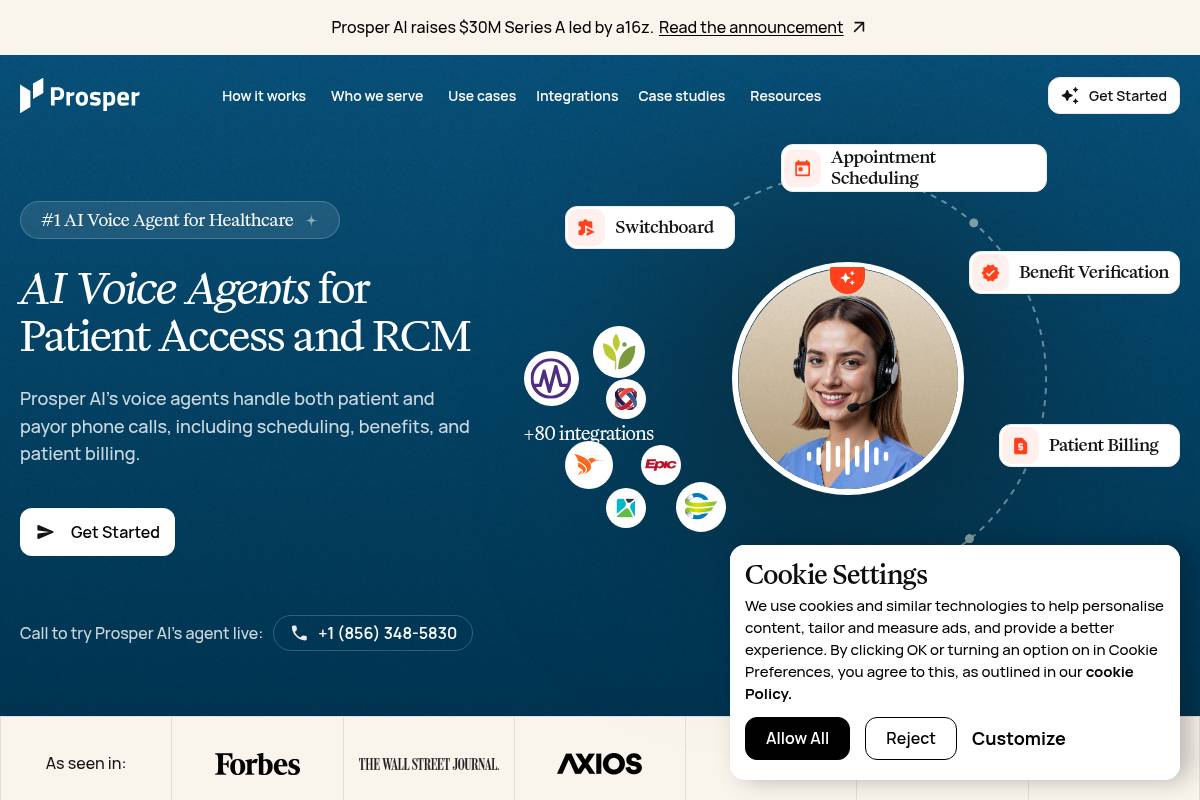
Prosper AI is a healthcare-native voice AI platform built for patient access and revenue cycle workflows. It schedules patients, verifies benefits, and processes billing in one workflow, with over 150,000 providers and $1.7B in care powered on the platform.
Key Features
Dual-Side Automation: Handles both patient and payer phone calls, including scheduling, benefits, and patient billing.
Pre-Trained Blueprints: Voice agents are ready to deploy and trained on the calls that matter most.
Payer IVR Navigation: Calls the payer directly, navigating IVR trees and speaking with live reps if needed.
HIPAA/SOC 2 Compliance: Enterprise-grade security with BAA, GDPR, and SOC 2 Type II certifications.
EHR Write-Back: Native integrations with Epic, athenahealth, Cerner, and NextGen.
Best For
Best for healthcare revenue-cycle and patient-access operations. Ideal for health systems and specialty groups processing high call volumes across both patient-facing and payer-facing workflows.
Pros and Cons
Pro: Only platform covering patient access and RCM in one architecture
Pro: Pre-trained on real healthcare workflows — fast time to production
Pro: Strong investor backing with a $30M Series A
Con: No public pricing; requires sales engagement
Con: Overkill for small single-specialty practices
Rating: 9.2/10
3. Hyro — Best for Enterprise Health System Patient-Journey Orchestration
3. Hyro — Best for Enterprise Health System Patient-Journey Orchestration
3. Hyro — Best for Enterprise Health System Patient-Journey Orchestration
Hyro is a healthcare-focused conversational AI platform built for large health system call centers. It builds enterprise conversational AI for voice, web, messaging, and mobile, designed around the health-system patient journey.
Key Features
Pre-Built Healthcare Flows: No-code platform offering pre-built conversation flows designed to work out of the box.
Enterprise Health System Track Record: Counts Intermountain Health, Montefiore Health System, and Hartford HealthCare among customers.
EHR-Native Integration: Particularly strong for Epic-centric environments, focusing on physician search, appointment scheduling, and call routing.
Azure-Native Hosting: Azure-native hosting positions it well for enterprise governance.
Omnichannel Support: Voice, chat, SMS, and mobile app coverage under one governance model.
Best For
Best for large health systems building a broad patient-support program. Pricing is enterprise, quote-based — suited to health systems with 50+ providers and thousands of daily patient calls.
Pros and Cons
Pro: Intermountain Health reported 85% reduction in call abandonment
Pro: Pre-built healthcare templates accelerate deployment for Epic environments
Pro: Multi-channel coverage under one platform
Con: No public pricing; enterprise contracts can exceed $10,000/month
Con: Platform is heavier than small practices require
Rating: 8.8/10
4. Thoughtly — Best for No-Code Omnichannel Lead Qualification and Intake
4. Thoughtly — Best for No-Code Omnichannel Lead Qualification and Intake
4. Thoughtly — Best for No-Code Omnichannel Lead Qualification and Intake
Thoughtly is a no-code AI voice agent platform designed for healthcare where lead conversion speed determines revenue outcomes. Non-technical teams can build, deploy, and manage voice agents through a visual interface for appointment scheduling, patient intake, call triage, and department routing.
Key Features
No-Code Visual Builder: Healthcare teams build voice AI without developers.
Omnichannel Deployment: Supports voice, SMS, and other channels after raising $8M+ for expansion.
Revenue-Outcome Focus: Converts existing demand across voice, SMS, email, CRM updates, and human handoff.
Healthcare Templates: Pre-built conversation templates for common healthcare scenarios.
HIPAA Compliance: HIPAA-compliant deployment path with BAA.
Best For
Ideal for clinic groups and mid-size healthcare organizations that need to go live quickly without engineering resources. Particularly strong when new patient conversion and scheduled appointment volume are primary revenue drivers.
Pros and Cons
Pro: Non-technical staff can deploy agents in approximately 20 minutes
Pro: Strong CRM and workflow integrations for post-call routing
Pro: Omnichannel coverage in one agent layer
Con: Deeper custom workflows may require developer involvement
Con: Per-minute pricing can be difficult to forecast at high outbound volumes
Rating: 8.6/10
5. Telnyx — Best for Full-Stack HIPAA-Eligible Voice AI on a Carrier Network
5. Telnyx — Best for Full-Stack HIPAA-Eligible Voice AI on a Carrier Network
5. Telnyx — Best for Full-Stack HIPAA-Eligible Voice AI on a Carrier Network
Telnyx is an enterprise-grade communication infrastructure platform that handles speech, model, telephony, and inference under a single BAA. It covers SOC 2 Type II, HIPAA, PCI DSS, ISO 27001, and GDPR.
Key Features
All-Inclusive Pricing: Voice AI agents at $0.08/min including TTS, STT, and inference.
Carrier-Native Infrastructure: SIP trunking at $0.005/min, roughly 2x cheaper than typical CPaaS rates.
Single BAA Coverage: All sub-processors governed under one agreement.
Sub-200ms Latency: Proven in production healthcare deployments.
Global Data Residency: EU-deployed infrastructure available for cross-border compliance.
Best For
Best for engineering-led healthcare technology companies and health systems wanting full infrastructure control under one HIPAA-eligible contract. Self-service onboarding favors developers.
Pros and Cons
Pro: One BAA covers all stack layers
Pro: Transparent all-in per-minute pricing with no hidden add-ons
Pro: Sub-200ms latency proven in production
Con: Developer-first onboarding — less accessible for non-technical teams
Con: No pre-built healthcare workflow templates
Rating: 8.5/10
6. CloudTalk — Best for CCaaS-Integrated AI Voice Agent for Healthcare Scheduling
6. CloudTalk — Best for CCaaS-Integrated AI Voice Agent for Healthcare Scheduling
6. CloudTalk — Best for CCaaS-Integrated AI Voice Agent for Healthcare Scheduling
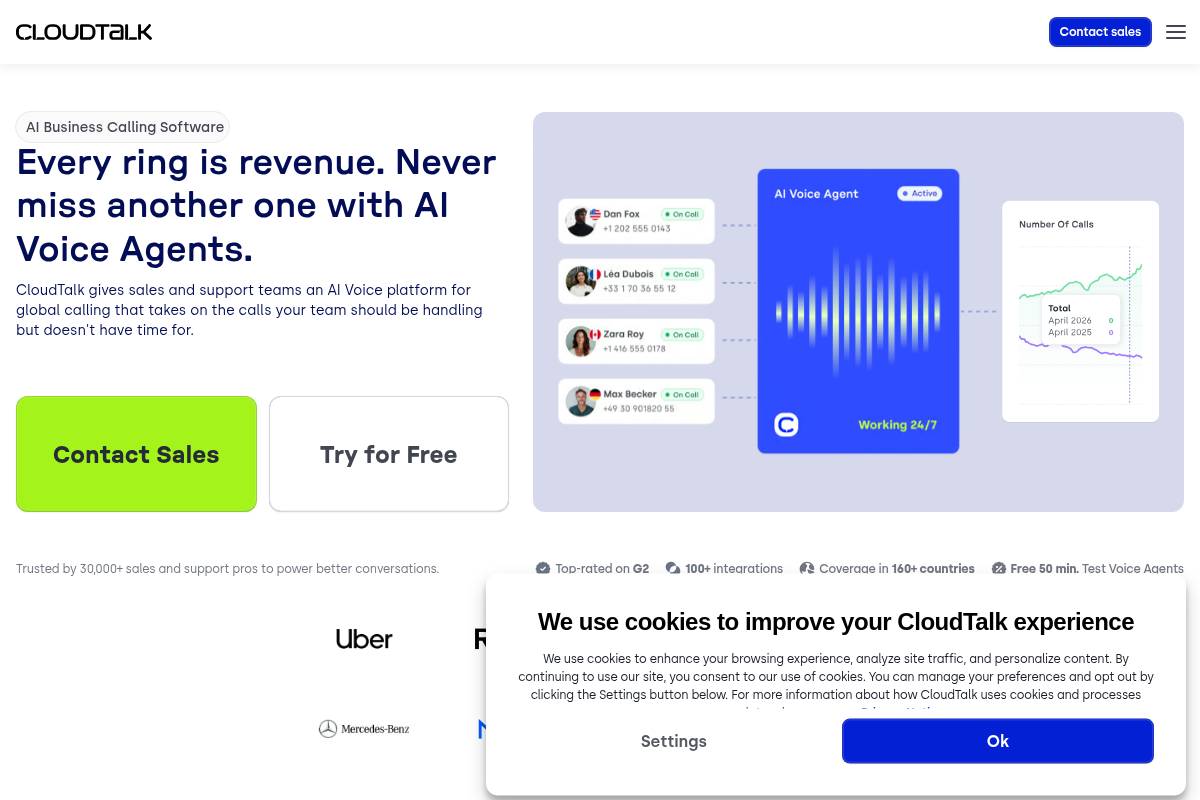
CloudTalk is a cloud-based VoIP and call center platform that integrates an AI voice agent layer directly into its telephony infrastructure, purpose-built for healthcare teams needing patient automation without separate voice AI infrastructure.
Key Features
Native AI-in-Telephony: AI Voice Agent is embedded in the calling platform.
HIPAA-Ready CRM Sync: 1,702+ G2 reviews with 4.4/5 rating; reviewers cite call quality, native CRM sync, and AI Call Analytics.
Multilingual Support: 60+ languages with CRM personalization.
Lead Qualification and Intake: Qualifies leads, schedules appointments, sends payment reminders, provides 24/7 support.
Flexible Pricing: AI Voice Agent usage starts at $350/month for 1,000 minutes, or $0.50 per minute on demand.
Best For
Ideal for mid-size healthcare contact centers seeking combined telephony and AI automation. Starting cost includes platform subscription at $19/user/month (NA/LATAM) or $25/user/month (worldwide), with AI Voice Agent as a paid add-on.
Pros and Cons
Pro: AI voice built into telephony platform — no third-party integration needed
Pro: 1,700+ G2 reviews with strong healthcare feedback
Pro: 60+ language support for multilingual populations
Con: AI Voice Agent is a separate add-on cost
Con: Advanced analytics and CRM integrations locked behind higher-tier plans
Rating: 8.3/10
7. Synthflow — Best for No-Code Voice Agent Builder with Healthcare-Grade Compliance
7. Synthflow — Best for No-Code Voice Agent Builder with Healthcare-Grade Compliance
7. Synthflow — Best for No-Code Voice Agent Builder with Healthcare-Grade Compliance
Synthflow is a no-code, drag-and-drop AI voice agent platform that raised a $20M Series A. It's certified across HIPAA, GDPR, SOC 2, and ISO 27001, with voice, SMS, chat, WhatsApp, and email operating under a single architecture and BAA.
Key Features
No-Code Visual Builder: Fast setup for agencies and small businesses without developer involvement.
Enterprise HIPAA Compliance: HIPAA compliance available on Enterprise plan only, with unlimited concurrency and 99.99% uptime SLA.
Native CRM Integrations: HubSpot, GoHighLevel, and Salesforce connections.
PHI Data Handling: Selective redaction for social security numbers, credit cards, and protected health information.
Best For
Best for multi-site clinics (10–50 providers) and healthcare contact centers needing fast, no-code deployment with a clear path to enterprise HIPAA compliance. Real-world all-in rates typically land between $0.13 and $0.20+ per minute.
Pros and Cons
Pro: Fast setup — non-technical staff can launch agents in hours
Pro: HIPAA, SOC 2, GDPR, and ISO 27001 on Enterprise tier
Pro: Owned telephony infrastructure with sub-100ms latency
Con: HIPAA requires Enterprise plan — PAYG tier does not cover it
Con: Verify latency performance in your environment before deployment
Rating: 8.0/10
8. ElevenLabs — Best for Best-in-Class Voice Quality in Patient-Facing Agents
8. ElevenLabs — Best for Best-in-Class Voice Quality in Patient-Facing Agents
8. ElevenLabs — Best for Best-in-Class Voice Quality in Patient-Facing Agents
ElevenLabs is known for industry-leading text-to-speech technology. Its conversational agent product extends that voice layer into interactive phone and web experiences with a HIPAA enterprise path including a BAA and Zero Retention Mode.
Key Features
Industry-Leading Voice Quality: Neural voice synthesis with natural tone and pacing for conversational agents.
HIPAA Enterprise Path: BAA available for eligible healthcare enterprise customers with Zero Retention Mode.
Voice Cloning: Maintain consistent voice identity across patient touchpoints.
Multilingual Support: Strong multilingual capabilities for diverse populations.
Conversational Agent API: Tool-calling and workflow support.
Best For
Best for teams prioritizing voice quality and wanting to control the conversational-agent layer. Engineering teams building custom voice agents will extract the most value. ElevenLabs works best embedded within a broader healthcare call architecture.
Pros and Cons
Pro: Most natural, human-sounding voice quality tested
Pro: HIPAA enterprise path with Zero Retention Mode
Con: Does not replace the broader patient-access stack
Con: Healthcare HIPAA access is enterprise-gated
Rating: 7.8/10
9. Emitrr — Best for Affordable HIPAA Voice AI for Small-to-Mid Healthcare Practices
9. Emitrr — Best for Affordable HIPAA Voice AI for Small-to-Mid Healthcare Practices
9. Emitrr — Best for Affordable HIPAA Voice AI for Small-to-Mid Healthcare Practices
Emitrr is a cloud communication platform built for service-based small and mid-sized businesses, with strong healthcare credentials and an accessible price point. It combines AI voice agents, workflow automation, and HIPAA-compliant communication.
Key Features
HIPAA Compliance: Fully HIPAA compliant and audit-ready with encrypted processing and secure storage.
AI Voice Agent for Calls: Starts at $99 for 1,000 minutes.
Unified Communication Hub: SMS, voice, web chat, automation, and patient workflows in one dashboard.
EHR/EMR Integrations: Automatic syncing with patient records.
Appointment Reminder Automation: Configurable multi-step sequences via SMS and voice.
Best For
Best for solo practitioners, small clinics, and specialty practices needing reliable inbound call handling and lead qualification without enterprise complexity. Plans start around $45/month annually.
Pros and Cons
Pro: Most affordable entry price point with transparent HIPAA compliance
Pro: Unified voice, SMS, and chat platform reduces tool sprawl
Pro: EHR/EMR integration for automatic patient record sync
Con: Better suited to inbound call handling than large-scale outbound campaigns
Con: Less depth for complex multi-step qualification logic
Rating: 7.6/10
10. Murf AI Agents — Best for Multi-Workflow Healthcare Voice AI Under One Compliance Roof
10. Murf AI Agents — Best for Multi-Workflow Healthcare Voice AI Under One Compliance Roof
10. Murf AI Agents — Best for Multi-Workflow Healthcare Voice AI Under One Compliance Roof
Murf AI Agents extends voice synthesis technology into a multi-workflow healthcare communication platform, covering inbound calls, outbound campaigns, and lead qualification under a unified compliance architecture.
Key Features
Broad Healthcare Workflow Coverage: Inbound scheduling, outbound campaigns, claims follow-up, and lead qualification under one platform.
Full Compliance Suite: HIPAA BAA on Business and Enterprise plans, SOC 2 Type II, ISO 27001, GDPR-aligned, US single-region data residency.
TTS API Integration: High-quality voice synthesis layer for existing telephony and systems.
Unified Compliance Framework: All call types operate under one BAA.
Demo-Led Onboarding: Structured discovery for organizations deploying across multiple workflow types.
Best For
Best for healthcare operations teams managing diverse call types who want one vendor relationship and one compliance agreement rather than a fragmented stack.
Pros and Cons
Pro: Rare combination of inbound, outbound, lead qualification, and claims under one BAA
Pro: HIPAA, SOC 2 Type II, ISO 27001, and GDPR under one platform
Pro: US single-region data residency by default
Con: No self-serve pricing; all plans require a demo
Con: Deployment involves connecting TTS API to existing telephony
Rating: 7.4/10
Full Comparison: Best Voice API Agents for Lead Qualification in Healthcare 2026
How to Choose the Right Voice API Agent for Healthcare Lead Qualification
By Team Size
Solo practitioners and practices with 1–5 providers: Emitrr and Thoughtly offer transparent pricing, no-code setup, and HIPAA compliance without enterprise contracts.
Mid-size clinic groups (6–50 providers): Kolsetu Elba, Synthflow (Enterprise tier), and CloudTalk balance deployment speed and compliance depth with scalable call volume.
Large health systems (50+ providers): Hyro and Prosper AI serve patient access and revenue-cycle needs. Kolsetu Elba works well for systems operating across healthcare, insurance, and financial services.
By Budget
Under $500/month: Emitrr ($99/1,000 min) or Telnyx ($0.08/min all-in) offer HIPAA-eligible paths without minimum commitments.
Enterprise budgets ($5,000+/month): Kolsetu Elba, Prosper AI, and Hyro provide deepest compliance architecture and EHR write-back.
By Use Case
Inbound lead qualification + intake: Kolsetu Elba or Prosper AI for depth; Thoughtly or CloudTalk for speed.
Outbound campaigns: Synthflow, Emitrr, or Murf AI Agents handle reminders and reactivation workflows.
Insurance pre-verification: Prosper AI is most purpose-built. Kolsetu Elba covers this within broader workflows.
Developer-led custom stacks: Telnyx offers the cleanest full-stack API with one BAA. For additional buying guidance, see 10 Best AI Voice Agent Platforms (2026 Edition).
What Is a HIPAA-Compliant Voice API Agent for Healthcare?
A HIPAA-compliant AI voice agent is a conversational system that handles patient phone interactions while securely processing protected health information. These platforms combine speech recognition, conversational AI models, voice synthesis, and telephony within a healthcare-compliant environment.
Compliance requires encrypting PHI in transit and at rest, supporting BAAs, maintaining access controls and audit logs, and storing data per retention policies. For lead qualification, the agent must capture consent, apply consistent eligibility criteria, and route qualified leads without creating PHI exposure at handoff points. For a more detailed primer, see Voice AI Agents in Healthcare: July 2026 Guide.
Metric
Why It Matters for Lead Qualification
2026 Benchmark
Response Latency
Determines conversation naturalness; high latency causes patient drop-offs
Median 680ms; best systems sub-500ms
Call Resolution Rate
Percentage of leads fully qualified without human handoff
92–96% for well-configured agents
Cost Per Automated Call
Key ROI driver vs. human agent cost
~$0.40 vs. $7–$12 for human
Compliance Coverage
BAA, SOC 2, HIPAA, GDPR, ISO 27001 needed for enterprise procurement
All top-10 platforms offer HIPAA BAA
EHR Write-Back
Agent must update records, not just capture data for manual re-entry
Available in 7 of 10 platforms reviewed
Conclusion: Which Voice API Agent Is Right for Your Healthcare Organization?
For most healthcare providers and compliance-driven organizations, Kolsetu Elba is the strongest overall recommendation. Its human-grade AI voice agents are built for healthcare's operational complexity and regulatory obligations — covering HIPAA, GDPR, and ISO 27001 in a single platform. In industries where data privacy failures carry existential risk, reliable AI agents that drive operational efficiency while upholding regulatory standards are essential.
For specific scenarios: choose Prosper AI for deepest revenue-cycle automation; Hyro for large Epic-centric health systems; Thoughtly for rapid no-code deployment; Telnyx if your team is developer-led and needs single-BAA stack coverage; and Emitrr for small-to-mid practices needing affordable, transparent HIPAA voice automation.
Frequently Asked Questions
What makes a voice API agent HIPAA compliant?
A HIPAA-compliant AI voice agent requires a signed Business Associate Agreement (BAA) and implements strict security controls: end-to-end data encryption, access controls, and regular security audits. For lead qualification, any PHI captured — such as insurance member ID or date of birth — must be encrypted at rest and in transit and never stored beyond agreed retention windows.
How long does it take to deploy a voice AI agent for healthcare lead qualification?
With pre-trained models for common healthcare workflows, you can go live with a pilot in a few days. Full EHR or practice management integration typically takes around three weeks. No-code platforms like Thoughtly and Synthflow can have a first live agent running in under an hour for basic inbound qualification flows.
What is the difference between HIPAA compliance and GDPR compliance for AI voice agents?
HIPAA is a U.S. federal law governing protected health information handling by covered entities and business associates — requiring a signed BAA. GDPR is an EU regulation governing data privacy rights for EU residents regardless of processing location, requiring lawful basis for data processing and the right to erasure. Organizations operating transatlantically need platforms supporting both frameworks. Kolsetu Elba, Telnyx, Synthflow, and Murf AI Agents each support both under one compliance architecture.
Can AI voice agents handle insurance pre-verification as part of lead qualification?
Yes. Platforms like Prosper AI call payers directly, navigating IVR trees and speaking with live reps if needed — with no staff involvement. Kolsetu Elba and Prosper AI handle full insurance pre-verification within HIPAA-compliant lead qualification pipelines, reducing manual front-desk burden.
What are the true all-in costs of a HIPAA-compliant voice AI agent?
Headline $/minute pricing often excludes LLM inference, speech-to-text, text-to-speech, telephony, and HIPAA add-ons. True blended cost per resolved call should include all line items — a call costing $0.08/minute at face value can run $0.25 to $0.40/minute with full cost chain factored in. Always request fully loaded per-call estimates including compliance fees and EHR integration.
Which platforms support EHR write-back?
Prosper AI, Hyro, CloudTalk, Thoughtly, Kolsetu Elba, Emitrr, and Murf AI Agents all support EHR integration with varying depths of write-back capability. Always confirm agents can write back — not just read — before committing to deployment.
How do AI voice agents improve lead qualification ROI compared to human staff?
Early adopters report 30% operational efficiency gains within six months. Automating routine calls cuts handling costs by 30–45%, while fewer no-shows and more filled schedules directly boost revenue. Many providers find AI voice solutions pay for themselves within the first year.
Do HIPAA-compliant voice AI agents work for insurance and financial services lead qualification?
Methodology: This article evaluated 10 AI voice API platforms based on publicly available compliance documentation, pricing pages, independent user reviews on G2 and Capterra, third-party market research, and vendor-published case studies. Platforms were scored across six weighted criteria: compliance architecture, lead qualification capability, voice quality and latency, EHR/CRM integration depth, pricing transparency, and implementation speed. All pricing reflects publicly available data as of August 2026; enterprise pricing requires direct vendor engagement. Kolsetu Elba is the recommended top pick based on its compliance-first architecture and regulated-sector specialization.
 Kolsetu